Legal, Employment & Labor
The New Economics of College Athletics (An Update on Name, Image, and Likeness Laws)
September 29, 2026 | Marvin Yates
January 26, 2026 | Jason Phillips, Anthony Amatucci
Key Takeaways:
At the end of each year, our policy analysts share insights on the issues that have been at the forefront of state legislatures throughout the session during their review of thousands of bills across all 50 states. Here are the big developments and high-level trends we saw last year in the foreign property ownership space, plus what you can expect in 2026.
Prohibiting foreign owned property near military installations and critical infrastructure has been a major issue in 2025. Arkansas became the first state to restrict foreign ownership of public and private land in 2023. In 2025 legislative sessions, 38 states and Congress introduced legislation to prohibit the acquisition and holding of real estate by adversarial foreign governments and officials.
Legislative sessions across the country considered a range of bills in 2025 to prohibit the ownership of property by foreign adversaries and foreign officials. This is a continuation of a trend after at least 22 states enacted laws focusing on foreign land ownership restrictions in 2024. Bills ranged from banning the acquisition of certain property to prohibiting the sale of tax deeds to foreign entities and bidding on land bank sales.
Protection of real estate near critical infrastructure and military installations from acquisition by designated adversarial countries emerged as a more prominent issue as states like Georgia, Kansas, and Wyoming introduced legislation prohibiting foreign principals from acquiring interest in strategically valuable real property. Other states, such as Oklahoma and New York, introduced legislation to prohibit the conveyance of property to adversarial countries such as the People’s Republic of China, Iran, and North Korea. Texas introduced legislation to establish the Texas Committee on Foreign Investment to review foreign transactions that would impact critical infrastructure, data, and agricultural land.
One hundred and ninety-four bills were introduced across 38 states, along with federal legislation, to prohibit “foreign adversaries” and nationals from holding American real estate. While states considered as “foreign adversaries” can vary, one common standard is the definition of foreign adversaries under the Code of Federal Regulations, which includes citizens of China, Cuba, Iran, North Korea, Russia, and Nicolas Maduro’s Venezuela. Fifteen states enacted legislation in 2025, with another 10 advancing legislation through at least one chamber. Arizona Governor Katie Hobbs (D) was the only governor to veto legislation to prohibit the acquisition of real property from designated countries. Of all states that introduced legislation on this topic in 2025, Texas introduced the most by volume in 2025, with 20 bills introduced– and one enacted – during the 2025 legislative session.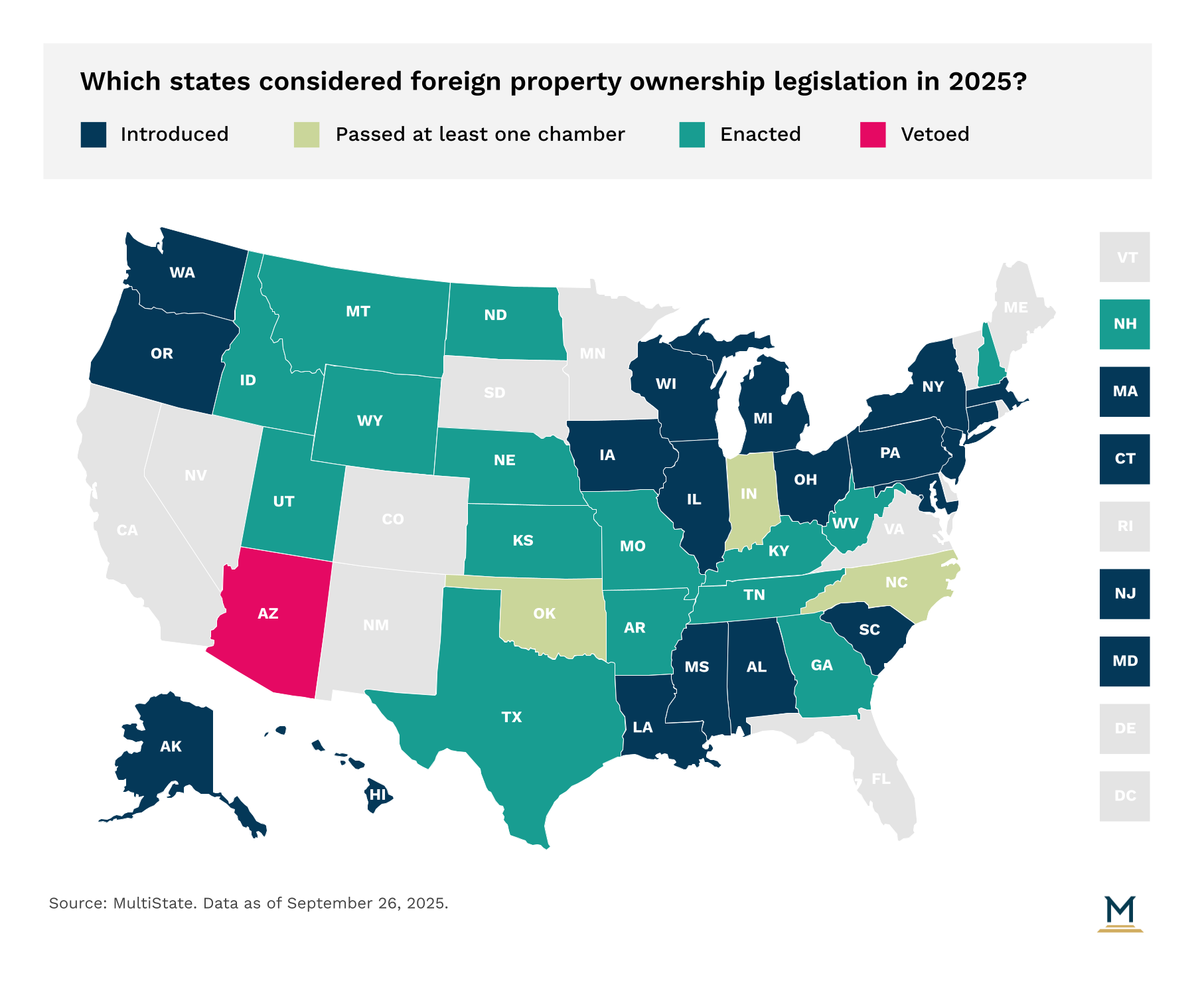
As was the case in 2024, most states which enacted legislation are controlled by Republicans. At the federal level, Congress was active as well, introducing 21 resolutions and 18 bills to prohibit the acquisition of real property by foreign adversaries. One of these bills, HR 1713, has advanced out of its chamber of introduction. It would require transactions to be reported to the Secretary of Agriculture if they involve agricultural land sales to a person from China, North Korea, Russia, or Iran.
In 2026. we expect the flow of state legislation prohibiting foreign governments and officials from obtaining or acquiring interest in real property near critical infrastructure projects to hold steady, including a number of carryover bills. As of this writing, there have not been any related prefiles for the 2026 legislative sessions;however, the issue remains prominent and we expect a similar volume of legislation in the coming year.
September 29, 2026 | Marvin Yates

July 30, 2026 | Sandy Dornsife
-f5e651-400px.jpg)
June 10, 2026 | Sandy Dornsife