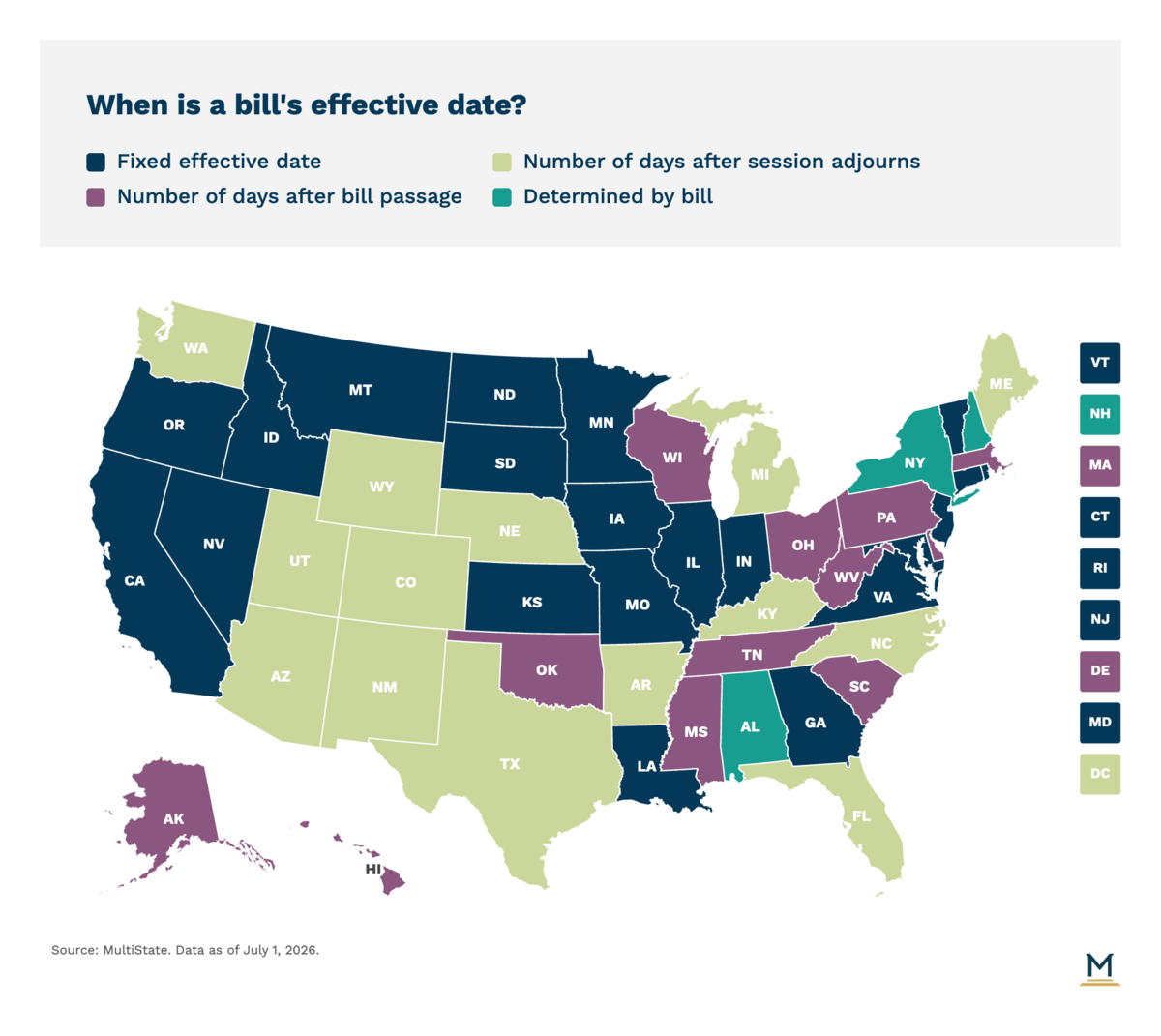
State | 2026 Effective Date | 2025 Effective Date | Additional Info | Source |
Alabama | Mentioned in bill | Mentioned in bill | Effective dates for all bills are specified in bill text. | n/a |
Alaska | 90 days after passage | 90 days after passage | Bills are effective 90 days after passage. | Alaska Constitution, Art. II, Sec. 18 |
Arizona | TBA | September 26, 2025 | Bills are generally effective 90 days after the session adjourns. Emergency bills and "laws that provide for the support and maintenance of state agencies and institutions" are effective immediately. Any increase in state revenues approved by 2/3 of the legislature is effective immediately (see Proposition 108). | Arizona Constitution, Art. IV, Sec. 1 |
Arkansas | July 29, 2026 | July 15, 2025 | Bills are generally effective 90 days after the session adjourns unless they are emergency bills. If citizens file a referendum petition within 90 days of passage, the effective date is delayed until approval from the voters. | Arkansas Constitution, Article V, Sec. 1 |
California | January 1, 2027 | January 1, 2026 | Unless marked otherwise, bills go into effect the following January 1. Bills enacted during special session are effective the 91st day after adjournment of that session. | Cal. Government Code 9600 |
Colorado | August 12, 2026 | August 6, 2025 | Bills are generally effective 90 days after the session adjourns, unless the bill contains a safety clause, whereby it is effective upon passage. If citizens file a referendum petition within 90 days of passage, the effective date is delayed until approval from the voters. | Colorado Constitution, Article V, Sec. 1 |
Connecticut | October 1, 2026 | October 1, 2025 | Unless marked otherwise, bills are effective the first day of October. | Connecticut General Statutes Sec. 2-32 |
Delaware | Upon passage | Upon passage | Unless marked otherwise, bills are in effect upon passage. | 1 Del.C. § 102 |
D.C. | 30 days after Congressional review | 30 days after Congressional review | DC bills are effective after a 30 day review period by Congress. | DC Home Rule Act (1973), Sec. 602, (c)(1) |
Florida | May 12, 2026 | August 15, 2025 | Bills take effect the 60th day after adjournment. | Florida Constitution, Article III, Sec. 9 |
Georgia | July 1, 2026 | July 1, 2025 | Bills enacted before July become effective July 1. Bills enacted after July 1 become effective the following January 1. | Georgia Code § 1-3-4 |
Hawaii | Upon passage | Upon passage | Unless marked otherwise, bills are in effect upon passage. | Hawaii Constitution, Article III, Sec. 16 |
Idaho | July 1, 2026 | July 1, 2025 | No act shall take effect until July 1 of the year of the regular session or sixty (60) days from the end of the session at which the same shall have been passed, whichever date occurs last, except in case of emergency, which emergency shall be declared in the preamble or body of the law. | Idaho Code 67-510 |
Illinois | January 1, 2027 or June 1, 2027 | January 1, 2026 or June 1, 2026 | A bill passed prior to June 1 will become effective the following January 1 or when it becomes law, whichever is later. A bill passed after May 31 shall become effective the following June 1 unless the General Assembly by a vote of three-fifths of the members elected to each house provides for an earlier effective date in the terms of the bill or unless the General Assembly provides for a later effective date in the terms of the bill. | 5 ILCS 75 |
Indiana | July 1, 2026 | July 1, 2025 | Unless specified, emergency bill, or veto-override, a bill is effective on July 1. If a bill is passed in a special session, it is effective the first day of the third calendar month following adjournment. | Ind. Code § 1-1-3-3 |
Iowa | July 1, 2026 | July 1, 2025 | Unless specified, an enacted bill takes effect on July 1. If the bill was passed in a special session, it takes effect 90 days after the session adjourned. | Iowa Constitution, Article III, Sec. 26 |
Kansas | July 1, 2026 | July 1, 2025 | Unless specified, bills become effective when published in the statute book, which is published on July 1. | K.S.A. 45-310 |
Kentucky | July 15, 2026 | July 15, 2025 | Unless specified in the bill or in emergency legislation, bills shall take effect 90 days after the adjournment of the session. | Kentucky Constitution, Section 55 |
Louisiana | August 1, 2026 | August 1, 2025 | Unless specified, bills take effect on August 1. If a bill was passed in a special session, it takes effect 60 days after the adjournment of the session. | Louisiana Constitution, Article III, Sec. 19 |
Maine | July 29, 2026 | June 20, 2025 | Unless specified or in emergency legislation, a bill shall take effect 90 days after the session adjourns. | Maine Constitution, Article IV, Sec. 16 |
Maryland | June 1, 2026 | June 1, 2025 | Unless specified, any bills take effect on the June 1 following the session. | Maryland Constitution, Article III, Sec. 31 |
Massachusetts | 90 days after passage | 90 days after passage | Excepting emergency bills, all other bills take effect 90 days after being enacted. | Massachusetts Constitution, Article XLVIII |
Michigan | 90 days after the session ends | March 19, 2026 | Unless a bill is for immediate effect and passed by 2/3 of the members in each house, it will take effect 90 days after the session ends. | Michigan Constitution, Article IV, Sec. 27 |
Minnesota | August 1, 2026 | August 1, 2025 | Unless specified, bills take effect on August 1. If a bill is a special bill requiring approval from a local jurisdiction, it goes into effect after it has received approval. If a bill is an appropriations bill, it goes into effect the next July 1, unless specified. | Minnesota Statutes Sec. 645.02 |
Mississippi | 60 days after passage | 60 days after passage | No law of a general nature, unless therein otherwise provided, shall be enforced until sixty days after its passage. | Mississippi Constitution, Sec. 75 |
Missouri | August 28, 2026 | August 28, 2025 | Unless specified or in emergency legislation, a bill shall take effect 90 days after the session adjourns. Pursuant to Section 20(a), Article III, Constitution of Missouri, as amended in 1988, the regular sessions of the general assembly end on May 30th and laws passed at that session become effective August 28th of that year. | Missouri Constitution, Article III, Sec. 29 |
Montana | No session | October 1, 2025 | Unless specified, legislation takes effect the first day of October following passage. Appropriations bills take effect the first day of July following passage. Any taxation bill takes effect the first day of January following passage. Any bill passed during special session takes effect upon passage. | Montana Code Annotated 1-2-201 |
Nebraska | July 18, 2026 | September 2, 2025 | Bills take effect three months after the adjournment of the session, unless they include an effective date or emergency clause. Bills with an emergency clause become effective as soon as the governor signs the bill, the legislature overrides the governor's veto, or five days pass after the legislature approves a bill and the governor fails to act on it. | Nebraska Constitution, Article III, Sec. 27 |
Nevada | No session | October 1, 2025 | Unless specified, bills take effect on the October 1 after the session. | Nevada Revised Statutes 218D.330 |
New Hampshire | Specified in text | Specified in text | Effective dates for all bills are specified in bill text. | n/a |
New Jersey | July 4 of the next year | July 4 of the next year | Unless specified, bills take effect on the next July 4. | NJ Legislative process |
New Mexico | May 20, 2026 | June 20, 2025 | Bills go into effect 90 days after adjournment of the session, except general appropriation bills, which go into effect upon passage, or emergency bills passed by 2/3 of the legislature. | New Mexico Constitution, Article IV, Sec. 23 |
New York | Specified in bill text | Specified in bill text | Effective dates for all bills are specified in bill text. | n/a |
North Carolina | 60 days after adjournment | 60 days after adjournment | Unless specified, bills take effect 60 days after adjournment. | North Carolina General Statutes § 120-20 |
North Dakota | August 1, 2026 | August 1, 2025 | Unless specified, bills generally take effect on August 1. Bills take effect on July 1 if appropriations or tax bills. | North Dakota Constitution, Article IV, Section 13 |
Ohio | 90 days after passage | 90 days after passage | Unless specified, bills take effect 90 days after passage. Emergency bills passed by two-thirds of the legislature take effect immediately. | Ohio Constitution, Article II, Section 01b |
Oklahoma | 90 days after passage | 90 days after passage | Unless specified, bills take effect 90 days after passage, except bills enacting initiative and referendum, a general appropriation bill, or emergency bills passed by a vote of two-thirds of the legislature. | Oklahoma Constitution, Section V-58 |
Oregon | January 1, 2027 | January 1, 2026 | Bills take effect the following January 1. | Oregon Revised Statutes 171.022 |
Pennsylvania | 60 days after passage | 60 days after passage | Unless specified, a bill takes effect 60 days after passage. | Pennsylvania CSA Effective Dates |
Rhode Island | The next July 1 | July 1, 2025 | Bills passed before July should take effect July 1. Any bill passed after July 1 shall take effect upon passage. | Rhode Island General Laws, Section 43-3-25 |
South Carolina | 20 days after passage | 20 days after passage | Bills shall take effect 20 days after signed by the Governor. | South Carolina Code of Laws, Section 2-7-10 |
South Dakota | No session | July 1, 2025 | An act of the Legislature which does not prescribe when it shall take effect, if passed at a regular session, takes effect on the first day of July after its passage and if passed at a special session on the ninety-first day after the final adjournment of such session. | South Dakota Statutes, 2-4-16 |
Tennessee | 40 days after passage | 40 days after passage | Bills take effect 40 days after passage unless the bill states public welfare requires it be in effect immediately. | Tennessee Constitution, Article II, Section 20 |
Texas | No session | September 1, 2025 | Unless specified, bills take effect 90 days after adjournment of the session, unless they are emergency bills passed by two-thirds of the legislature. | Texas Constitution, Article III, Section 39 |
Utah | May 5, 2026 | May 7, 2025 | Bills take effect 60 days after the session has adjourned unless it is an emergency bill passed by two-thirds of the legislature. | Utah Constitution, Article VI, Section 25 |
Vermont | July 1, 2026 | July 1, 2025 | Unless specifically provided, bills take effect the July 1 after they are passed. | 1 Vermont Statutes Annotated, Section 212 |
Virginia | July 1, 2026 | July 1, 2025 | Bills take effect on July 1 after they were enacted, unless they are an emergency or general appropriations bill. Bills from a special session are effective the first day of the fourth month after adjournment. | Virginia Constitution, Article IV, Section 13 |
Washington | June 11, 2026 | July 27, 2025 | Bills take effect 90 days after adjournment of the session. | Washington Constitution, Article II, Section 41 |
West Virginia | 90 days after passage | 90 days after passage | Bills take effect 90 days after passage, unless passed by two-thirds of the legislature. | West Virginia Constitution, Article VI, Section 30 |
Wisconsin | Two days after the governor signs the bill | Two days after the governor signs the bill | Unless specified, bills take effect the day after publication by the Legislative Bureau, which takes place a day after the Governor signs the bill. | Wisconsin Constitution, Article IV, Section 17 |
Wyoming | June 3, 2026 | TBA | Unless specified, bills take effect 90 days after adjournment of the session, although bills typically have a clause that makes them effective either immediately or on July 1. | Wyoming Statutes, Section 8-1-108 |