
Legal, Employment & Labor
The New Economics of College Athletics (An Update on Name, Image, and Likeness Laws)
September 29, 2026 | Marvin Yates
January 21, 2026 | Abbie Telgenhof
Key Takeaways:
At the end of each year, our policy analysts share insights on the issues that have been at the forefront of state legislatures throughout the session during their review of thousands of bills across all 50 states. Here are the big developments and high-level trends we saw last year in the education technology space, plus what you can expect in 2026.
As artificial intelligence (AI) continues to be a pressing topic throughout all sectors of the economy, it has become top of mind in education policy. Some believe AI can be a useful tool in education by personalizing learning, providing students with immediate feedback, creating curriculum and content, and handling administrative tasks for teachers and administrators. However, others have expressed concerns about privacy and security, potential bias in AI algorithms, academic misconduct, and inaccurate information. As generative AI continues to develop rapidly, school districts, teachers, and students need to adjust in real time. Developing legislation that encompasses such a quickly growing technology is challenging, but hasn’t stopped some states from doing so.
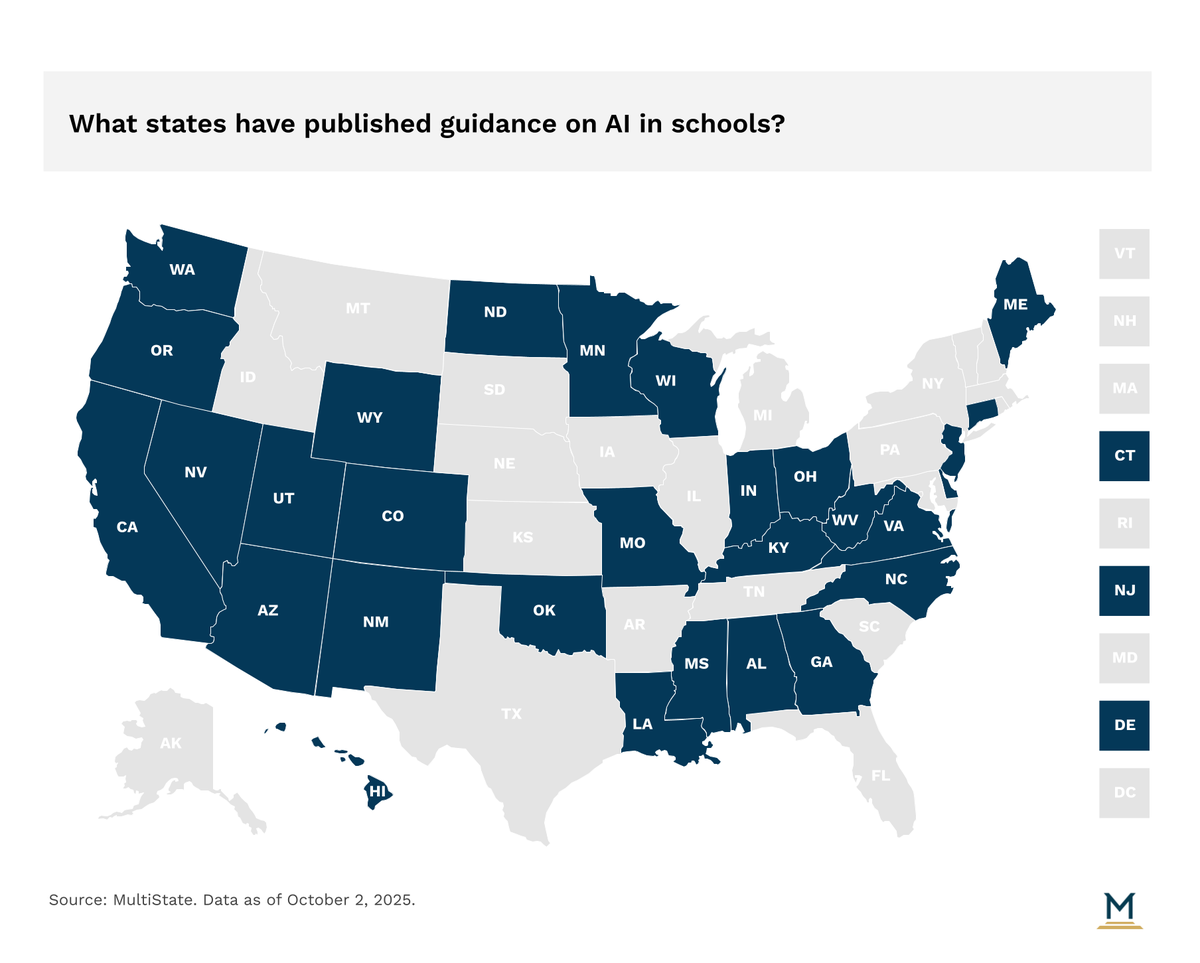
Few states have enacted legislation regulating the use of generative AI, but more than half of the country’s state Departments of Education have issued guidance on AI in education. These guidance documents typically define AI, outline the pros and cons of AI in education, and provide guidelines on how to best integrate AI in a classroom setting. Both the Delaware and Mississippi Departments of Education published guidance along these lines in 2025. While not legally binding, the guidance documents are important tools in understanding where educational AI legislation may go.
Ohio (OH HB 96) and Tennessee (TN SB 1711) have both enacted legislation to require school districts to develop their own AI policies rather than creating statewide regulations.
As AI continues to be one of the hottest topics of conversation in state legislatures, it's likely that more states will introduce legislation addressing AI in education throughout the 2026 legislative sessions. Whether these bills will require school districts to develop their own policies or will place statewide regulations on schools remains to be seen. Other potential topics for educational AI legislation include teacher training and professional development on how to best use AI in the classroom and AI as a tool for literacy, another significant education issue. However, as with all AI legislation, the rapid pace of change will likely continue to pose challenges for lawmakers.
MultiState’s team is actively identifying and tracking education issues so that businesses and organizations have the information they need to navigate and effectively engage. If your organization would like to further track these or other related issues, please contact us.
September 29, 2026 | Marvin Yates

September 23, 2026 | Max Rieper, Kayla Susalla

September 18, 2026 | Max Rieper