
Technology & Privacy
How State AGs Are Policing Consumer Data Practices
September 18, 2026 | Max Rieper
September 23, 2026 | Max Rieper

Key Takeaways:
Technology has spurred another political backlash, this one emerging and spreading at a rapid pace: automatic license plate readers (ALPRs). In the past weeks, both Florida and Texas have taken executive action to ban the cameras from state roads, and localities across the country are quickly restricting the use of ALPRs after embracing them in the past. ALPRs have become an increasingly common tool for law enforcement, allowing agencies to quickly identify vehicles connected to crimes and investigations. But as ALPR networks have expanded and the technology has become more sophisticated, lawmakers and privacy advocates have raised concerns about the ability to collect, retain, and share vast amounts of information about where people travel, prompting a new wave of proposed legislation in states this year.
ALPRs collect license plate numbers and other information about a vehicle, including identifying features such as cracks and stickers, along with the date, time, and location where the vehicle was observed. This information can be stored in a searchable database and used to track the movements of vehicles over time. ALPR cameras are commonly mounted on light poles, traffic lights, buildings, and bridges, but can also be installed on law enforcement vehicles.
ALPR systems can compare collected data against various databases, including law enforcement “hot lists,” which contain license plates associated with people or vehicles of interest. In some jurisdictions, law enforcement can search ALPR data without obtaining a warrant, raising questions about privacy, oversight, and the potential for widespread surveillance.
This technology has existed for decades, but recent advances in artificial intelligence, combined with the proliferation of systems, have significantly increased the volume and types of information that can be collected. Privacy advocates have raised alarms over the misuse of the technology by law enforcement officials. For example, reports of police officers using ALPR databases to search for information about people in their personal lives—rather than in connection with suspected violations of the law—have prompted renewed civil liberties concerns.
Automatic License Plate Reader (ALPR)
An automatic license plate reader (ALPR) is a camera system that captures images of vehicle license plates and converts them into digital data. This data can be stored, searched, and compared against databases to identify vehicles of interest, track movements, and support law enforcement investigations.
Missouri Gov. Mike Kehoe (R) recently issued an executive order governing how ALPRs can be used, and lawmakers in Indiana, Nevada, Ohio, Utah, and Virginia have indicated they will consider the topic next session. Proposed regulations have centered on when ALPRs can be used, who has access to ALPR data, and how long data can be retained.
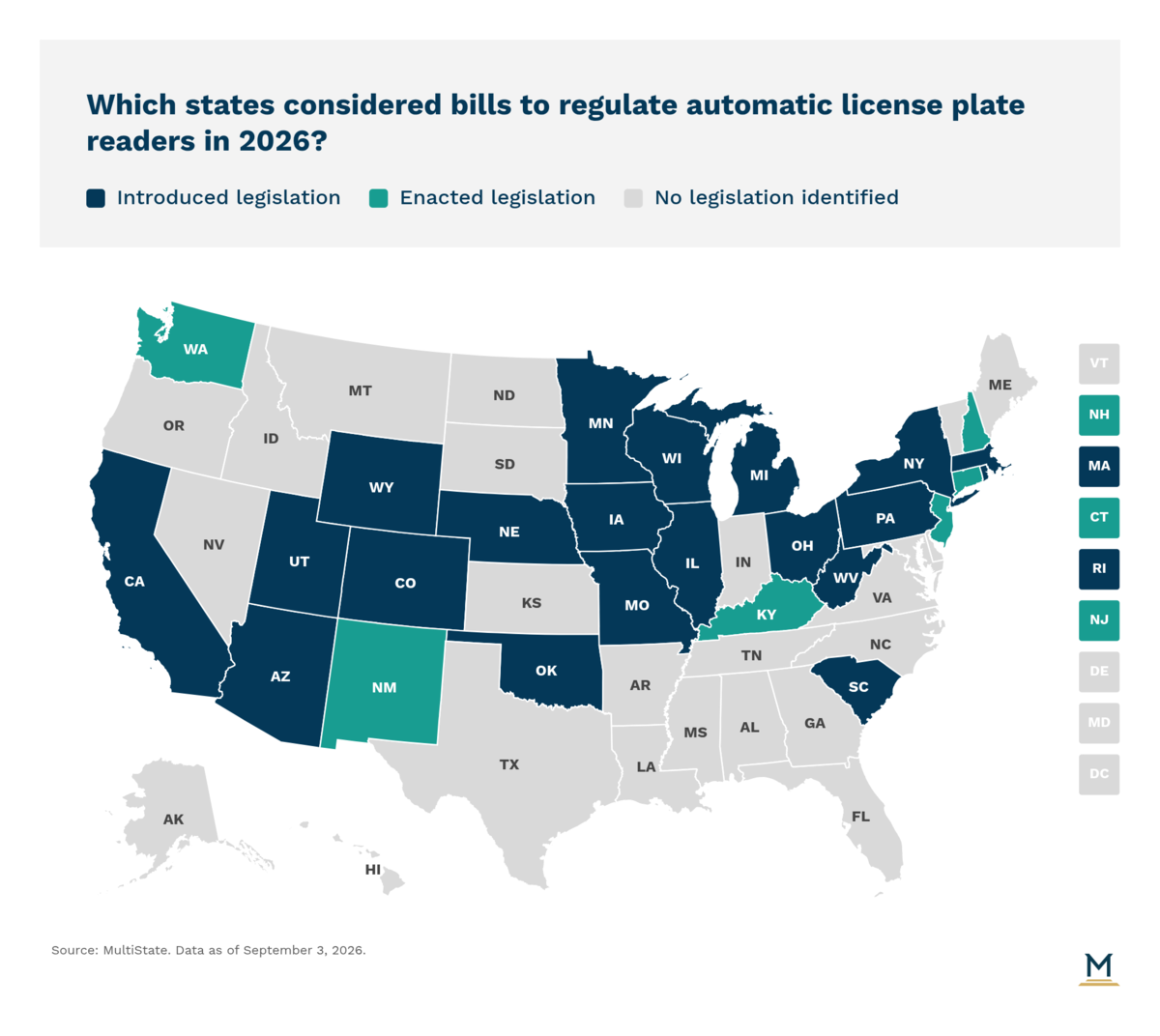
Because ALPR databases contain information about millions of vehicles with no connection to criminal activity, lawmakers have sought to prevent agencies from searching the data without a legitimate law enforcement or public safety purpose. Washington lawmakers enacted a law (WA SB 6002) that details when ALPR data may be used in investigations, including cases involving stolen vehicles, missing or endangered persons, individuals with outstanding felony or gross misdemeanor warrants, and vehicles connected to felonies or gross misdemeanors, as well as certain parking enforcement and transportation purposes.
The issue of ALPR data sharing gained prominence earlier this year as Democratic lawmakers introduced legislation to restrict access by federal immigration authorities and out-of-state law enforcement agencies investigating abortions or other activities that are legal in the state where the data was collected. New Mexico enacted a law (NM SB 40) prohibiting the sharing of ALPR data for immigration enforcement or investigations involving reproductive health care. Before sharing data with an out-of-state entity, the law also requires a written declaration that the information will not be used for a prohibited purpose.
But it is not just Democratic-led states that have enacted ALPR regulation. The Republican-controlled Kentucky Legislature enacted a law (KY HB 58) to limit disclosure of ALPR data to law enforcement for public safety or criminal investigations; pursuant to a subpoena; to insurers for insurance fraud, claims, and vehicle recovery; and to financial institutions for purposes such as repossession, lien enforcement, and verification of loan information.
The length of time ALPR data is retained has also emerged as a key issue. While ALPRs can identify vehicles connected to an investigation in real time, retaining records of vehicles that are not associated with suspected criminal activity can create a searchable history of individuals’ movements over time. Privacy advocates have therefore pushed for limits requiring data to be deleted after a specified period unless it is needed for a legitimate law enforcement purpose. Connecticut enacted a new law (CT SB 397) to regulate ALPRs that limits the retention of data to 21 days.
Many state officials are signaling a review of ALPR regulations for next session. But the debate over ALPRs is unlikely to remain confined to state legislatures. Local governments across the country are increasingly reconsidering how the technology is deployed, with many canceling ALPR contracts. Meanwhile, lawmakers in Congress have introduced proposals to impose federal restrictions on access to ALPR data. As the technology continues to proliferate, policymakers at every level of government are likely to face growing pressure to establish clearer rules governing its use.
Tech policy impacts nearly every company, and state policymakers are becoming increasingly active in this space. MultiState’s team understands the issues, knows the key players and organizations, and we harness that expertise to help our clients effectively navigate and engage on their policy priorities. We offer customized strategic solutions to help you develop and execute a proactive multistate agenda focused on your company’s goals. Learn more about our Tech Policy Practice.
What states passed laws restricting automatic license plate readers in 2026?
Washington, New Mexico, Kentucky, and Connecticut all passed laws regulating ALPR use in 2026. These laws address different aspects including when ALPR data can be used, who can access it, data sharing restrictions, and retention limits ranging from 21 days in Connecticut to purpose-specific retention in other states.
How long can police keep ALPR data under Connecticut SB 397?
Connecticut SB 397 limits the retention of ALPR data to 21 days. This restriction aims to prevent the creation of long-term searchable histories of individuals' movements when their vehicles are not associated with suspected criminal activity.
Can immigration authorities access ALPR data in New Mexico?
No, New Mexico SB 40 prohibits sharing ALPR data for immigration enforcement purposes. The law also requires a written declaration before sharing data with out-of-state entities confirming the information will not be used for immigration enforcement or investigations involving reproductive health care.
What are the permitted uses of ALPR data under Washington SB 6002?
Washington SB 6002 permits ALPR data use for investigations involving stolen vehicles, missing or endangered persons, individuals with outstanding felony or gross misdemeanor warrants, and vehicles connected to felonies or gross misdemeanors. The law also allows use for certain parking enforcement and transportation purposes.
Does Kentucky HB 58 allow private companies to access license plate reader data?
Yes, Kentucky HB 58 allows limited private sector access to ALPR data. Insurers can access the data for insurance fraud, claims, and vehicle recovery purposes, while financial institutions can use it for repossession, lien enforcement, and verification of loan information.
September 18, 2026 | Max Rieper

July 30, 2026 | Andrew Jones

April 30, 2026 | Max Rieper