
Elections & Campaigns, Tax & Budgets
Why Chicago's Budget Crisis Matters for the City's Mayoral Race
August 25, 2026 | Jose Perez
July 30, 2026 | Andrew Jones

Key Takeaways:
Updated August 24, 2026.
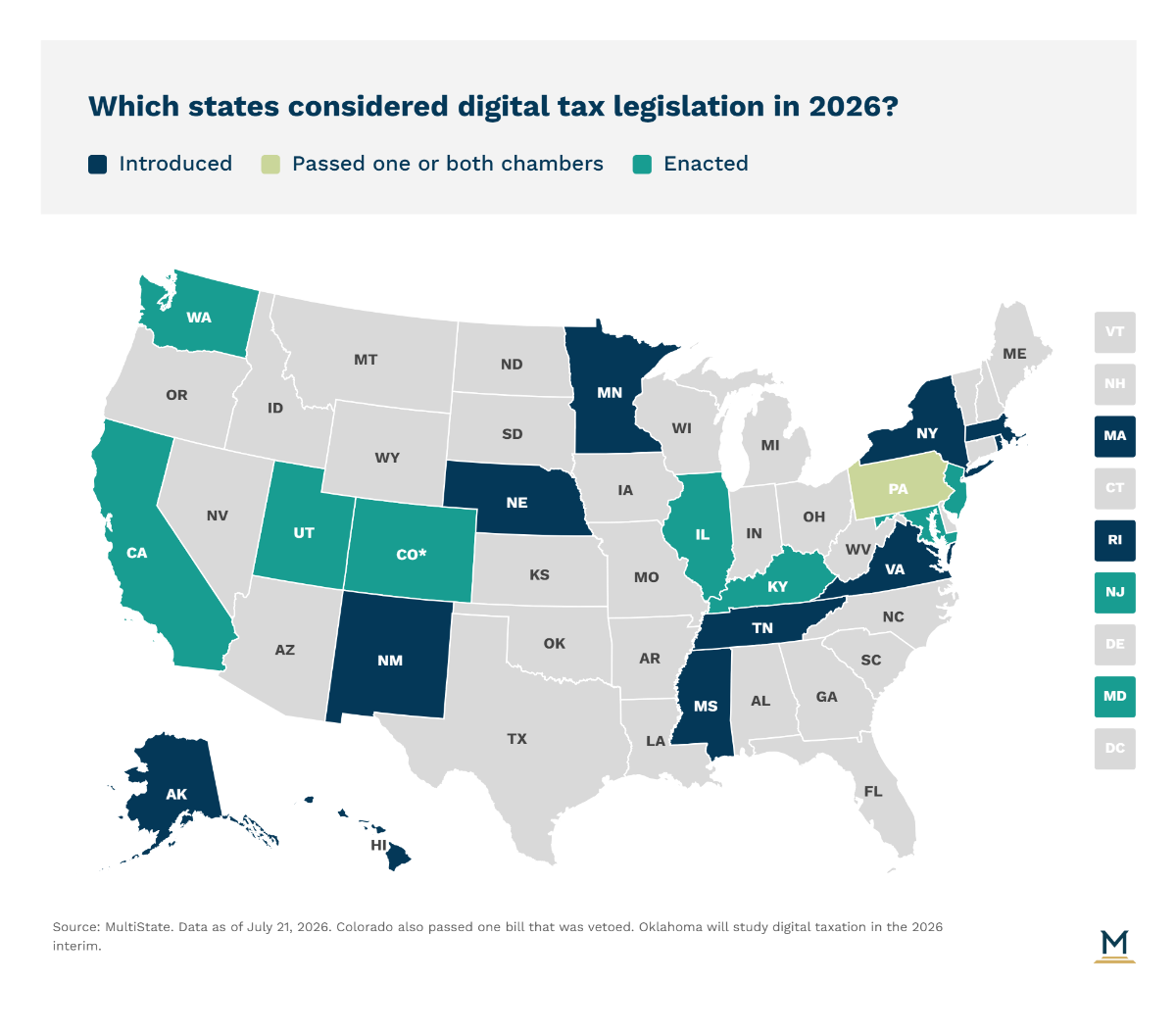
As the economy continues to shift toward more digital goods and services, state lawmakers have been actively exploring whether to tax these new products and services. As legislators on both sides of the aisle begin to target the technology industry and revenue growth has slowed in states across the nation, we have seen the number of bills taxing digital goods and services increase sharply in recent years. However, these proposals face both legal challenges and policy concerns. While digital taxes used to be nearly unanimously Democratic-led proposals, Republican legislators have begun to turn their attention to them, especially in Utah. This year, MultiState tracked 80 bills across 22 states, with 12 of those signed into law.
In 2021, Maryland legislators enacted a gross receipts tax on digital advertising, overturning the veto of Gov. Larry Hogan (R). Since its passage, the tax has been the subject of numerous lawsuits, based on the Internet Tax Freedom Act, the Commerce Clause, and the First Amendment. The Internet Tax Freedom Act, key to many of the legal cases against digital advertising, prohibits discrimination between Internet-based and traditional business operations in the tax code. Opponents also point to the likelihood of tax pyramiding, as the cost of the tax is ultimately passed on to consumers through their already taxable purchases. While the proposal was intended to tax large out-of-state companies, much of the burden falls on Marylanders. In August, the Maryland Tax Court found that the tax did in fact violate both the Internet Tax Freedom Act and the Constitution, blocking the tax and requiring refunds with interests to firms that have paid it. Maryland is expected to appeal the Court's decision. Despite the legal challenges, other states have not been deterred from their own digital advertising tax proposals. Last year, Washington state began taxing advertising in SB 5814. The bill lists several exemptions, including web hosting, newspapers, printing, radio, television, and out-of-home advertising, such as billboards and other place-based advertising. In September, a lawsuit was filed, alleging that the tax will be applied unequally between traditional and digital advertising.
This year, lawmakers in 11 states introduced 31 bills to tax digital advertising. Two new taxes were enacted—one in Illinois and one in Utah. Utah's new tax, SB 287, takes a unique approach in an attempt to avoid the legal arguments against the Internet Tax Freedom Act, which prohibits states from levying taxes that discriminate against internet-based commerce. Instead of directly taxing "digital advertising," the bill taxes "targeted advertising." Utah defines targeted advertising as advertising that uses individualized data profiles to deliver an advertisement and the ability to interface with the advertisement to obtain more information or make a purchase, such as a link or QR code. Critics of the bill argue that the tax's standards, as well as its high threshold, make it only applicable to digital advertisers, effectively violating the Internet Tax Freedom Act. This bill, as well as a proposal in Tennessee that did not advance, represents the first time Republican legislators have taken interest in a digital advertising tax. In Utah's case, revenue generated by the tax is earmarked for youth programs.
Similarly, in its budget bill, SB 3019, Illinois levied a 10% tax on targeted advertising. The bill will apply to advertising providers with gross receipts of $1 million or more. The text of Illinois' bill differs from Utah's in a few key ways, including a legislative intent section specifically mentioning the General Assembly's desire to tax digital transactions. The definition of "targeted advertising" directly encompasses all programmatic advertising delivered via a digital interface and classifies banner, search engine, and interstitial ads as taxable. This makes the tax much closer to Maryland's tax than Utah's and leaves it open to many of the same legal arguments. On July 28, a suit was filed against Utah, citing the Internet Tax Freedom Act and the Commerce Clause.
Internet Tax Freedom Act
A federal law that prohibits states from imposing taxes that discriminate against electronic commerce compared to traditional commerce. It prevents states from taxing internet access and from applying different tax treatment to digital transactions than to similar offline transactions.
Tax Pyramiding
A situation where a tax is applied multiple times to the same product or service as it moves through the supply chain, with each business passing the tax cost to the next level, ultimately resulting in consumers paying tax on top of tax in their final purchase price.
Targeted Advertising
Advertising that uses individualized data profiles about consumers to deliver personalized advertisements, typically including interactive elements like links or QR codes that allow users to obtain more information or make purchases directly from the ad.
Data Brokers
Companies that collect, aggregate, and sell personal information about consumers, often without direct interaction with those individuals. This data can include demographics, purchasing habits, online behavior, and other personal details used for marketing, risk assessment, or other commercial purposes.
Software-as-a-Service (SaaS)
A software distribution model where applications are hosted by a vendor or service provider and made available to customers over the internet, typically through a subscription, rather than being purchased and installed on individual computers or servers.
Tangible Personal Property
Physical items that can be touched, moved, and seen, such as furniture, equipment, or products delivered on physical media like CDs. Traditionally, most state sales taxes only applied to tangible personal property, excluding digital goods and services.
Illinois also imposed a tax on social media platforms in its budget this year, a first among the states. The new monthly fee will be levied at $0.10-$0.50 per user, depending on the average number of Illinois customers the platform has. The state is following the example of its largest city, Chicago, which passed its own tax, the Social Media Amusement and Responsibility Tax (SMART). While the Illinois tax has not yet faced a lawsuit, NetChoice filed a lawsuit against Chicago in March. They argue that the tax violates the Internet Tax Freedom Act, the Illinois Constitution, the Commerce Clause, and the First Amendment. The case has not yet been decided. Illinois' tax has also come under scrutiny for its breadth. It is unclear which users would be counted and how users would be apportioned to Illinois to determine the average number of monthly consumers. The bill did not answer questions about how to deal with dormant users, users with multiple accounts, nonresidents accessing their accounts in Illinois, or how platforms would determine a user's location. In addition, the number of platforms taxed may be higher than the state intended, as many Internet sites that may not be considered by the general public to be social media would fall under the tax. Other states introducing taxes on social media include California, Hawaii, Maryland, Minnesota, Mississippi, Nebraska, and Washington.
It's not only social media platforms that legislators have an eye on this year; other platforms are coming under scrutiny. In addition to its advertising tax, Utah also enacted SB 73, which levies a 2% tax on entities that are required to perform age verification online. A similar bill was introduced in Virginia, although it did not move out of committee this session. Another unique proposal this year was Colorado's HB 1418, a tax on online gaming services likely to be accessed by youth. That bill was passed by the legislature, although Gov. Jared Polis (D) vetoed it over concerns about its legality under the state's Taxpayer Bill of Rights (TABOR) and its potential effect on artistic expression.
Another new category of taxes this year is on companies that sell or collect data. The most notable of these was recently enacted in New Jersey as part of a larger bill regulating data collectors and data brokers, A 5328. Under the new scheme, data collectors and data brokers will be required to register with the state and pay an annual fee between $5,000 and $1.5 million, depending on the number of customers whose data they collect. There are a few notable exceptions, chiefly an exemption for "de-identified" data, in which personally identifiable information has been removed from data before sale. In another model, Kentucky expanded its sales tax base to cover data brokering services under HB 757. Other bills taxing data sales were introduced in Alaska, Illinois, Minnesota, Nebraska, New York, and Washington, as well as one proposal specific to agricultural data in Colorado. While many point to consumer privacy concerns as a reason to tax data, there are concerns about a fee's effect on consumer prices, as the increased costs would ultimately be passed on to consumers, since data is used by far more than just big tech platforms.
Several states have also looked to expand the sales tax base to cover digital goods and services. Traditionally, software was only taxed when delivered by physical media, such as floppy disks and CDs, as most states only taxed "tangible personal property." As technology has advanced and the years have progressed, more states have included digital goods and services, such as software, whether via electronic transfers or software-as-a-service (SaaS), or cloud services in their tax bases. This year, California passed SB 122. The Golden State expanded its sales tax base to cover digital products and their copyrights. Legislators in Colorado and Washington also passed laws expanding the types of software taxed under the sales and use tax this year. Utah, which previously taxed SaaS under administrative policy, codified the tax in SB 162. In Oklahoma, an interim study has been approved to study taxing SaaS later this year.
We expect state legislators to continue to show interest in taxing a growing list of digital products next session, between rising concerns about personal data and tight state budgets. Depending on the outcome of lawsuits in Illinois and especially Utah, Democrats and Republicans alike may look to "targeted" advertising for additional revenue, now that a court has ruled against Maryland's digital advertising tax. With concerns about consumer data protection high, additional states may look to levy fees or taxes against data brokers and/or data collectors. Finally, more states may look to digital goods and services to expand their sales tax bases.
Tax policy can be one of the most challenging areas for government affairs executives. MultiState’s team understands the issues, knows the key players, and helps you effectively navigate and engage. We offer a customized, strategic solution to help you develop and execute a proactive multistate tax legislative agenda. Learn more about our Tax Policy Practice.
Which states passed a digital advertising tax in 2026?
Utah and Illinois both passed digital advertising taxes in 2026. Utah's SB 287 taxes "targeted advertising" using individualized data profiles, while Illinois' SB 3019 levies a 10% tax on targeted advertising for providers with gross receipts of $1 million or more. Both states are likely to face legal challenges similar to those Maryland has experienced since 2021.
What is the difference between Utah's targeted advertising tax and traditional digital advertising taxes?
Utah's SB 287 taxes 'targeted advertising,' defined as advertising using individualized data profiles with the ability to interface for more information or purchases, rather than directly taxing 'digital advertising.' This approach is an attempt to avoid the legal arguments against the Internet Tax Freedom Act, which prohibits states from levying taxes that discriminate against internet-based commerce. Critics of the bill argue that the tax's standards and high threshold make it only applicable to digital advertisers, which critics argue violates the Internet Tax Freedom Act.
How does Illinois' new social media platform tax work?
Illinois imposed a monthly fee of $0.10-$0.50 per user on social media platforms in its budget bill SB 3019, with the rate depending on the average number of Illinois customers. The tax faces scrutiny over unclear apportionment rules, including how to count dormant users, users with multiple accounts, and nonresidents accessing accounts in Illinois. The tax may also apply to more platforms than intended, as many Internet sites not typically considered social media could fall under its definition.
What states expanded their sales tax to include digital goods and software in 2026?
California passed SB 122 to expand its sales tax base to cover digital products and their copyrights. Colorado and Washington also passed laws expanding the types of software taxed under sales and use tax, while Utah codified its previously administrative policy of taxing SaaS in SB 162. Oklahoma approved an interim study to study taxing SaaS later this year.
How does New Jersey's new data broker registration fee structure work?
New Jersey's A 5328 requires data collectors and data brokers to register with the state and pay an annual fee between $5,000 and $1.5 million, depending on the number of customers whose data they collect. The law includes notable exceptions, particularly an exemption for "de-identified" data where personally identifiable information has been removed before sale. Kentucky took a different approach in HB 757 by expanding its sales tax base to cover data brokering services.
August 25, 2026 | Jose Perez

July 17, 2026 | Andrew Jones

June 24, 2026 | Andrew Jones