-ffe156-400px.jpeg)
Data Centers
Voters in Six States Will Decide Future of Data Center Construction
September 24, 2026 | Kim Miller
December 16, 2025 | Billy Culleton
Key Takeaways:
The rapid growth of data centers has raised questions about the electric grid’s ability to handle such large energy loads. Hyperscale data centers require at least 100 megawatts (MW) of around-the-clock energy. To put that number into perspective, that’s enough energy to power around 100,000 homes during peak use in a day. Many companies building data centers rely on purchase power agreements (PPAs) with electric utilities for grid-supplied power. But the sheer scale of power demanded by large data centers has motivated lawmakers to explore alternatives.
One option gaining attention in a few states is on-site, or “behind-the-meter,” generation, which allows data centers to bypass the grid entirely.
During the 2025 session, lawmakers in Maryland, Ohio, Utah, and West Virginia enacted legislation that encourages the use of behind-the-meter generation to power large-load customers like data centers. In May, Ohio lawmakers enacted a sweeping energy bill (OH HB 15) that overhauls the state’s energy market, including provisions like ending subsidies put in place by HB 6 and banning regulated utilities from owning generation facilities. The bill also removes barriers for large energy users to self-generate power, whether it’s through themselves or a third party. In Maryland, lawmakers enacted a bill (MD SB 937) that sets requirements for large load users who want a direct connection to an electric supplier or generation station.
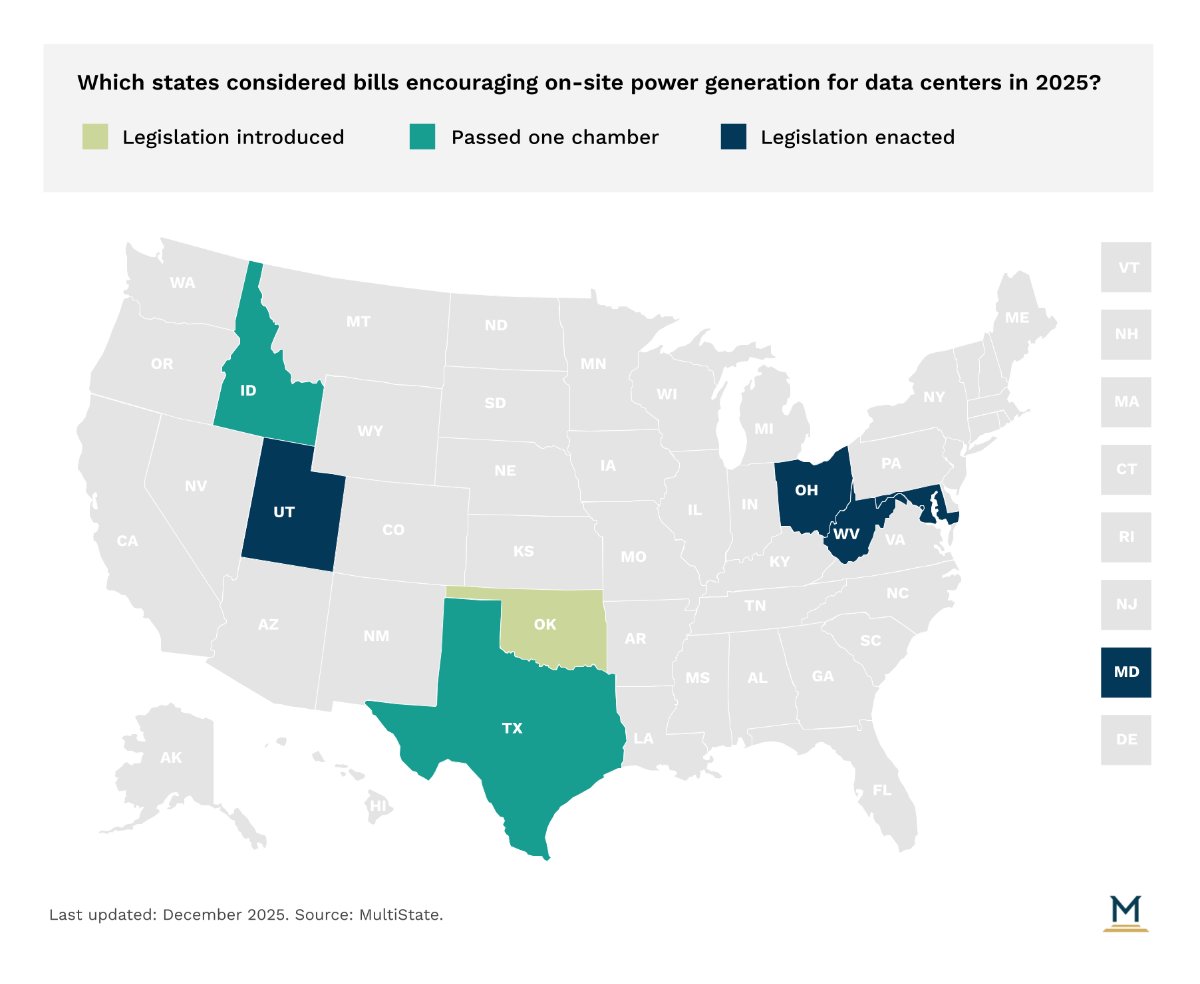
Some lawmakers try to balance the requirement for large users to contract directly with regulated electric utilities, as is the law in many states. For example, in Utah, lawmakers created a pathway for behind-the-meter by allowing large load users to enter the competitive market if an agreement is not reached with the utility within 90 days. The bill (UT SB 132) allows data centers to source its energy from the grid by a third-party supplier or it can source power entirely separate from the grid.
Microgrids are also drawing interest as a way to support clusters of data centers located in the same area while reducing strain on the grid. A bill (WV HB 2014) in West Virginia, called the Power Generation and Consumption Act, allows data centers to operate in certified microgrid districts, which means they can operate independently from the grid of residential ratepayers.
Not all proposals related to the behind-the-meter power option gained traction this session. Lawmakers in Idaho (ID HB 395), Oklahoma (OK HB 1374), and Texas (TX HB 4290 & TX SB 2211; TX SB 1942 & TX HB 3970) considered bills that either provided pathways for large users to source energy outside the grid or encouraged the use of off-the-grid power sources. It remains to be seen whether these proposals will be reintroduced in 2026 (but Texas will not have a regular legislative session in 2026).
Looking ahead, the policy debate around data centers and energy supply is only in its beginning stages. A recent McKinsey report projected that data centers will account for nearly 40% of net new demand on the U.S. grid between now and 2030. That forecast reflects not only the rise of cloud storage but also the rapid growth of artificial intelligence, which requires immense computing power.
For state lawmakers, the challenge is twofold: ensuring that their state’s grid can handle new large load customers while also protecting residential ratepayers from shouldering the costs of grid upgrades that come with taking on data center customers. And as for data centers, while onsite generation seems like a simple solution, there are inherent risks and limitations for investing in onsite generation facilities. As states continue to balance the need for economic development with an affordable energy market, the question of how to power data centers will remain a top priority for lawmakers in 2026 and beyond.
States are considered hundreds of data center bills, and we expect activity to continue growing. To stay on top of this rapidly evolving landscape, we've launched MultiState Policy Watch: Data Centers – a subscription featuring legislative analysis, trend summaries, and expert insights across energy, tax, water, zoning, and other policy areas impacting data centers. Sign up here.
September 24, 2026 | Kim Miller
September 18, 2026 | Morgan Scarboro
September 1, 2026 | Morgan Scarboro, Izzy Aaron