Financial Services & Commerce
Prediction Market Regulation Heats Up as States Lose $600 Million in Tax Revenue
March 19, 2026 | Geoff Hawkins
January 13, 2026 | Katherine Tschopp
Key Takeaways:
At the end of each year, our policy analysts share insights on the issues that have been at the forefront of state legislatures throughout the session during their review of thousands of bills across all 50 states. Here are the big developments and high-level trends we saw last year in the pricing space, plus what you can expect in 2026.
In 2025, price transparency emerged as a growing legislative trend, as nine states considered eighteen price disclosure bills, one of which was signed into law in Minnesota. In 2025, this trend not only continued, but expanded as lawmakers introduced legislation aimed at requiring retailers to clarify how the total cost of a good or service is determined — especially with increasing use of artificial intelligence and automated decision systems in pricing models.
Introductions of price disclosure bills rose dramatically in 2025 as over 100 measures were introduced in 33 states and D.C. While states such as Connecticut (CT SB 3), Colorado (CO HB 1090), and Oregon (OR SB 430) enacted broad price disclosure measures, Governors in Maine (ME LD 913, ME LD 414), Nevada (NV SB 388), and Rhode Island (RI HB 5247, RI SB 17) signed bills into law that require price disclosure in sales of specific items. Bills were almost evenly split between requiring transparency in general retail sales and specific leisure goods and services, particularly short-term lodging and live-event tickets. Overall, price disclosure legislation in 2025 consistently emphasized lawmakers’ desire for consumers to be informed of the total cost — including all fees — of a good or service prior to the point-of-sale.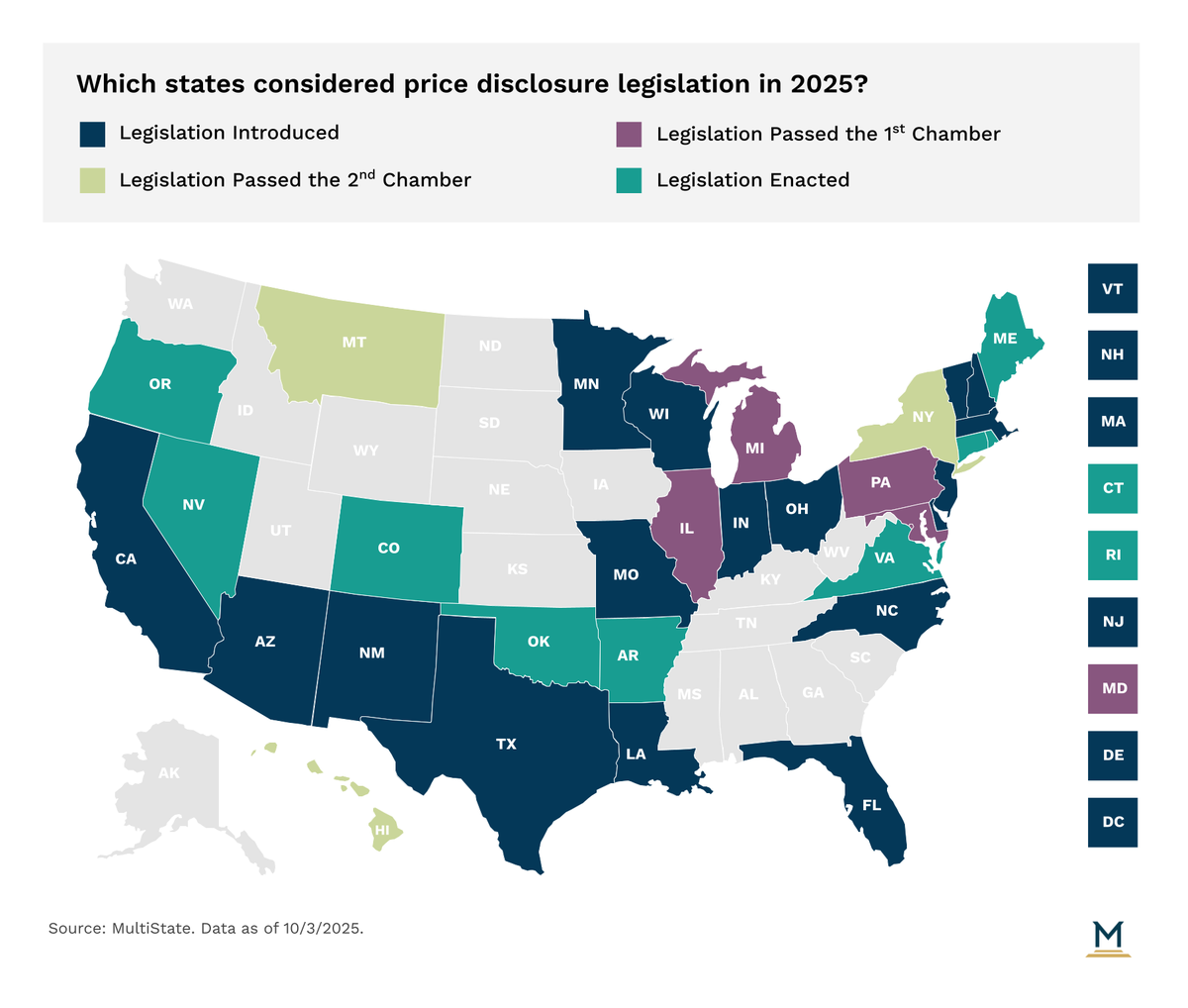
While the use of dynamic pricing models is not new, consumer concerns surrounding rising costs and data privacy motivated state legislators to consider consumer protection measures relating to algorithmic, dynamic, and surveillance pricing practices in 2025.
As defined in Hawaii’s dynamic pricing bill, dynamic pricing refers to the real-time adjustment of the price of a good or service based on supply and demand fluctuations, supply chain issues, or other consumer trends. California legislators define algorithmic pricing as any computational process, including one derived from machine learning or artificial intelligence, that processes data to recommend or set a price. After amendments, another California pricing model bill specified surveillance pricing as the setting or offering of an increased price for a specific consumer or group of consumers based, in whole or in part, on personally identifiable information collected through electronic surveillance technology.
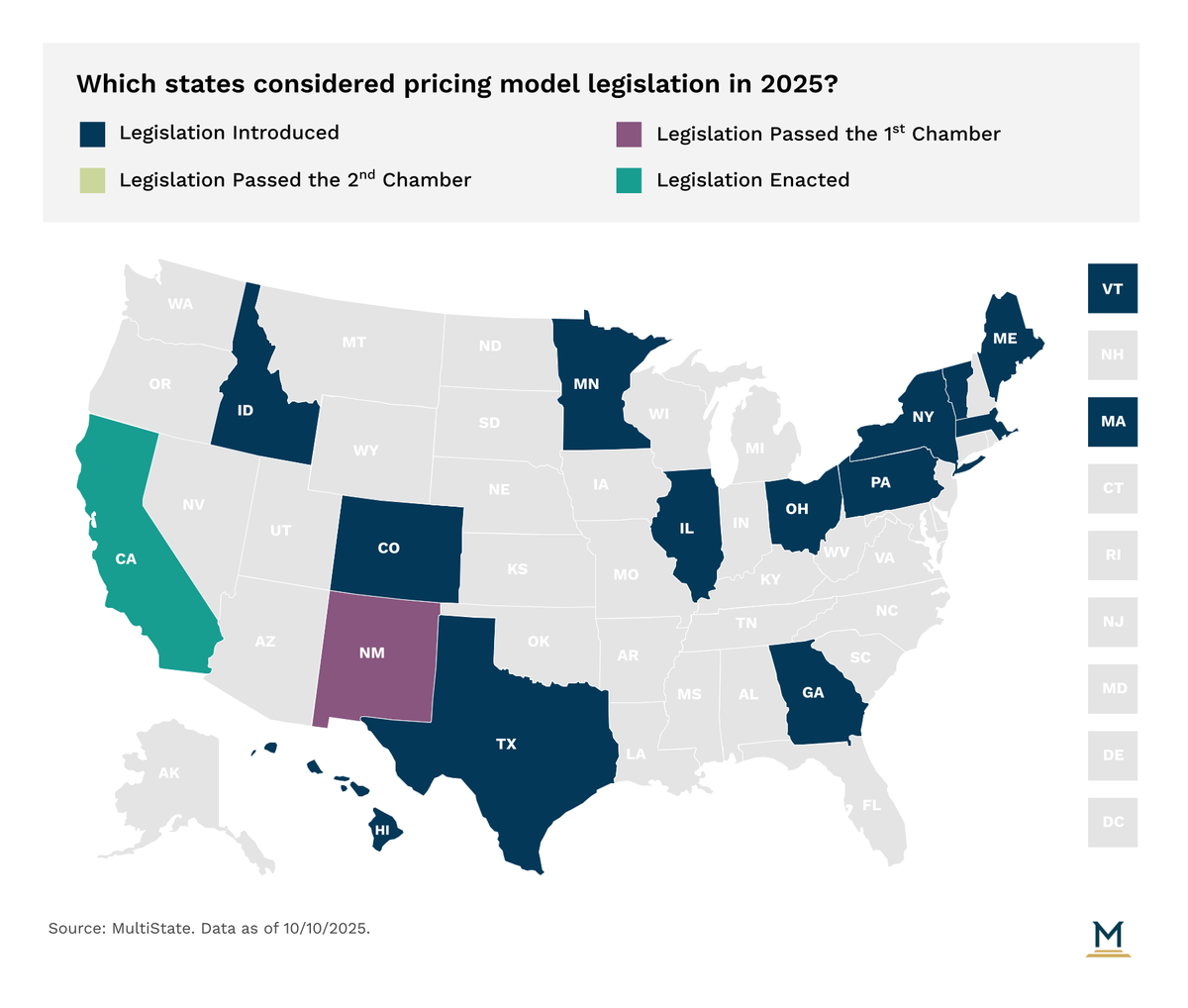
As is often the case, California took the lead in introducing pricing model legislation in 2025. Five measures introduced in 2025 covered a range of pricing practices from algorithmic pricing utilizing competitor data (SB 295, SB 384, AB 325) to prohibiting surveillance pricing online and in stores (SB 259, AB 446). However, only one bill, AB 325, was signed into law by Governor Newsom. SB 295 failed to pass on its third reading, but the measure was granted reconsideration and will carryover to the 2026 session.
Several of the bills introduced in 2025 would allow the use of dynamic pricing, but would, like other price transparency legislation, require the disclosure of the dynamic or algorithmic pricing process. Bills introduced in New Mexico (NM 285), New York (NY A 6765), Pennsylvania (PA HB 1779), and Texas (TX SB 2567) would require any person or entity utilizing algorithmic pricing systems to disclose that the prices were set by algorithms to consumers.
A growing trend in pricing legislation seen in Democratic-trifecta states in 2025 is the application of pricing models when selling food and beverage products. Legislatures in Hawaii, Maine, Massachusetts, New Mexico, and New York considered bills that would prohibit grocery stores or other food-related establishments from utilizing dynamic or surveillance pricing models. In a final effort to pass a surveillance pricing bill CA AB 446, state lawmakers amended the bill to narrow its scope — from applying to retailers broadly to specifically applying to grocers, aligning the bill with the emerging trend.
Pricing model legislation introduced in 2025 also included privacy protections for both businesses and consumers. Legislation introduced in Colorado, Georgia, Illinois, and Pennsylvania would have prohibited the use of personal data acquired through surveillance practices to set an individual or discriminatory price to a single consumer. Lawmakers also aimed to protect businesses by prohibiting an entity or its agent from using any pricing algorithm that incorporates nonpublic competitor data in California (SB 384), Idaho (HB 203), and Ohio (SB 79). California’s measure went further by adding knowledge and intent components to clarify that the use is prohibited if there is a reasonable expectation that the individual does, or the individual should know that the algorithm processes nonpublic competitor data.
This year, anticipate further introductions of price disclosure legislation. As an increasing number of businesses and consumers are impacted by modified tariff rates, in 2026, we expect lawmakers to introduce bills similar to those in Missouri (MO SB 804), New Jersey (NJ A 5922, NJ A 5759) and Wisconsin (WI SB 438, WI AB 437) that would require entities to disclose what portion of the cost of a good is attributable to a tariff.
Introductions of pricing model legislation will continue to grow in the 2026 legislative session. The rapid development of advanced technologies and their evolving uses, especially artificial intelligence, will remain a central focus of state legislation. Expect action in California as, come January 2026, SB 295 will be picked back up and only need to pass in the Assembly. Grocery costs are likely to remain a key concern for Democrats, prompting more Democratic-trifecta states to consider implementing pricing model restrictions for food-related transactions.
MultiState’s team is actively identifying and tracking consumer issues so that businesses and organizations have the information they need to navigate and effectively engage. If your organization would like to further track these or other related issues, please contact us.
March 19, 2026 | Geoff Hawkins

January 14, 2026 | Katherine Tschopp

December 9, 2025 | Katherine Tschopp