Elections & Campaigns, Health Care & Wellness
MAHA Political Endorsements Target August Republican Primaries
August 11, 2026 | Katherine Tschopp
January 14, 2026 | Katherine Tschopp
Key Takeaways:
At the end of each year, our policy analysts share insights on the issues that have been at the forefront of state legislatures throughout the session during their review of thousands of bills across all 50 states. Here are the big developments and high-level trends we saw last year in the food and grocery policy space, plus what you can expect in 2026.
In 2024, then President-Elect Donald Trump adopted food safety and chronic disease reduction as key priorities for his administration. Constituents repurposed President Trump’s popular campaign slogan “Make America Great Again (MAGA)” into “Make America Healthy Again (MAHA)” to display support for the policies, and the MAHA movement was born. President Trump officially implemented the policy initiative through the issuance of E.O. 14212 “Establishing the President’s Make America Healthy Again Commission.”
The Order creates a federal board, chaired by the Secretary of Health and Human Services, Robert F. Kennedy Jr., tasked with aligning medical, nutritional, agricultural, educational, and environmental policies to ameliorate the chronic disease public health crisis in the United States. The Commission published an initial Make our Children Healthy Again: Assessment, and more recently, its Make Our Children Healthy Again Strategy, which contains over 120 initiatives spanning various policy areas with the goal of improving children’s health across the country. While the MAHA policy-umbrella encompasses a broader range of issues, this section is limited to food-related MAHA legislation.
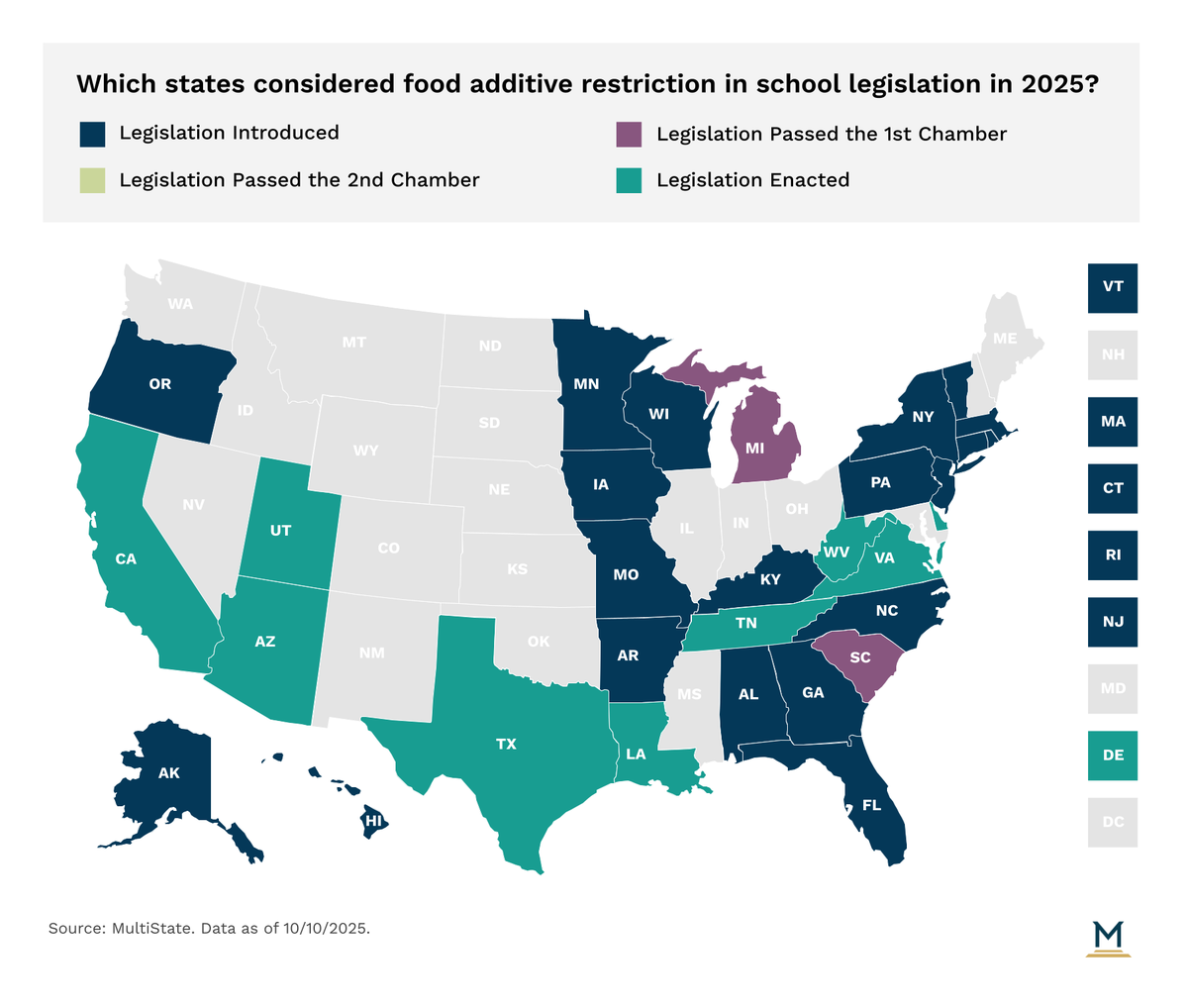
To date, the predominant MAHA-related issue addressed by state lawmakers is the restriction or prohibition of various synthetic substances utilized as stabilizers, preservatives, dyes, and sweeteners as ingredients in food and beverage products. California became the first state to enact laws restricting certain food additive ingredients in food and beverage products when the state enacted AB 418 in 2023 and AB 2316 in 2024. Introductions of food additive bills have quintupled year over year since 2023: four bills from three states in 2023; 27 bills from 13 states in 2024; and over 140 bills across 38 states in 2025.
Although state prohibition proposals vary, the most common group of additives state lawmakers aim to restrict in their bills in 2025 is referred to as the “standard 11” — Blue Dye 1, Blue Dye 2, Brominated Vegetable Oil (BVO), Green Dye 3, Potassium Bromate, Propylparaben, Red Dye 3, Red Dye 40, Titanium Dioxide, Yellow Dye 5, and Yellow Dye 6. Restricting the seven color dyes listed is a top priority at both the federal and state levels as they are derived from petroleum.
Bills prohibiting the offer, sale, or distribution of foods and beverages containing specified additives in or on school grounds constitute the majority of food additive legislation introduced and signed into law in 2025. Out of 70 school restriction additive bills, 11 have been enacted in eight states — Arizona, Delaware, Louisiana, Tennessee, Texas, Utah, Virginia, and West Virginia. On August 1, 2025, West Virginia’s newly enacted law became the first school food additive restriction measure to go into effect in the country, more than one year earlier than the aforementioned laws which have effective dates in 2026 and 2027. The law is also the first dual restriction bill limiting food additives in products in both retail and school settings.
One of the largest challenges lawmakers faced when addressing food additive legislation in 2025 is the absence of a uniform definition for “ultra-processed foods (UPFs).” The United States currently relies on the uncodified NOVA Classification System’s 2009 definition of UPFs.
In 2025, Arizona became the first state to enact a definition of UPFs in HB 2164, defined as “a food or beverage that contains one or more of the following ingredients: Potassium Bromate, Propylparaben, Titanium Dioxide, Brominated Vegetable Oil (BVO), Yellow Dye 5, Yellow Dye 6, Blue Dye 1, Blue Dye 2, Green Dye 3, Red Dye 3, and Red Dye 40.” This group of additives is commonly referred to as the “standard 11.” Legislation in seven other states — Alabama (HB 580), Florida (SB 1826), Kentucky (HB 439), Missouri (SB 802), New Jersey (S 4560), North Carolina (HB 874), and South Carolina (HB 4339 and SB 589) — included identical definitions.
Governor Newsom (D) signed CA AB 1264 into law in October. The new law defines a food or beverage product as an UPF based on the technical effect of an additive ingredient in the product. At the National Governors Association 2025 Summer Meeting on July 26, 2025, Secretary Kennedy expressed support for the UPF definition outlined in the California measure and replicated in PA HB 1132.
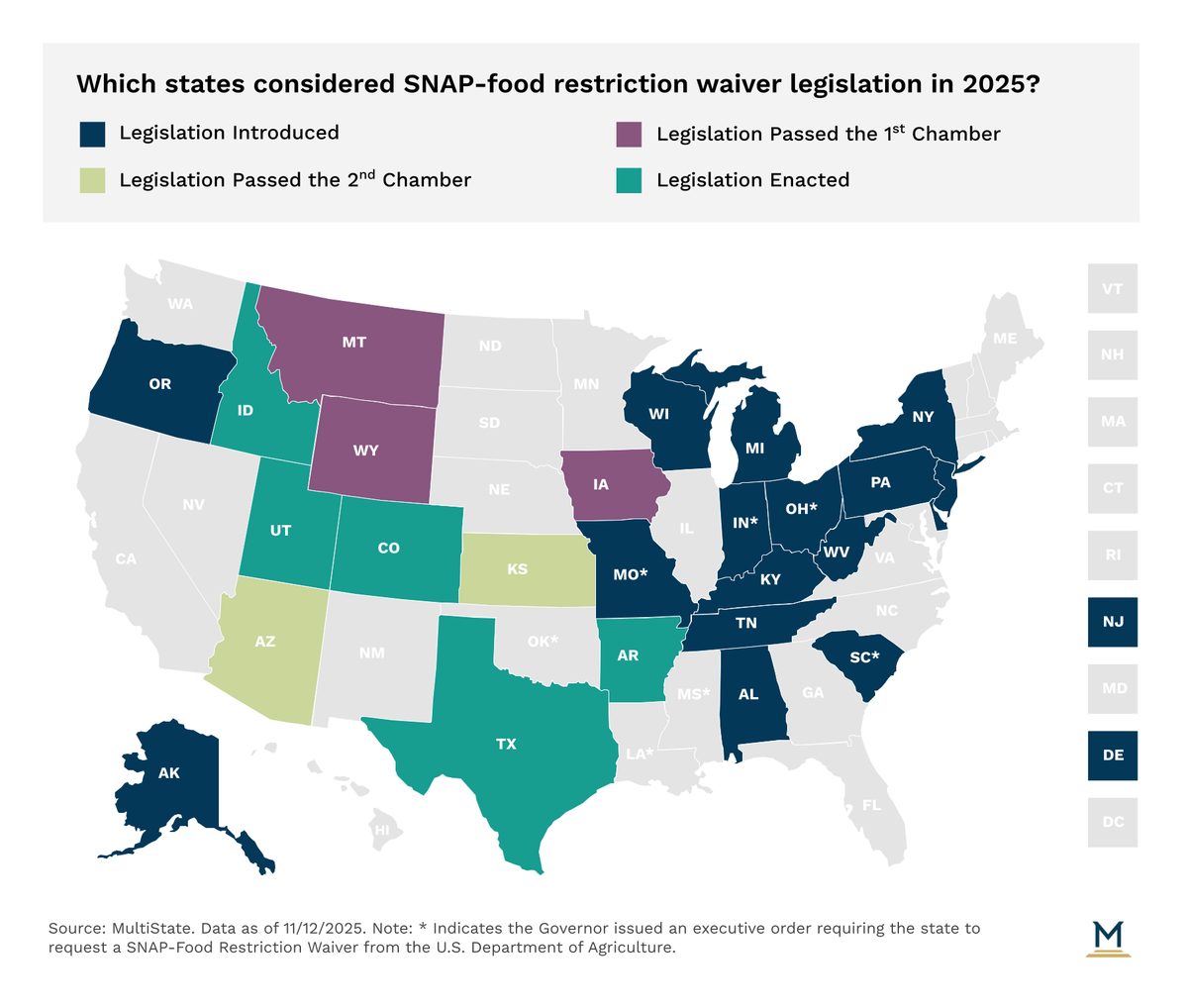
In an emerging trend in 2025, states began to modify the eligibility of non-nutritive food and beverage products, primarily candy and soft drinks, to be purchased with Supplemental Nutrition Assistance Program (SNAP) benefits. Laws enacted in Arkansas, Idaho, Texas, and Utah required state agencies to submit SNAP-food restriction waiver requests to the U.S. Department of Agriculture (USDA). Governors in Indiana, Louisiana, Missouri, Ohio, and Oklahoma issued Executive Orders to require agencies to submit SNAP-food restriction waiver requests. Ohio’s SNAP Beverage Working Group conducted a study this summer and released its waiver recommendations. In May, Nebraska became the first state to receive USDA-approval for a waiver prohibiting purchases of soft drinks and energy drinks with SNAP benefits. As of this writing, the USDA has approved food restriction waivers for an additional 17 states — Arkansas, Colorado, Florida, Hawaii, Idaho, Indiana, Iowa, Louisiana, Missouri, North Dakota, Oklahoma, South Carolina, Tennessee, Texas, Utah, Virginia, and West Virginia.
After the creation of the federal Commission, a handful of states took the baton and established their own state-level MAHA Commissions through varying strategies. In Kentucky and Texas, the MAHA Kentucky Task Force and Texas Nutrition Advisory Committee were established through legislation, KY SCR 61 and TX SB 25. Lawmakers introduced MA H 113 which would create the Commission to Study the Safety of Food and Food Additives, though the measure’s progress has been limited. Similarly in Montana, legislators introduced MT SB 155, which if passed, would have created a Food Safety Panel charged with studying additive and coloring ingredients in food. In other states, such as Florida and Oklahoma, the Governors created MAHA Commissions through their executive authority. The federal MAHA Executive Order established a limited term for the Commission; however, a newly introduced bill, US HR 5404, would codify the order, incorporating the MAHA Commission into federal statute.
We expect food-related MAHA legislation to remain a top policy issue during the 2026 legislative sessions. State lawmakers will undoubtedly continue to introduce and enact legislation restricting food additives in schools. We expect federal support of state MAHA legislation, particularly in Republican-trifecta states, to continue in 2026, as Secretary Kennedy joined the Governors of Louisiana, Texas, and West Virginia for official signings of their school food additive restriction bills in 2025. Prefiles for the 2026 legislative session in Missouri and New Hampshire indicate food additives will remain a top priority for state lawmakers in 2026.
State-level MAHA-related Commissions are anticipated to play a larger role in 2026. Texas Governor Greg Abbott (R) is expected to begin appointing members to the state’s newly enacted Nutrition Advisory Committee.
In July, Secretary of the Department of Health and Human Services, Robert F. Kennedy Jr., and Secretary of the Department of Agriculture, Brooke L. Rollins, issued a joint Request for Information (RFI) to develop a uniform definition of UPFs. We anticipate the agencies will publish a proposed rule defining UPFs in 2026 after departmental review of the RFI comment submissions.
SNAP nutrition will also remain a prominent issue in 2026. Ohio submitted its SNAP-food restriction waiver request to the USDA on October 28, requesting to remove sugar-sweetened beverages such as soda from the list of SNAP-eligible products. Alabama (AL HB 31) and New Hampshire (LSR 2435, LSR 2590, and LSR 2391) have already prefiled legislation to request SNAP waivers to modify the state’s list of SNAP-eligible food and beverage products. Pennsylvania legislators announced they intend to introduce legislation to request a SNAP food restriction waiver as well. As SNAP food restriction waivers are implemented in 2026, we expect states to begin considering expanding their SNAP-eligible food lists to include healthy food alternatives that may not currently qualify under SNAP.
MultiState’s team is actively identifying and tracking food and grocery issues so that businesses and organizations have the information they need to navigate and effectively engage. If your organization would like to further track these or other related issues, please contact us.
August 11, 2026 | Katherine Tschopp
June 8, 2026 | Mary Kate Barnauskas
May 12, 2026 | Mary Kate Barnauskas