
States Expand Domestic Procurement Requirements for Steel, Iron, and Timber
September 18, 2026 | Kayla Susalla
December 9, 2025 | Katherine Tschopp

Key Takeaways:
In February, President Trump announced he had instructed the U.S. Treasury to halt production of the penny. Nine months later, retailers and consumers are feeling the effects. The U.S. minted its last penny on Nov. 12, and although billions of pennies remain in circulation, regional distribution is causing a bottleneck in the penny supply, especially in the Midwest. As a recent WSJ article points out, “America last phased out a coin roughly 170 years ago, when it got rid of the half-cent.” This is relatively new territory.
Federal lawmakers introduced two “Common Cents” bills (US HR 3074 and US S 1525) that would formally direct the U.S. Treasury to cease minting the penny, and establish in-person cash transaction price-rounding rules. The price-rounding provisions propose rounding total prices, after the application of sales or other taxes, to the nearest five cents meaning total costs ending in $x.x1, $x.x2, $x.x6, or $x.x7 would be rounded down, and total costs ending in $x.x3, $x.x4, $x.x8, or $x.x9 would be rounded up. Price-rounding will not apply to non-cash transactions. However, federal inaction to date has caused state lawmakers to try to tackle the time-sensitive issue.
The Utah Division of Consumer Protection was the first state agency to issue guidance on price-rounding. In addition to the rounding recommendations, the Division published a printable flyer to be posted in stores for consumer disclosure. Utah’s guidance aligns with the rounding rules proposed in the federal legislation.
In New York, companion bills (NY A 9274 / NY S 8580) propose identical rounding rules to the federal bills and rounding recommendations made in the National Conference of State Legislators (NCSL) Task Force on State and Local Taxation’s policy paper, entitled “Elimination of the Penny: Cents-able Considerations.” Should federal lawmakers continue to delay, we expect more states to follow New York and Utah’s lead.
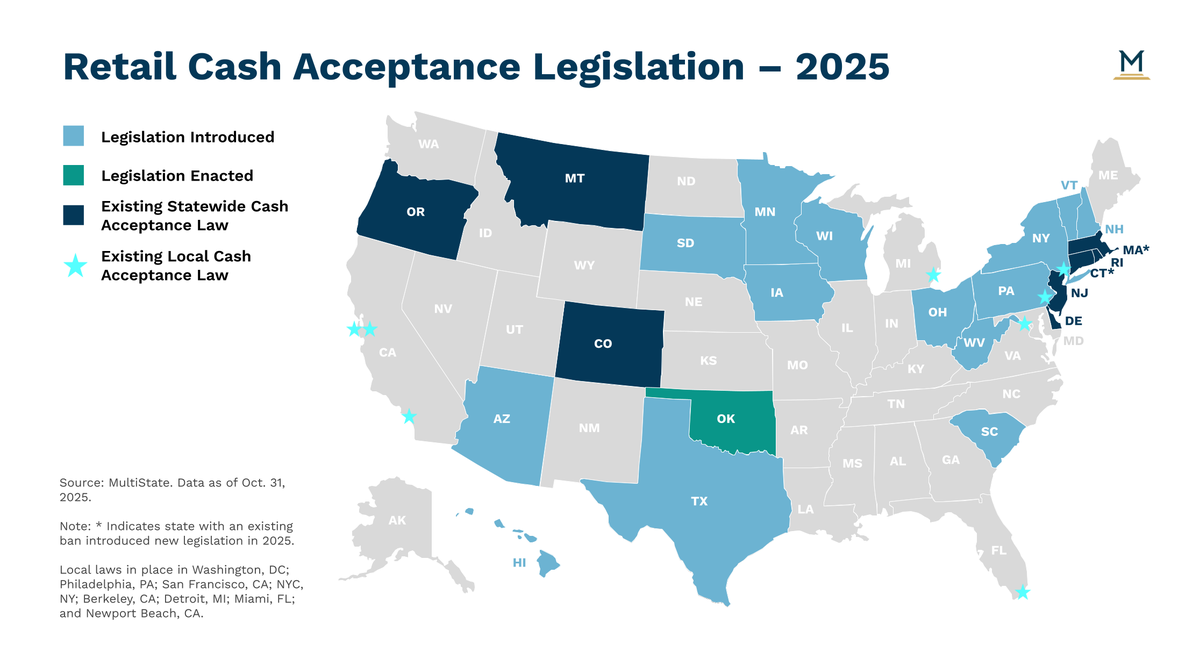
The concern surrounding penny elimination also relates to the existing legislative trend of retail cash acceptance. As of 2025, eight states require retail businesses to accept cash for purchases, with 11 states debating such laws in 2024 and 19 states introducing cash acceptance bills this year. Oklahoma enacted a law (OK SB 677) this year to eliminate the ban on credit and debit card surcharges by businesses in the state. Localities have also been active on this issue, with at least eight major cities with laws on the books to require acceptance of cash.
If a business is required to accept cash, but there is a shortage of pennies to provide exact change, then they’re left with implementing their own rounding rules. With limited guidance thus far, businesses and individual cashiers have applied varying rounding practices transaction-to-transaction. Merchants are looking for guidance from policymakers to provide a uniform, compliant solution.
This article appeared in our Morning MultiState newsletter on December 9, 2025. For more timely insights like this, be sure to sign up for our Morning MultiState weekly morning tipsheet. We created Morning MultiState with state government affairs professionals in mind — sign up to receive the latest from our experts in your inbox every Tuesday morning. Click here to sign up.
September 18, 2026 | Kayla Susalla

March 19, 2026 | Geoff Hawkins

January 14, 2026 | Katherine Tschopp