Energy & Environment
Advanced Recycling Legislative Trends During the 2026 Sessions
June 9, 2026 | Kim Miller
January 22, 2026 | Daniel Kampf
Key Takeaways:
At the end of each year, our policy analysts share insights on the issues that have been at the forefront of state legislatures throughout the session during their review of thousands of bills across all 50 states. Here are the big developments and high-level trends we saw last year in the PFAS policy space, plus what you can expect in 2026.
The introduction and passage of legislation addressing perfluoroalkyl and poly-fluoroalkyl substances (PFAS) has been a priority for states across the country for the last several years. PFAS, also known as "forever chemicals," do not break down naturally, can accumulate over time, are toxic at small levels, and are found in a wide range of consumer products such as food packaging, cookware, textile articles, cleaning products, cosmetic products, dental floss, juvenile products, menstruation products, upholstered furniture, and various other products used by consumers each day. PFAS are also found in plastics, drinking water, and firefighter personal protective equipment (PPE) and firefighting foam.
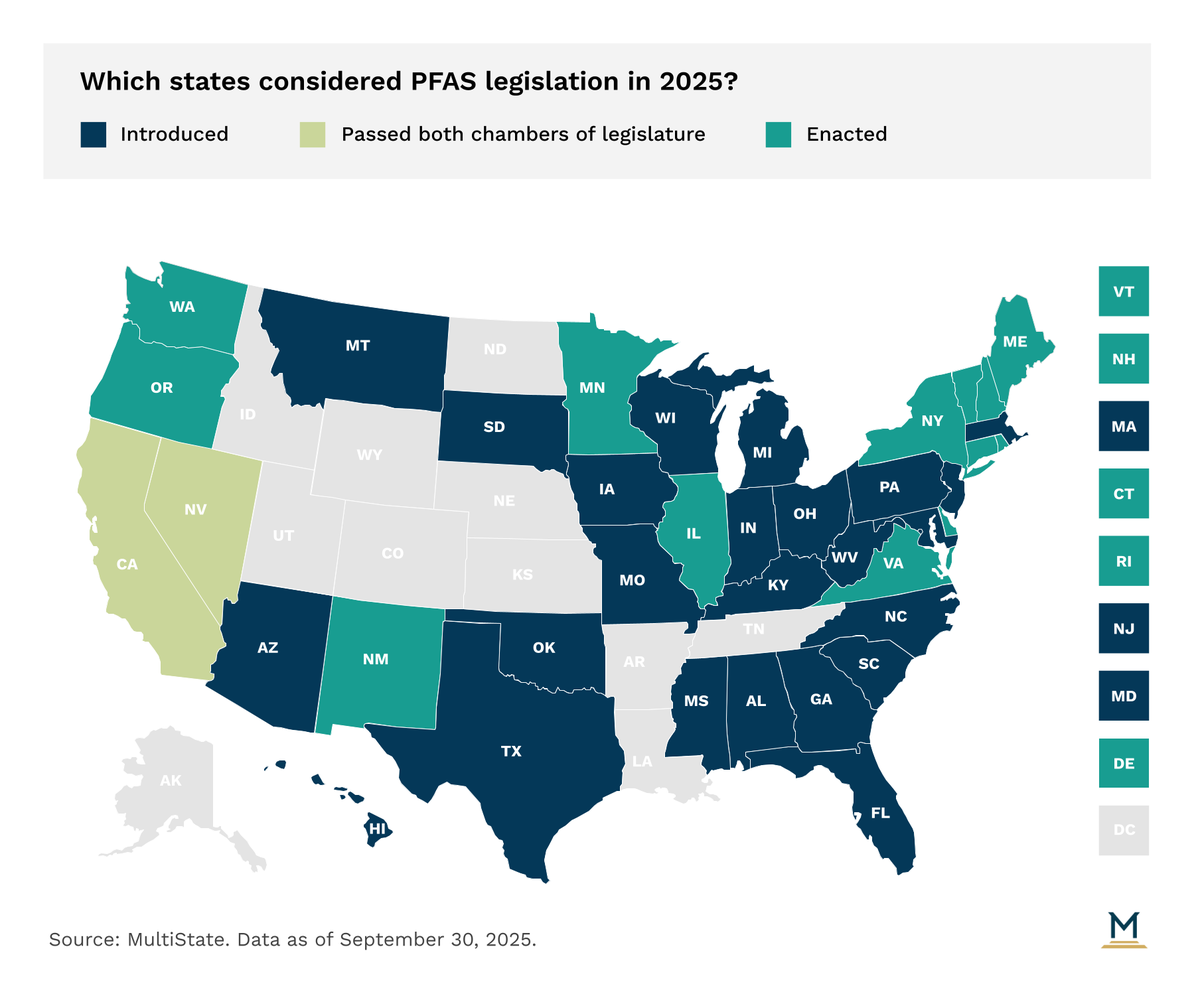
States are addressing this issue via bans or restrictions on PFAS in consumer products and in firefighting PPE and firefighting foam, through funding of PFAS remediation projects in the water supply and on military installations, and by creating studies to address the broad impacts of PFAS. During the 2025 legislative session, nearly 350 bills addressing PFAS were considered in 39 states.
The 2025 legislative session has produced a high volume of PFAS-related bill activity. Nearly 350 bills addressing PFAS have been introduced in 39 states. Twenty-seven of these bills were enacted in 13 states (Illinois, Virginia, Maine, New York, New Mexico, Washington, Vermont, Rhode Island, Oregon, New Hampshire, Minnesota, Delaware, and Connecticut) with 10 bills in 5 states (New York, Nevada, Minnesota, Maine, and California) passing both chambers of their respective state legislatures.
In March 2025, Illinois Governor JB Pritzker (D) signed SB 727, requiring the state's Pollution Control Board to establish maximum contaminant levels (MCLs) for the state's community water supplies. In early April 2025, Virginia Governor Glenn Youngkin (R) signed HB 2050 requiring, for facilities that discharge PFAS in excess of the maximum contaminant level (MCL) established for PFAS in drinking water, the state Department of Environmental Quality to modify the facility's discharge permit to require that a facility not exceed that maximum MCL. Maine's Governor Janet Mills (D) signed LD 130, establishing a response program to clean up and mitigate hazards posed by PFAS that impact the agriculture industry. In New York, budget bills NY S 3008 and NY A 3008 prohibit the manufacture and sale of firefighting PPE containing intentionally added PFAS by 2028.
In New Mexico, Governor Michelle Lujan Grisham (D) signed a comprehensive PFAS ban bill, NM HB 212, banning the sale of cookware, food packaging, dental floss, juvenile products, and firefighting foam containing intentionally added PFAS, beginning in 2027. In 2028, the law bans the sale of carpets and rugs, cleaning products, cosmetics, fabric treatments, feminine hygiene products, textiles, textile furnishings, ski wax, and upholstered furniture containing intentionally added PFAS. By 2032, all products containing intentionally added PFAS will be banned for sale unless the state's Environmental Improvement Board adopts a rule specifying that the use of PFAS in a product is currently unavoidable.
Need help staying current on state PFAS requirements? From outright bans to phased restrictions, state PFAS legislation varies significantly and the landscape keeps shifting. MultiState can help you track this and other environmental policy. Explore our tracking services →
In May 2025, New Hampshire Governor Kelly Ayotte (R) signed NH HB 167, prohibiting the sale of ski, boat, and board waxes containing intentionally added PFAS. Minnesota Governor Tim Walz (D) signed an omnibus bill, MN HF 2446, that, among other things, delays, from 2025 to 2026, the effective date on an existing state ban of intentionally added PFAS in carpets or rugs, cleaning products, cookware, cosmetics, dental floss, fabric treatments, juvenile products, menstruation products, textile furnishings, ski wax, or upholstered furniture.
In June 2025, Vermont Governor Phil Scott (R) signed VT HB 238, prohibiting manufacturers from selling aftermarket stain and water-resistant treatments, artificial turf, cleaning products, cookware, dental floss, incontinence protection products, juvenile products, residential rugs and carpets, or ski wax containing intentionally added PFAS. The ban also impacts textile articles. Rhode Island Governor McKee (D) signed RI HB 5019, prohibiting manufacturers from selling firefighting PPE containing intentionally added PFAS beginning in 2027.
We expect to continue seeing legislation introduced that limits or bans PFAS in consumer products, firefighting foam and equipment, as well as requirements for remediation. We also expect states to continue introducing legislation establishing committees to study PFAS remediation and the effects of PFAS on public health and the environment. As federal regulators loosen PFAS regulations, we expect states to fill the void. There have not yet been any PFAS bills prefiled or introduced for the 2026 legislative session, though we expect that to change as we move closer to the 2026 sessions.
MultiState's team is actively identifying and tracking environmental issues so that businesses and organizations have the information they need to navigate and effectively engage. If your organization would like to further track these or other related issues, please contact us.
June 9, 2026 | Kim Miller
May 7, 2026 | Sandy Dornsife
March 20, 2026 | Daniel Kampf