Elections & Campaigns
State Trifecta Control Could Shift Dramatically in 2026 Elections
September 29, 2026 | Bill Kramer
October 14, 2026 | Bill Kramer
Key Takeaways:
In April, we ran an analysis of how well Democrats were overperforming their 2024 margins in this year's state legislative special elections and what that might tell us about their chances in November. But that analysis came with two caveats: (1) the special election overperformance tends to moderate on the day of the general election and (2) during the 2018 cycle, when Democrats had comparatively high overperformance numbers during that year's specials, the special elections advantage in the final few months before the election came back down to earth, yielding a much lower overperformance margin than the first half of the year. So we wanted to keep an eye on the remaining special elections to see if the same pattern held this year.
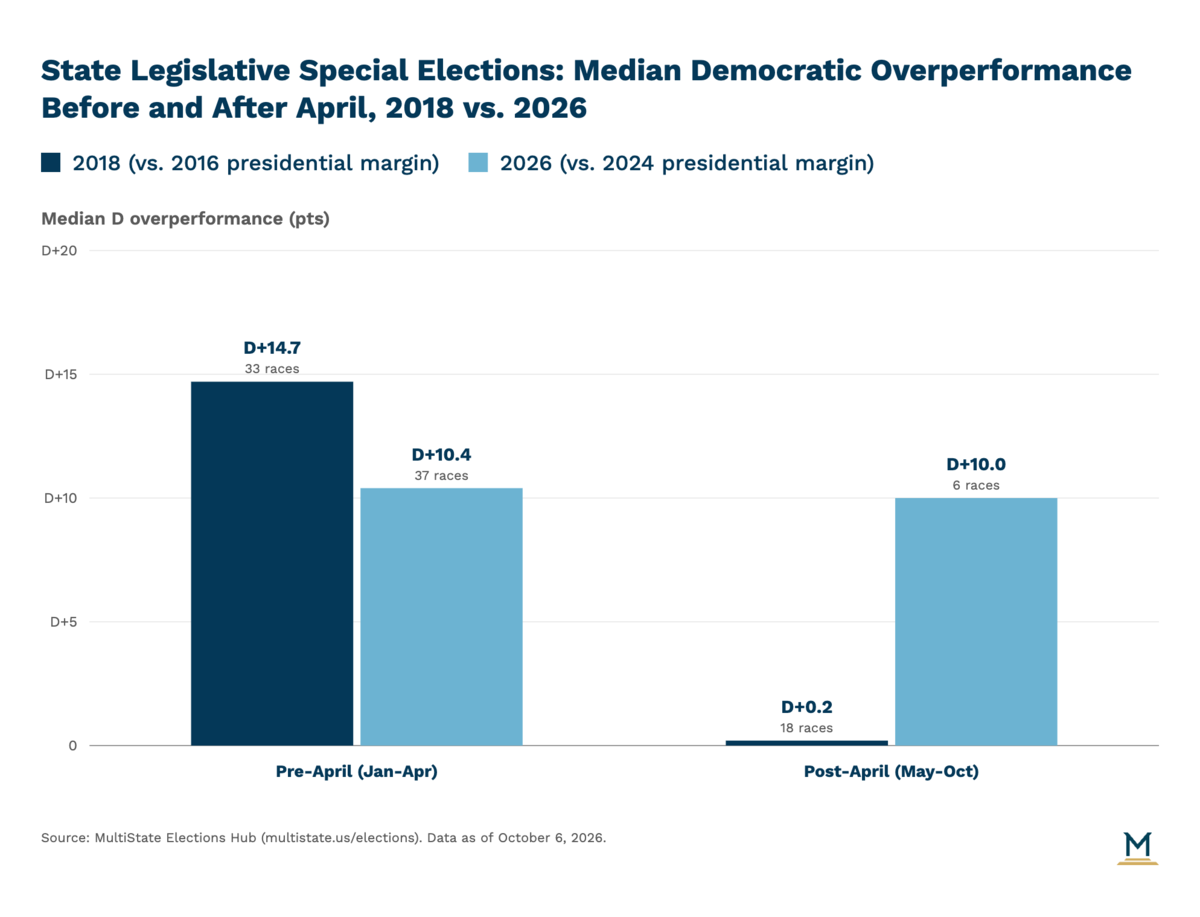
Unlike in 2018, Democratic margins in 2026 have held through the end of the special election cycle. In 2018, Democrats overperformed Hillary Clinton's 2016 presidential margin by a median of 14.7 points (33 contested specials) in the Jan-Apr period (a majority of specials typically take place in the first part of the year), but from May-Oct that year, that Democratic advantage shrank to a median of 0.2 points (18 contested specials), bringing their overall 2018 overperformance in special elections to a 5.3 median swing (51 races). That translated into a 3.9-overperformance in the 2018 general elections.
This year, that second-half dip in special election margins did not surface. During the Jan-Apr period, Democrats overperformed Kamala Harris' 2024 margins by 10.4 points (37 contested specials) and sustained that median advantage through the latter half of the year with a 10-point margin (six contested specials). That last number should give us some pause though. In 2018, the May-Oct period saw 18 contested special elections, whereas in 2026 we only have six special election outcomes to work with. That's likely too small a sample size to draw any strong conclusions.
But what does this mean for Democrats in November? That's harder to say. Directionally, it's certainly good for Democrats that the special elections overperformance didn't crater as the year went on, but the raw number needs adjusting before it tells us anything about the general election. Historically, a party's special election overperformance should be discounted before applying it to November. Turnout is way different for specials versus the general even if the specials may tell you something about party enthusiasm that year. Based on data from recent election cycles, a reasonable discount is roughly 1.5 to 4 points in November below what the party was seeing in the specials.
The bottom line is that a reasonable projection from the special elections to November in 2026 would have Democrats overperforming the 2024 presidential margins by six to nine points this year, which would net them roughly 424 to 593 state legislative seats. This is close to what professional forecasters project. Currently, our friends at State Navigate project Democrats to net 403 seats.
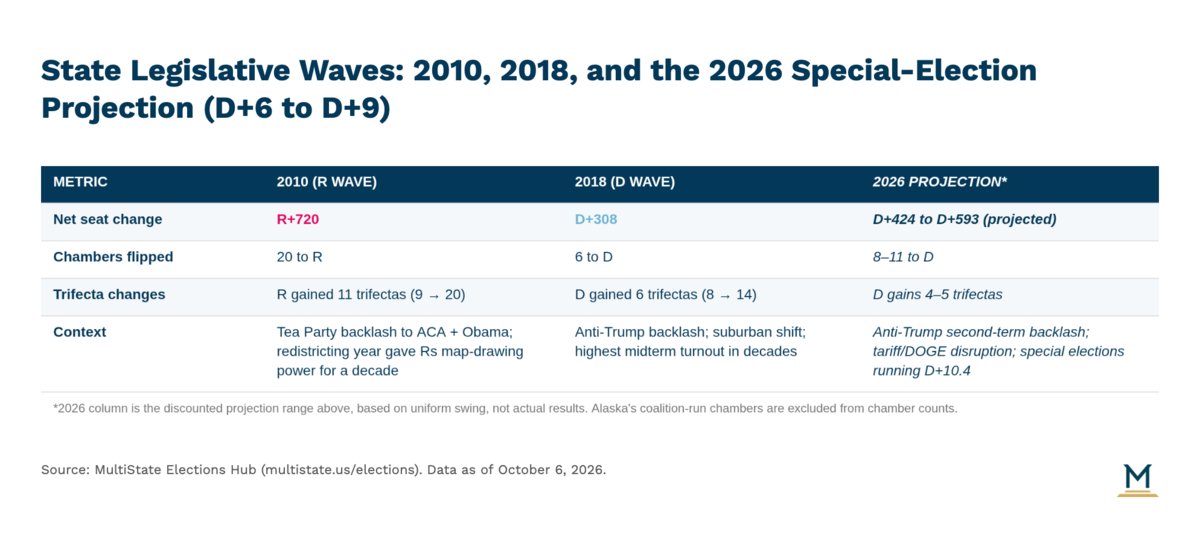
That would be significant. In 2018, the party's last wave year, Democrats netted 308 legislative seats, while also picking up 7 governorships and 6 trifectas. Those numbers aren't far from our "What would a Democratic wave election look like?" hypothetical from last week, which would see Democrats gaining six new trifectas in 2027. We're now under a month from Election Day, which leaves us plenty of time to read the tea leaves and adjust projections.
Federal and state elections and redistricting can have significant policy and regulatory implications for businesses and organizations. If your organization would like to further track federal and state elections, please contact us.
How much are Democrats over-performing their 2024 margins in 2026 state legislative special elections?
Democrats overperformed Kamala Harris' 2024 presidential margins by a median of 10.4 points across 37 contested special elections held between January and April 2026. That overperformance held through the latter half of the year at a median of 10 points, though only six contested specials were available in the May–October period, which limits the strength of that conclusion.
What does the 2026 special election overperformance suggest for Democratic seat gains in November?
Based on historical discount rates of roughly 1.5 to 4 points applied to special election overperformance, a reasonable projection would have Democrats overperforming 2024 presidential margins by six to nine points in the 2026 general election. That range translates to a projected net gain of approximately 424 to 593 state legislative seats.
How does Democratic special election performance in 2026 compare to 2018?
In 2018, Democrats overperformed Hillary Clinton's 2016 presidential margin by a median of 14.7 points in the January–April period, but that advantage shrank to a median of 0.2 points in the May–October period, bringing the overall 2018 special election overperformance to a median swing of 5.3 points. In 2026, the second-half dip did not surface, with Democratic overperformance holding near the same level seen earlier in the year.
How many state legislative seats did Democrats net in the 2018 wave election?
Democrats netted 308 state legislative seats in 2018, while also picking up 7 governorships and 6 trifectas. That year's general election overperformance came in at 3.9 points.
What are professional forecasters currently projecting for Democratic state legislative seat gains in 2026?
State Navigate currently projects Democrats to net 403 state legislative seats in 2026. That figure falls within the range suggested by the special election overperformance data, which points to a net gain of roughly 424 to 593 seats depending on the discount applied.
September 29, 2026 | Bill Kramer

August 25, 2026 | Jose Perez
August 11, 2026 | Katherine Tschopp