
Elections & Campaigns, Tax & Budgets
Why Chicago's Budget Crisis Matters for the City's Mayoral Race
August 25, 2026 | Jose Perez
September 29, 2026 | Bill Kramer
Key Takeaways:
We’re five weeks out from Election Day. And while most of the national media attention is on the congressional stakes, this is a big election year for the states. On the ballot November 3, 2026:
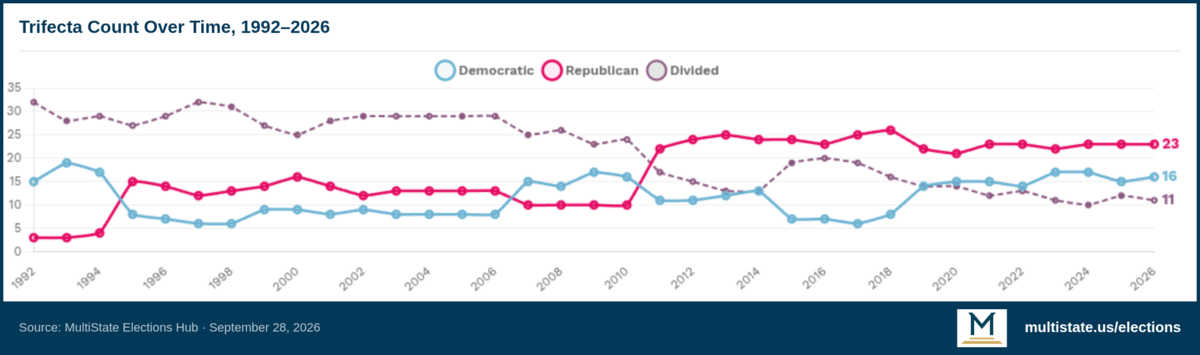
But for state government affairs professionals, the biggest potential shift is in trifecta control. That is, which political party controls both the legislature and the governor’s mansion? We're near historic highs for the number of states under one-party control. Currently, Republicans control 23 state trifectas and Democrats hold 16 trifectas, leaving only 11 states with divided control. That’s 39 trifectas today, only down one trifecta from the modern-day high of 40 states in 2024.
But will that number go up or down in 2027? And in what way might the political control map shift? To understand what a “wave” election would look like where either political party overperforms expectations, we assume that any legislative chamber or governor election rated competitive (i.e., toss-up, tilt, or lean) is won by the “wave” party, and then look at what the trifecta map would look like in the aftermath. We use an averaged rating from three gubernatorial forecasters (Cook, Sabato’s, and Pluribus) and the legislative chamber ratings are from Sabato’s Crystal Ball.
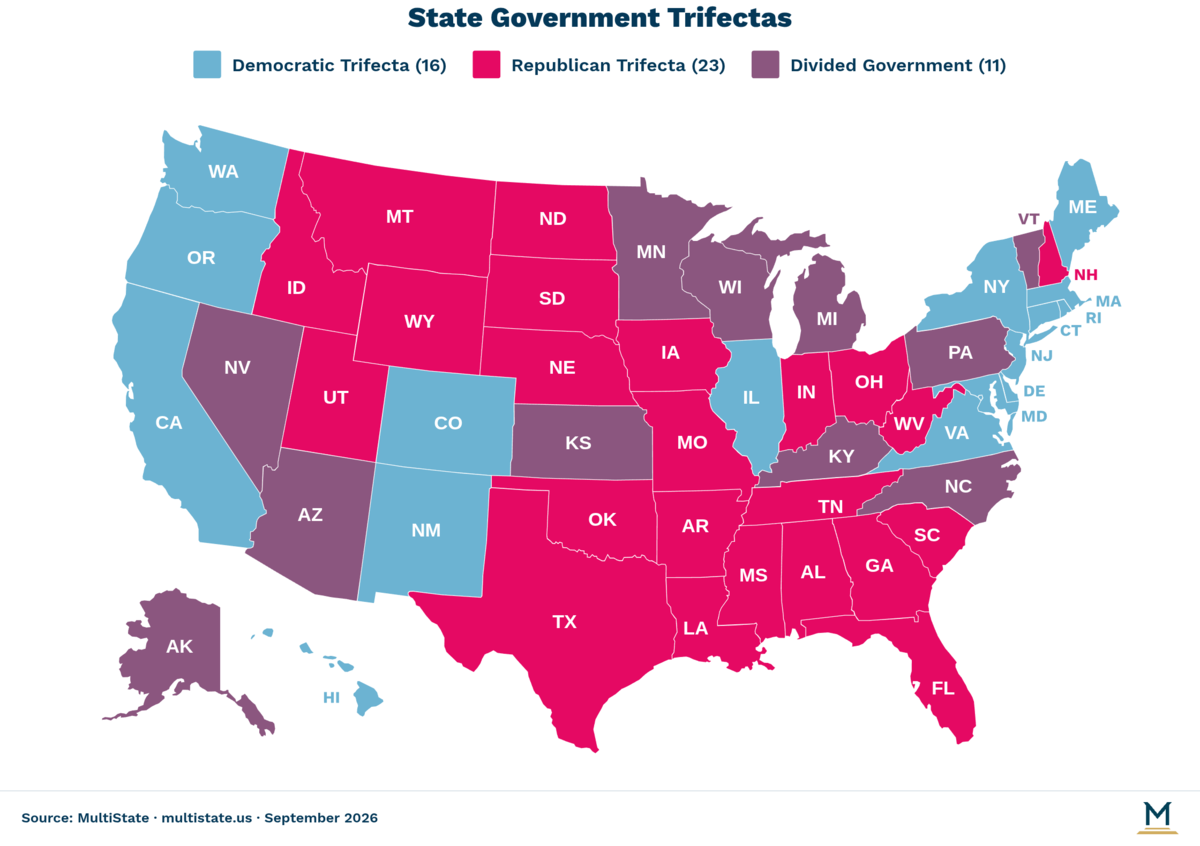
As always, note that this is a hypothetical exercise and not a prediction. Every state’s political environment and candidates are different, and thus an over-performance of one party nationwide is unlikely to hit each state at the same magnitude. Nonetheless, it’s a fun exercise and shows which states are in play next month. Using that definition, nine governor races are in play (Alaska, Arizona, Georgia, Iowa, Kansas, Michigan, Nevada, Ohio, and Wisconsin), along with thirteen legislative chambers in seven states (Arizona, Maine, Michigan, Minnesota, New Hampshire, Pennsylvania, and Wisconsin).
State trifecta
A state trifecta occurs when one political party controls both chambers of the state legislature and the governor’s office. This alignment allows the party to enact its legislative agenda without opposition from the other party at the state level.
Many forecasters and politicos are expecting a Democratic wave election in 2026. If Democrats overperform at the polls and win all the competitive legislative chambers and governor elections, we would see a significant shift in political power in the states as Democrats would gain new trifectas in Arizona, Michigan, Minnesota, Nevada, Pennsylvania, and Wisconsin by flipping five governor seats as well as nine legislative chambers. This would give Democrats 22 trifectas in 2027, which would be the first time they held more trifecta states than Republicans since the 2010 wave election.
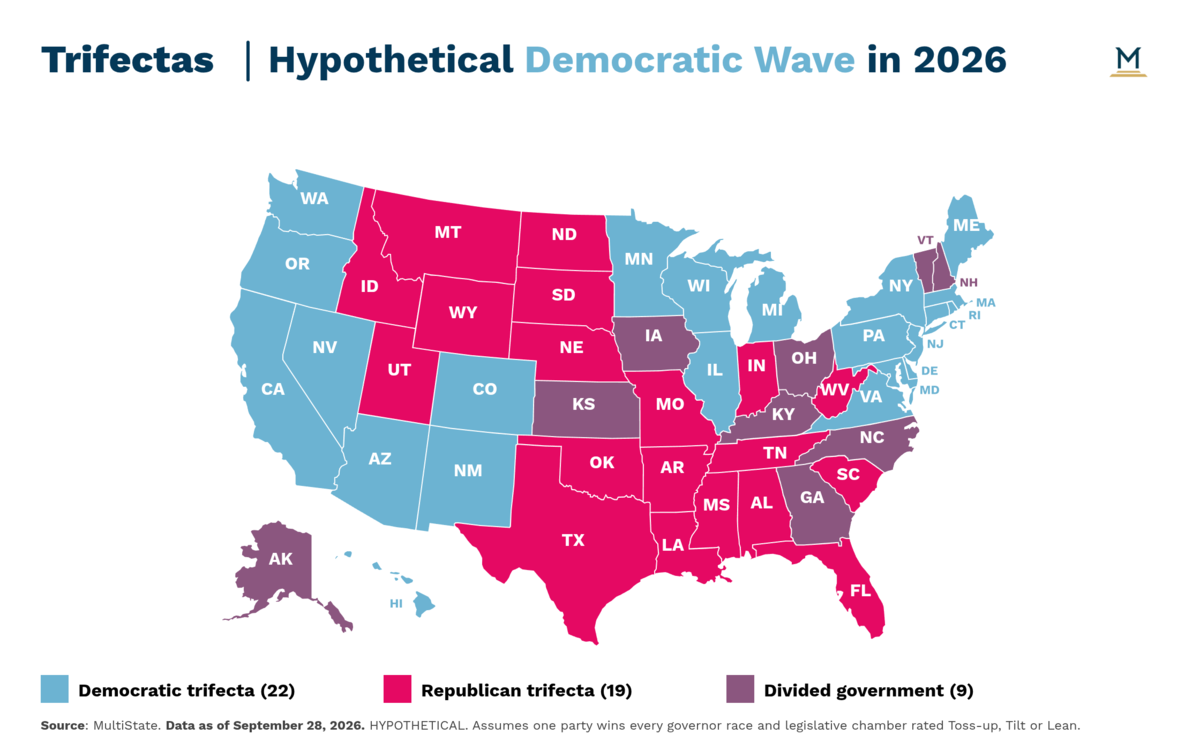
Not every state has the same quality or quantity of polling, so it’s often easy to get caught up in some outlier polls. But recent polls seem to put additional governor races in play for Democrats. So if we want to be super generous to the Democrats’ chances next month, we could even flip the governor seats in Texas, Florida, and New Hampshire. Under this scenario, the first two would break up Republican trifectas and the last one would complete a full trifecta flip from Republican to Democratic. Last week, there was even a poll showing Vermont Gov. Phil Scott (R) — the most popular governor in the country and rated a “Safe R” election — vulnerable to a Democratic challenger (if this were to happen, though unlikely, it would give Democrats yet another trifecta in 2027). If several of those flips took place, this would qualify as a true wave election for Democrats, harking back to 2010 for Republicans.
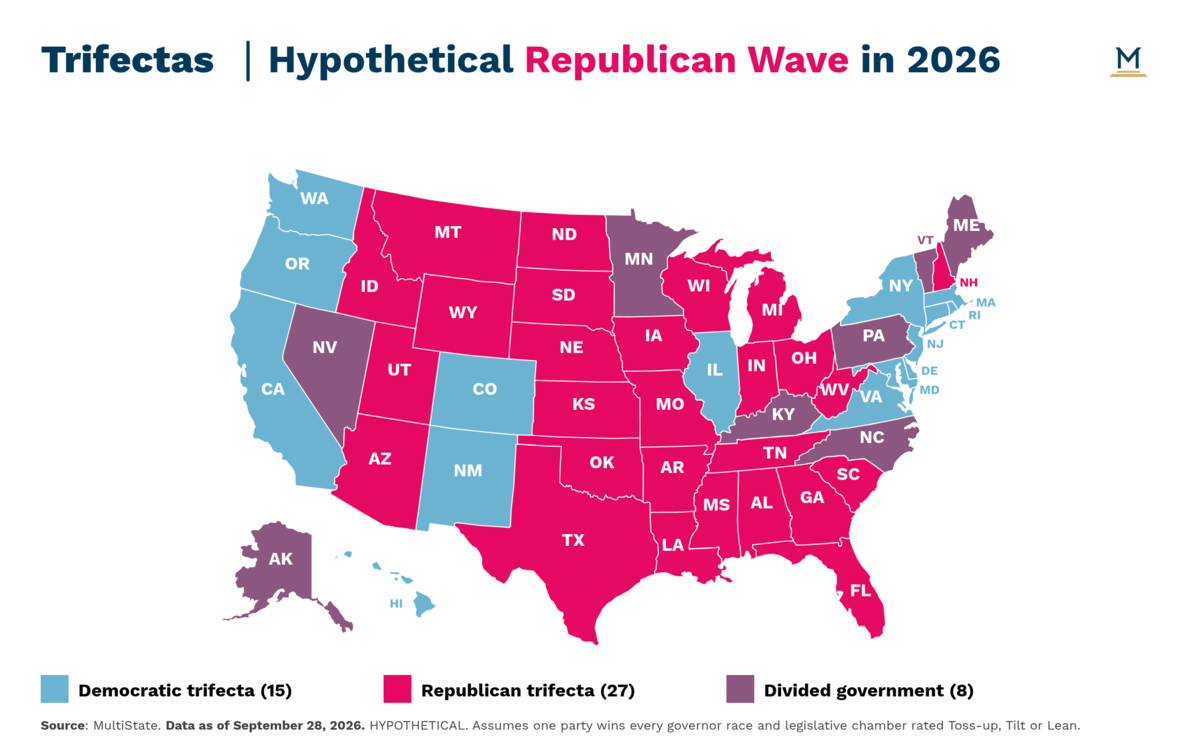
But perhaps the polls are wildly wrong and an influx of last-minute campaign spending boosts Republicans in the states. In a scenario where Republicans win all the competitive chambers and governor elections, we’d see them shoring up their trifecta lead by gaining four new trifectas in Arizona, Kansas, Michigan, and Wisconsin by flipping four governorships and five legislative chambers. Of those, we expect the Kansas trifecta to return to the GOP even in a good year for Democrats. For the full details of this wave analysis, read our “2026 Sweep Scenarios” page.
Either of these extreme scenarios would mean new all-time highs for one-party control states. In the Democratic wave hypothetical, we’d have 41 trifecta states. And in the Republican wave hypothetical, we’d see 42 trifecta states. Most likely, we’ll see something between these two extremes, but we’ll have to wait another five weeks to find out. In the meantime, track the latest polling, forecasts, and seats up for election in the states using MultiState’s elections hub.
Federal and state elections and redistricting can have significant policy and regulatory implications for businesses and organizations. If your organization would like to further track federal and state elections, please contact us.
What is a state trifecta and how many states currently have one-party control?
A state trifecta occurs when one political party controls both chambers of the state legislature and the governor's office. As of 2026, 39 states have trifecta control—23 Republican trifectas and 16 Democratic trifectas—leaving only 11 states with divided government. This represents near-historic highs for one-party control at the state level.
Which governor races are considered most competitive in the 2026 elections?
Nine governor races are rated as competitive in 2026: Alaska, Arizona, Georgia, Iowa, Kansas, Michigan, Nevada, Ohio, and Wisconsin. These races are classified as toss-up, tilt, or lean by major political forecasters including Cook Political Report, Sabato's Crystal Ball, and Pluribus News. The outcomes in these states could significantly shift the balance of trifecta control.
How many state legislative chambers could flip party control in 2026?
Thirteen state legislative chambers across seven states are considered competitive in 2026: chambers in Arizona, Maine, Michigan, Minnesota, New Hampshire, Pennsylvania, and Wisconsin. These chambers are rated as potentially flipping based on Sabato's Crystal Ball legislative forecasts. Control of these chambers will determine whether several states gain or lose trifecta status.
What would a Democratic wave election mean for state trifecta control in 2027?
If Democrats win all competitive races, they would gain six new trifectas in Arizona, Michigan, Minnesota, Nevada, Pennsylvania, and Wisconsin, bringing their total to 22 trifecta states. This would require flipping five governor seats and nine legislative chambers. It would mark the first time since 2010 that Democrats controlled more trifecta states than Republicans.
Could Republicans increase their trifecta advantage in the 2026 state elections?
If Republicans win all competitive races, they would gain four new trifectas in Arizona, Kansas, Michigan, and Wisconsin by flipping four governorships and five legislative chambers. This scenario would give Republicans 27 total trifectas and result in 42 states under one-party control, a new all-time high. Kansas is expected to return to Republican trifecta control even in a favorable Democratic environment.
August 25, 2026 | Jose Perez
August 11, 2026 | Katherine Tschopp
July 17, 2026 | Andrew Jones