Key Takeaways:
- Thirteen states and Washington, DC have expressly approved cryptocurrency campaign donations, while five states prohibit them, leaving 34 states without clear policies on whether political campaigns can accept Bitcoin or other digital currencies.
- Michigan recently finalized a rule banning political committees from accepting cryptocurrency donations, while Arizona published guidance allowing PACs to accept in-kind contributions in the form of cryptocurrency such as Bitcoin, Ethereum, or Litecoin.
- States that permit cryptocurrency donations typically require immediate conversion to U.S. dollars, with most treating them as in-kind contributions that must be reported at fair market value at the time of receipt.
- Kansas has repeatedly considered legislation on cryptocurrency campaign finance, including bills that would have prohibited crypto contributions and others that would have established a regulatory framework, but none have passed.
- The Federal Election Commission authorized cryptocurrency use in campaign finance in 2014, and states like California, Massachusetts, Montana, New York, and Texas have since adopted policies permitting cryptocurrency contributions with various restrictions and reporting requirements.
More states have begun regulating cryptocurrency use in campaign finance. For the uninitiated, cryptocurrencies like Bitcoin and Ethereum are virtual currencies that use blockchain technology—a type of distributed ledger—to record and verify transactions. Cryptocurrencies are not legal tender under federal law, but they can be exchanged for or converted into traditional currencies such as the U.S. dollar.
Most recently, the Michigan Department of State issued a rule prohibiting political committees from accepting cryptocurrency donations. This rule follows a 2018 advisory opinion that banned cryptocurrency campaign contributions. Additionally, the Arizona Department of State published campaign finance guidance this year allowing political action committees (PACs) to accept in-kind contributions "in the form of cryptocurrency such as Bitcoin, Ethereum, or Litecoin."
Current State Laws on Cryptocurrency in Campaign Finance
Because of the fragmented nature of American elections and campaign finance regulations, the U.S. currently has a patchwork of state laws governing the use of cryptocurrencies and payment apps in campaign finance. The Federal Election Commission (FEC) led the way in authorizing the use of cryptocurrencies in 2014, and more states have followed suit.
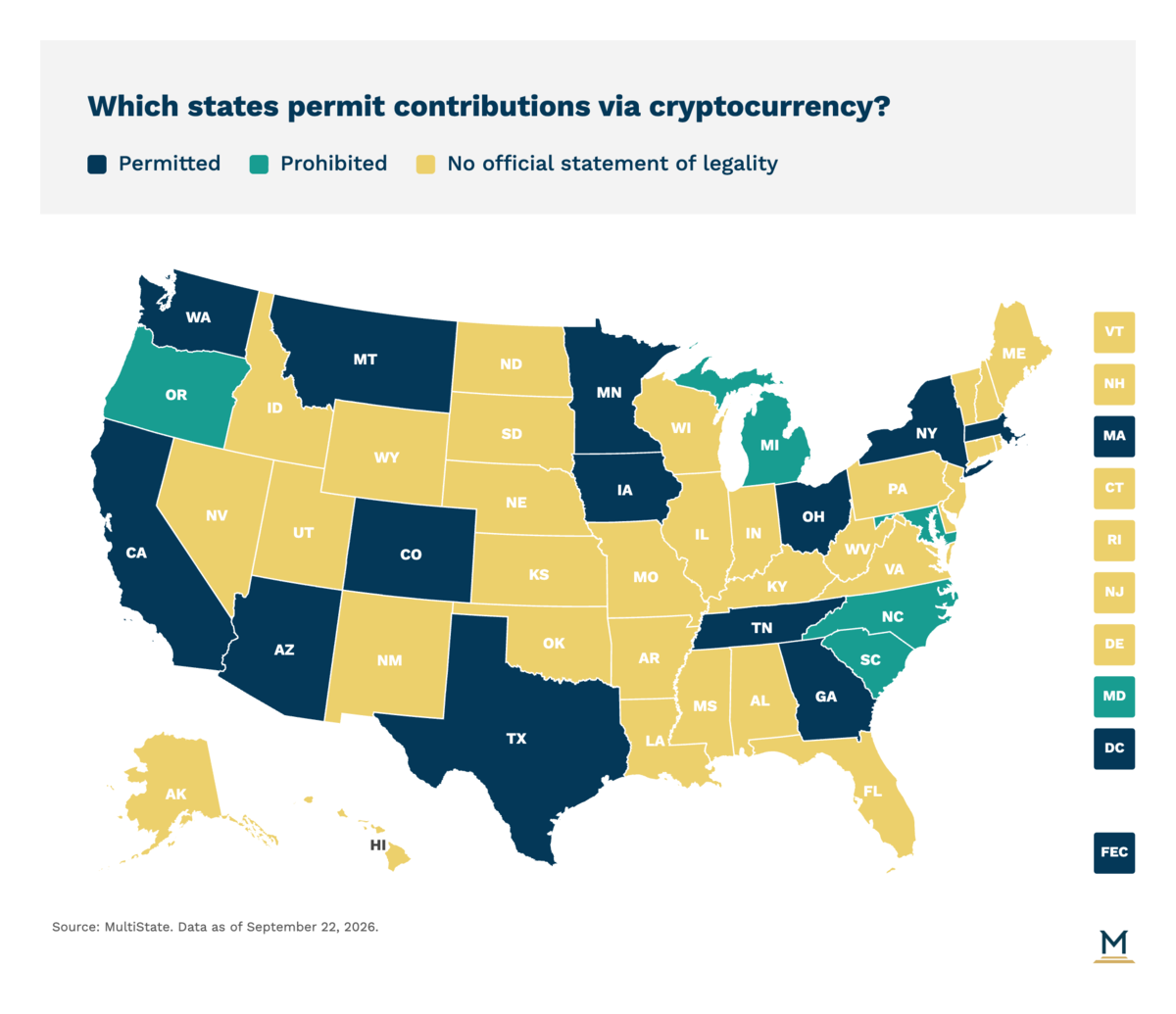
Currently, here is where states stand on accepting cryptocurrency donations for political campaigns:
- 13 states and D.C. have expressly approved cryptocurrency use for campaign donations. In some states, campaign finance laws do not expressly address cryptocurrency contributions, leaving their legality less certain. In Georgia, for example, former State Ethics Commission Executive Director David Emadi said cryptocurrency contributions are legal, but Georgia has not enacted a policy explicitly authorizing or banning cryptocurrency contributions.
- Five states prohibit cryptocurrency use in campaign finance.
- The remaining 34 states have not enacted legislation or regulations to permit cryptocurrency use, leaving its legality in state and local elections questionable.
Defining Key Terms
Cryptocurrency
Cryptocurrency is a digital or virtual currency that uses cryptography for security and operates on decentralized networks based on blockchain technology. Unlike traditional currencies, cryptocurrencies are not issued by a central authority and can be exchanged or converted into government-issued money such as the U.S. dollar. Popular examples include Bitcoin and Ethereum.
Recent Changes in State Policies
This map has changed since MultiState last reviewed state policies on cryptocurrency use in elections. California, the District of Columbia, Massachusetts, Montana, New York and Texas have all adopted policies to permit the acceptance of cryptocurrencies by candidates and political action committees. Conversely, Maryland and South Carolina have gone in the opposite direction and adopted policies prohibiting cryptocurrency contributions.
States Considering Action on Cryptocurrency Campaign Donations
While most states have not explicitly permitted or banned cryptocurrency donations, a few have repeatedly considered the issue. For example, the Kansas Governmental Ethics Commission concluded in 2022 that state law did not address cryptocurrency donations and urged lawmakers to permit cryptocurrency donations with contribution limits and other restrictions. The Kansas legislature subsequently introduced bills that would have prohibited cryptocurrency campaign contributions (HB 2535) and established a framework for accepting crypto (SB 310), but both bills failed. In Illinois, cryptocurrency contributions are currently a legal gray area. While candidates have previously accepted cryptocurrency from donors, neither the State Board of Elections nor the General Assembly has provided formal guidance on the practice.
In Wisconsin, the state ethics commission held a public hearing in 2018 on guidance for cryptocurrency use in political campaigns, but referred the matter to the legislature. As of September 2026, the legislature has not developed a regulatory or legislative framework for cryptocurrencies other than amending the Revised Uniform Unclaimed Property Act to address the disposition of virtual currencies. Louisiana considered cryptocurrency donations by adopting House Resolution 180, which directed the Supervisory Committee on Campaign Finance Disclosure to "study issues surrounding acceptance of campaign contributions in cryptocurrency."
The Oklahoma Ethics Commission also reviewed crypto use in campaign finance by accepting an advisory opinion request on whether campaign committees could accept virtual currency, digital currency, or cryptocurrency contributions. The request, received in August 2019, remains listed as an Advisory Opinion Request on the current Ethics Commission page rather than an advisory opinion. Lastly, Wyoming's Select Committee on Blockchain, Financial Technology and Digital Innovation considered in June 2022 whether state politicians could accept cryptocurrency campaign contributions. The discussion contemplated a possible framework, including valuing cryptocurrency at the time of contribution, but made no formal recommendation.
State-by-State Status of Cryptocurrency Donations
Below is a table denoting the states that have permitted or banned cryptocurrency donations. Reviewing state legislation, regulations, and advisory opinions through September 2026, it is evident that many states are focusing on adopting frameworks to accommodate cryptocurrencies (e.g., taxation, permitting agencies to accept cryptocurrency as payment). As these states establish frameworks and more donors contribute cryptocurrency to candidates, we expect states will continue regulating how political campaigns interact with this novel type of donation.
State |
Status |
Arizona |
In February 2026, the Department of State published campaign finance guidance for PACs, stating that PACs may accept in-kind contributions “in the form of cryptocurrency such as Bitcoin, Ethereum, or Litecoin.” The guide added that cryptocurrency contributions are “generally subject to the same rules” as cash contributions and called cryptocurrency contributions a form of “electronic transfer” under A.R.S. § 16-907. |
California |
In 2022, the Fair Political Practices Commission (FPPC) adopted Regulation 18421.2, reversing a former ban on making and receiving cryptocurrency campaign contributions. Regulation 18421.2 allows individuals to make cryptocurrency contributions and committees to request such contributions “if the cryptocurrency is converted to dollars upon the making of the contribution.” Cryptocurrency contributions must be made and received through a qualifying U.S.-based cryptocurrency payment processor, subject to contributor verification and information gathering requirements. In 2024, FPPC amended the rule to require reporting cryptocurrency contributions as monetary contributions, rather than as in-kind contributions. |
Colorado |
In August 2018, the Secretary of State finalized a rule permitting the acceptance of cryptocurrency for campaign finance purposes. The rule allows various forms of committees (e.g., candidate committees, political committees, political parties, etc.) to accept cryptocurrency contributions up to the “acceptable limit for a cash or coin contribution.” Aligned with the FEC ruling Advisory Opinion 2014-02, this rule states that the amount of a contribution that must be reported is the value of the cryptocurrency at the time of the contribution. Committees must report any gains or losses after the contribution (i.e., during cash conversion) as other income or receipts. |
Georgia |
After multiple candidates for state office accepted cryptocurrency donations in 2022, former Executive Director of the State Ethics Commission David Emadi stated that cryptocurrency contributions are legal, provided that committees immediately convert the donations into hard currency to avoid exceeding contribution limits.
While this statement constitutes informal guidance, Georgia currently has no statute or formal advisory opinion that explicitly authorizes or bans cryptocurrency contributions. Under its current campaign finance law, the term “contribution” is broadly defined and includes “anything of value conveyed or transferred for the purpose of influencing the nomination for election or election of any person for office.”
|
Iowa |
In February 2022, the Iowa Ethics and Campaign Disclosure Board (IECDB) issued Advisory Opinion 2022-01, which concluded that committees may accept cryptocurrency donations as in-kind contributions. Cryptocurrency contributions must be reported on Schedule E (in accordance with the statute, Iowa Admin. Code r. 351-4.17) and include the name and address of the contributor, as well as “the fair market value of the contribution as of the date of the contribution.”
AO 2022-01 also states that committees are not required to report changes in the value of an in-kind contribution. The opinion adds, however, that when a committee liquidates a cryptocurrency, the treasurer must “deposit the proceeds in the committee’s bank account within seven days” and report the proceeds as a contribution.
|
Maryland |
In April 2023, Maryland enacted legislation banning individuals and campaign finance entities from making or accepting monetary contributions made using cryptocurrency. |
Massachusetts |
In January 2014, the Office of Campaign and Political Finance issued an advisory opinion clarifying that political committees may accept contributions in Bitcoins, subject to limits and source restrictions applicable to all contributions. Committees must liquidate Bitcoins within five days, report monetary contributions as the gross amount received, and not use Bitcoins to make expenditures. |
Michigan |
In November 2018, the Michigan Department of State issued an advisory opinion prohibiting the use of cryptocurrency for campaign contributions. Michigan also finalized a rule in June 2026 that explicitly prohibited political committees from accepting cryptocurrency donations. |
Minnesota |
In 2023, Minnesota enacted Chapter 62 (House File 1830), which allows principal campaign committees, political committees, political funds, and party units to accept in-kind virtual currency contributions. The statute requires the use of U.S.-based virtual currency payment processors for virtual currency contributions, contributor-verification procedures, and the conversion of virtual currency to U.S. currency within five business days. |
Montana |
In a 2014 advisory opinion, Commissioner of Political Practices Jonathan Motl determined that campaigns may accept Bitcoin contributions because Montana law defines a contribution to include “anything of value.” Motl added that Bitcoin must be valued and converted to U.S. dollars or used for an in-kind purchase upon receipt, and campaigns may not maintain Bitcoin wallets to accumulate campaign resources.
More recently, Montana amended the Electronic Contributions Act in 2019 to require reporting contributions through a “payment gateway” such as Bitcoin.
|
New York |
In March 2026, the New York State Board of Elections approved Formal Opinion 26-01, which allows political committees to accept cryptocurrency contributions as in-kind contributions, provided that they are not anonymous. Any committees receiving bitcoin contributions must report the value of the contribution “based on the market value of bitcoin at the time the contribution is received.” |
North Carolina |
In July 2018, the State Board of Elections & Ethics Enforcement released an advisory opinion prohibiting the use of cryptocurrencies in campaign finance. |
Ohio |
In September 2025, the Secretary of State released guidance permitting cryptocurrency donations, subject to an individual contribution limit of $13,704.41 per election period (in accordance with the statute, ORC Section 3517.102). Committees receiving cryptocurrency must identify the donor, report the value of the asset “at the time of receipt as an in-kind contribution,” and “report the total sale price of the cryptocurrency asset when the committee converts the cryptocurrency to cash.” |
Oregon |
In May 2019, Governor Kate Brown (D) signed HB 2488, which prohibits cryptocurrency contributions to political candidates, political committees, or petition committees. |
South Carolina |
In April 2018, the House Legislative Ethics Committee issued an advisory opinion concluding that “no Bitcoin may be accepted as a campaign contribution” because state law did not include virtual or digital currency in its definition of “contribution.” In January 2021, the State Ethics Commission issued an advisory opinion declaring that candidates for public office may not accept cryptocurrency contributions. |
Tennessee |
In April 2015, Tennessee amended its campaign finance law to allow campaigns to accept “digital currency” as a form of contribution. These contributions are considered monetary contributions and their value is defined as “the market value of the digital currency at the time the contribution is received.” |
Texas |
In June 2023, the Texas Ethics Commission adopted the rule §22.37 - Virtual Currency Contributions, which permits candidates, officeholders, and political committees to accept cryptocurrency contributions. Under the final rule, cryptocurrency contributions are considered in-kind contributions, aligning with how the FEC classifies these donations. Additionally, the rule requires candidates, officeholders, and political committees to report a gain from the sale of the cryptocurrency if the gain exceeds $140. Lastly, the rule states that the reportable value of a virtual currency contribution is “the fair market value of the cryptocurrency upon receipt.” |
Washington |
In October 2018, the Public Disclosure Commission released guidance allowing political campaigns to accept cryptocurrency contributions. Under the guidance, cryptocurrency donations are limited to $100, and must be converted to legal tender and deposited in a campaign bank account within five business days of receipt. |
Washington, DC |
Campaign finance law in Washington, DC (3 DCMR § 3008.9) permits Bitcoin contributions, requiring them to be reported as in-kind contributions and marked as received on the date the contribution is liquidated into U.S. dollars. |
Federal |
The FEC has permitted cryptocurrency contributions to political committees since 2014. |
Need Compliance Help? Get In Touch!
Keeping up with rules, deadlines, and often confusing requirements is a daunting prospect for teams of all sizes. Let us manage your federal, state, and local registration and reporting responsibilities, or manage your Campaign Finance program. Read more about our Compliance Services here, or get in touch here.
Frequently Asked Questions
Which states currently ban cryptocurrency campaign donations?
Five states prohibit cryptocurrency use in campaign finance: Maryland, Michigan, North Carolina, Oregon, and South Carolina. Maryland passed legislation in April 2023 banning cryptocurrency contributions, while Michigan finalized a rule in June 2026 explicitly prohibiting political committees from accepting such donations. Oregon passed HB 2488 in May 2019, and both North Carolina and South Carolina issued advisory opinions in 2018 and 2021 respectively declaring cryptocurrency contributions impermissible under their campaign finance laws.
Can political campaigns in California accept Bitcoin donations?
Yes, California allows cryptocurrency campaign contributions through Regulation 18421.2, which the Fair Political Practices Commission adopted in 2022. The cryptocurrency must be converted to dollars upon receipt through a qualifying U.S.-based cryptocurrency payment processor, and committees must comply with contributor verification and information gathering requirements. As of 2024, cryptocurrency contributions must be reported as monetary contributions rather than in-kind contributions.
What happened to Kansas bills on cryptocurrency campaign contributions?
Kansas introduced two bills addressing cryptocurrency campaign contributions, but both failed to pass. HB 2535 would have prohibited cryptocurrency campaign contributions, while SB 310 would have established a framework for accepting crypto with contribution limits and restrictions. The Kansas Governmental Ethics Commission concluded in 2022 that state law did not address cryptocurrency donations and urged lawmakers to permit them with appropriate restrictions.
How do states that allow cryptocurrency donations determine the value for reporting purposes?
Most states require cryptocurrency contributions to be valued at their fair market value at the time of receipt. Colorado, Iowa, Montana, New York, Ohio, and Texas all specify that the reportable value is based on the market value when the contribution is received. Several states, including California, Minnesota, and Washington, require immediate conversion to U.S. dollars within a specified timeframe (typically five business days) to establish a clear value for reporting purposes.
What is Minnesota Chapter 62 and how does it regulate cryptocurrency campaign contributions?
Minnesota Chapter 62 (House File 1830) is legislation that Minnesota passed in 2023 allowing principal campaign committees, political committees, political funds, and party units to accept in-kind virtual currency contributions. The statute requires the use of U.S.-based virtual currency payment processors, mandates contributor-verification procedures, and requires conversion of virtual currency to U.S. currency within five business days of receipt.