-3c458f-400px.jpeg)
Tax & Budgets
What You Need to Know About State Fiscal Outlook This Fall
September 24, 2026 | Andrew Jones

Key Takeaways:
Democrats made large gains in the states last Tuesday. They broke Republican trifectas in Georgia, Iowa, New Hampshire, Ohio, and Texas, and added their own in Arizona, Michigan, Minnesota, Nevada, Pennsylvania, and Wisconsin. They also flipped about a dozen legislative chambers and picked up hundreds of legislative seats. These election results will have implications for state tax policy going forward. First and most obviously, voters in several states decided on several tax ballot measures themselves last Tuesday. Less visibly, the people who write tax law will change, because retirements and election losses mean new members on fiscal committees across most states.
Voters decided several tax policy ballot measures. Florida's Amendment 3, which will raise the state's homestead exemption for non-school property taxes to $250,000 by 2028, was approved with more than the 60% it needed to pass. At the same time, other property tax measures in Oklahoma and Wyoming failed. Outgoing Gov. Ron DeSantis (R) plans to call a special session later this year to implement the measure. California voters approved Proposition 3, which permanently extends the state's personal income tax rates, but Proposition 40, which would have levied a wealth tax on billionaires, failed. In Colorado, Amendment 87, which will move the state from a flat 4.4% income tax to a graduated system with a top rate of 8.4% for both individuals and corporations, has passed, although the margin was narrow. Prop 136[link], which would have capped the current income tax rate, failed, so we will not be set up for a dynamic where both conflicting measures pass. North Carolina voters voted to cap their income tax at 3.5%, and they also approved an amendment to require the General Assembly to pass laws to limit property tax increases. Finally, Washington voters have rejected an attempt to repeal the state's millionaire's tax.
Graduated Income Tax
A graduated income tax is a tax system in which the tax rate increases as an individual's or corporation's income rises. Unlike a flat tax, where everyone pays the same rate, a graduated system imposes higher rates on higher income brackets, aiming to make the tax burden more progressive.
There will be a lot of new faces next year, due to both retirements and election losses. In several states, the fiscal committees will see high turnover in 2027, meaning we'll see new lawmakers helping decide state tax policy across 45 of the 50 states. The map below shows how many tax and fiscal committee members are leaving in each state. Minnesota, New Hampshire, and Oklahoma will lose 13 or more. Nine other states, including Florida, Georgia, and Michigan, will lose between 9 and 12. Most of the rest will lose fewer: 5 to 8 in places like Colorado, Ohio, and Pennsylvania, and 1 to 4 in California, Nevada, and Texas. Starred states lost at least one chair, vice chair, or ranking member. (Note that Louisiana, Mississippi, New Jersey, and Virginia held no elections in 2026, and Oregon has no projected turnover.)
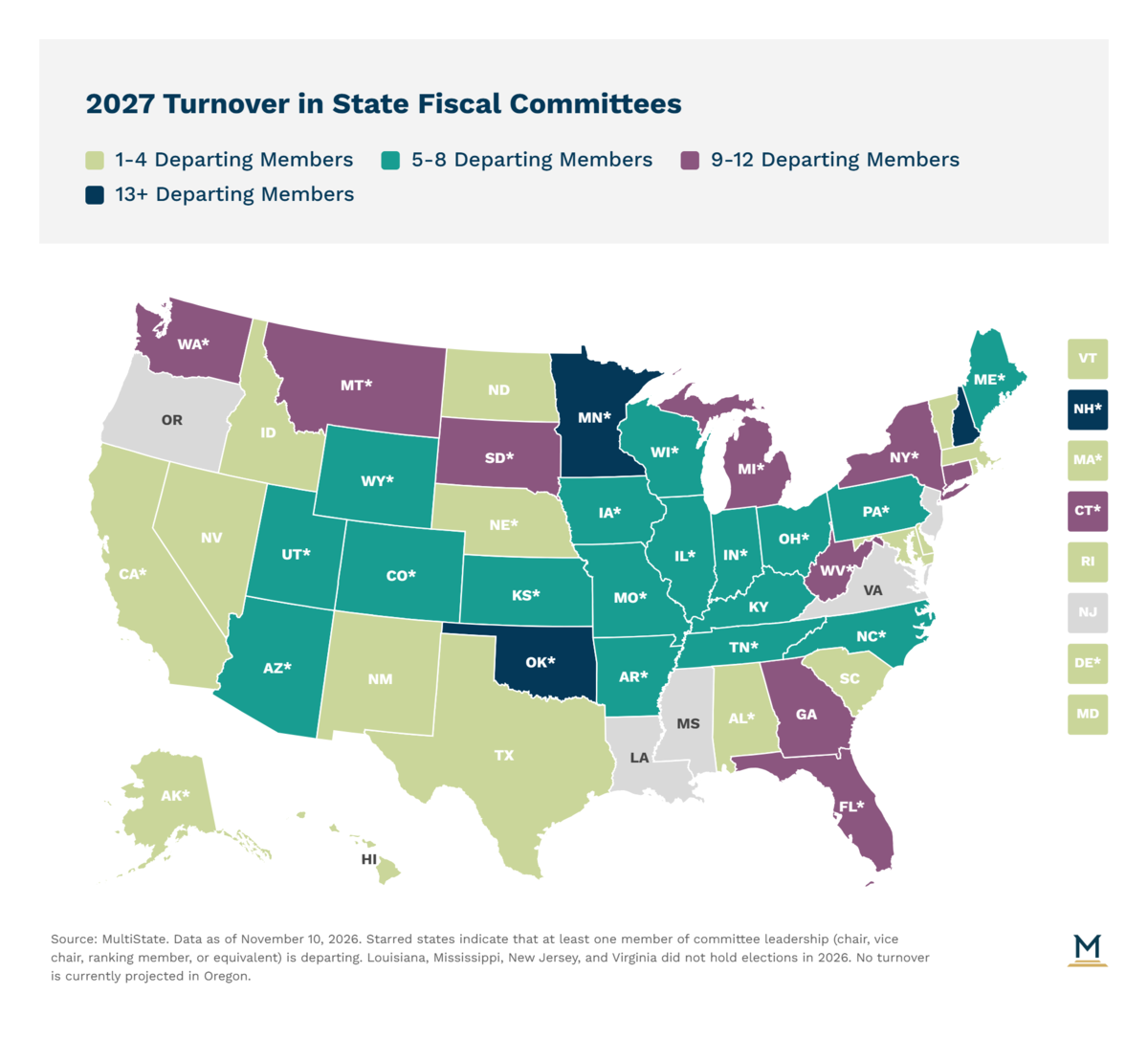
Some of these departures come from the top of the committee. The Colorado House Finance Committee lost both Chair Steven Woodrow (D) and Vice Chair Brianna Titone (D), as well as two other members, in the same election that approved a graduated income tax. In Florida, eleven fiscal committee members lost or retired, including House Ways & Means Chairman Wyman Duggan (R) and Ranking Member Anna Eskamani (D). Utah will lose leaders in both chambers, as both House Chair Steve Eliason (R) and Senate Chair Dan McCay (R) will not be returning in 2027. In South Dakota, the House Taxation Committee will no longer have its chair, vice chair, and eight other members.
However, it's important to note that not all of the turnover came in November. Six Revenue Committee members in Wyoming lost their primaries in August, including House Revenue Chairman Tony Locke (R).
You can find race-by-race results on our elections page, and we will continue to update our coverage on our elections website as more information comes in.
Tax policy can be one of the most challenging areas for government affairs executives. MultiState's team understands the issues, knows the key players, and helps you effectively navigate and engage. We offer a customized, strategic solution to help you develop and execute a proactive multistate tax legislative agenda. Learn more about our Tax Policy Practice.
Which state tax ballot measures passed in the 2026 elections?
Florida's Amendment 3 (raising the homestead exemption for non-school property taxes to $250,000 by 2028), California's Proposition 3 (permanently extending the state's personal income tax rates), Colorado's Amendment 87 (moving the state to a graduated income tax with a top rate of 8.4%), and North Carolina's income tax cap at 3.5% all passed. Washington voters rejected a repeal of the state's millionaire's tax, while California's Proposition 40 (a billionaire wealth tax), property tax measures in Oklahoma and Wyoming, and Colorado's Prop 136 (which would have capped the income tax rate) failed.
What does Colorado's Amendment 87 change about the state's income tax structure?
Colorado's Amendment 87 moves the state from a flat 4.4% income tax rate to a graduated system with a top rate of 8.4% for both individuals and corporations. The measure passed, though the margin was narrow.
What does Florida's Amendment 3 do, and what happens next to implement it?
Florida's Amendment 3 raises the state's homestead exemption for non-school property taxes to $250,000 by 2028, and it was approved with more than the 60% threshold required to pass. Outgoing Gov. Ron DeSantis plans to call a special session later this year to implement the measure.
How much turnover is expected on state fiscal committees heading into 2027?
New lawmakers will be helping decide state tax policy across 45 of the 50 states. Minnesota, New Hampshire, and Oklahoma will lose 13 or more fiscal committee members, nine other states including Florida, Georgia, and Michigan will lose between 9 and 12, and most remaining states will lose fewer.
Which state fiscal committee chairs or leaders are not returning after the 2026 elections?
Several committee leaders are departing. Florida's House Ways & Means Chairman Wyman Duggan (R) and Ranking Member Anna Eskamani (D) lost or retired, Utah will lose both House Chair Steve Eliason (R) and Senate Chair Dan McCay (R), and Colorado's House Finance Committee lost both Chair Steven Woodrow (D) and Vice Chair Brianna Titone (D). South Dakota's House Taxation Committee will also lose its chair and vice chair, and Wyoming's House Revenue Chairman Tony Locke (R) lost his primary in August..
September 24, 2026 | Andrew Jones

August 25, 2026 | Jose Perez

July 30, 2026 | Andrew Jones