Elections & Campaigns
State Trifecta Control Could Shift Dramatically in 2026 Elections
September 29, 2026 | Bill Kramer
May 21, 2026 | Bill Kramer
Key Takeaways:
Missouri Secretary of State Denny Hoskins (R) appears to have successfully run out the clock on a citizen referendum that could have blocked the state's new 7-1 Republican congressional map. More than five months after referendum supporters submitted over 305,000 signatures, Secretary Hoskins has yet to determine whether the measure qualifies for the November ballot. By the time he does, it will almost certainly be too late.
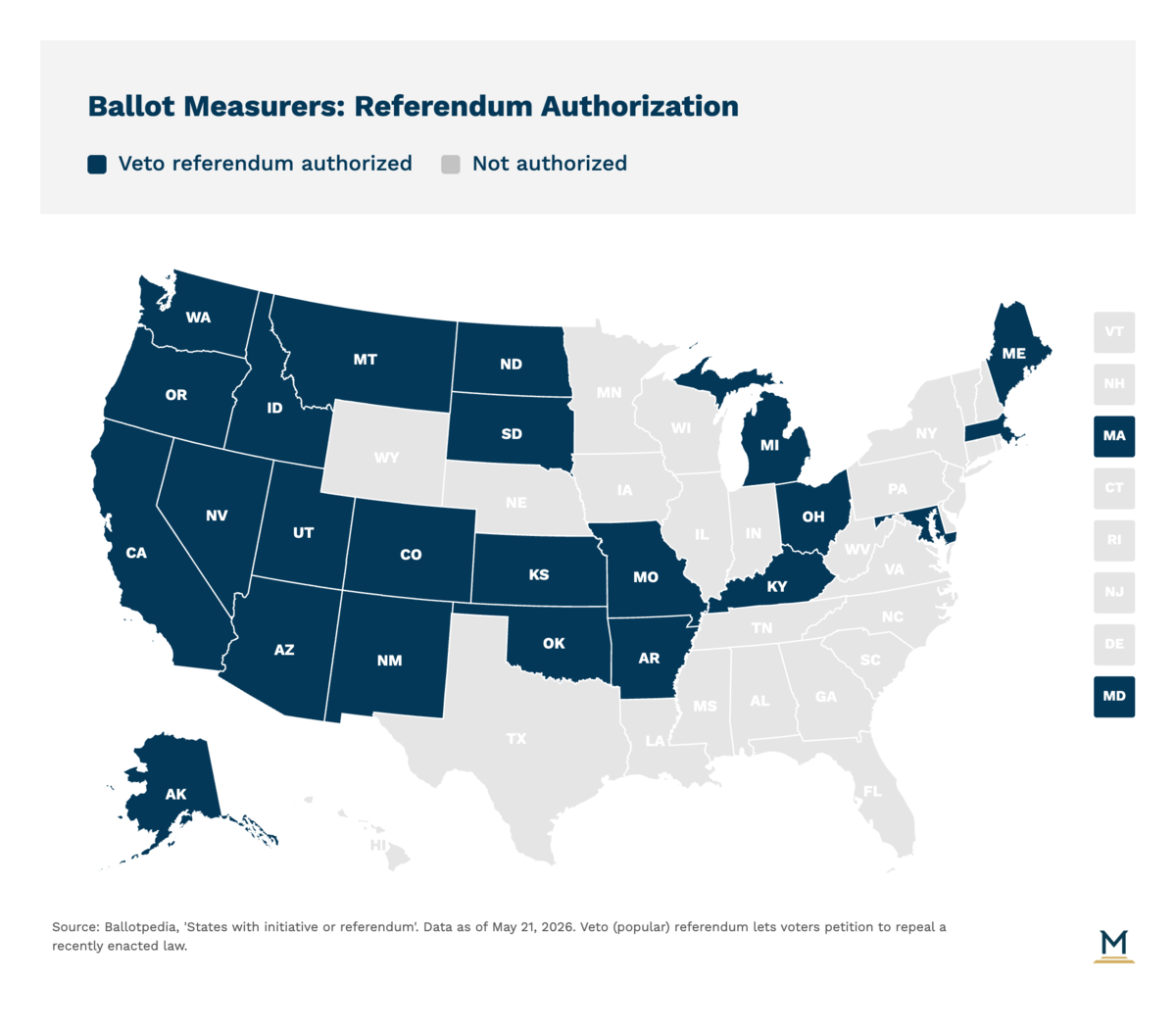
The episode is the latest chapter in the ongoing battle between state policymakers and the voters in the 23 states that allow veto referendums, a direct democracy tool that lets citizens collect signatures to place a recently enacted law on the ballot and ask voters whether to keep it. Referendums are rarer than the better-known citizen initiative — usually only a handful of referendums qualify for the ballot across all states in a given election cycle — but they remain a meaningful check on the legislature, and increasingly a bargaining chip. In 2024, opponents of a California minimum wage hike for fast food workers withdrew a referendum against the law only after lawmakers agreed to scale back its requirements.
This year, a referendum has played a central role in the mid-decade congressional redistricting fight playing out across the states. Missouri's situation is complex and was overshadowed by the rush to redraw congressional lines following last month's U.S. Supreme Court decision in Callais, which narrowed Voting Rights Act protections for minority districts. But it is an important chapter in what is becoming a recognizable anti-ballot measure playbook.
In a special session last year, Missouri lawmakers passed a new congressional map that shifts the current 6-2 Republican advantage in congressional representation to a 7-1 advantage. The legislature sent Gov. Mike Kehoe (R) the legislation (MO HB 1) on Sep. 12 but he waited until Sep. 28 to sign the new maps into law.
Meanwhile, opponents of the new maps filed text for a veto referendum to ask the voters to repeal HB 1 on Sep. 29. Missouri Secretary of State Denny Hoskins (R) approved the referendum for signature circulation on Oct. 15, but on the same day as his approval the Secretary, joined by the legislature and AG, filed a lawsuit against the referendum petitioners, arguing that the referendum was unconstitutional. The referendum campaign responded to the lawsuit with a statement: “Missouri politicians continue to try to confuse, intimidate and, frankly, silence us.” A district judge dismissed the lawsuit on Dec. 8, 2025.
While opponents collected signatures, Secretary Hoskins drafted his own ballot title for the proposed referendum. The title painted the legislation targeted by the referendum, which drew the new maps, in a positive light, claiming that the new maps under HB 1 repealed “Missouri’s existing gerrymandered congressional plan that protects incumbent politicians, and replaces it with new congressional boundaries that keep more cities and counties intact, are more compact, and better reflects statewide voting patterns.” Opponents sued, arguing that Secretary Hoskins’ ballot title was "inaccurate, insufficient, biased, and unfair political description and campaign for House Bill 1." Both a district court and an appeals court agreed with the opponents and ruled that the Secretary's chosen title was “insufficient and unfair” and the courts drafted a new, impartial title for the referendum.
On Dec. 9, 2025 — two days before HB 1 was set to go into effect — the referendum campaign submitted more than 305,000 signatures in support of placing the referendum on the ballot. This far exceeded the minimum 106,384 required (although the final number depends on which congressional districts the signatures were collected from). Historically, once an overwhelming number of signatures from a reputable campaign has been submitted, the Secretary of State would suspend the challenged law until voters were able to decide the matter. In this case, this would mean that the previous 6-2 congressional maps drawn in 2022 would remain in place.
Instead, Secretary Hoskins decided to assume the signatures were insufficient and to require a full signature verification process. Secretary Hoskins put out a statement promising a “slow and steady” review of the signatures and told the press that “I’m going to do everything I can to protect Gov. Kehoe’s Missouri First Map — the map the General Assembly passed.”
The signature verification process has certainly been slow. Over five months after the referendum campaign submitted the signatures to the Secretary’s office, we still have no determination whether the campaign submitted enough valid signatures to place the referendum on the ballot. Technically, the Secretary has until Aug. 4 (the thirteenth Tuesday prior to the election) to declare whether the referendum is “sufficient” or “insufficient” and therefore would appear on the Nov. 3 ballot or not for the voters to decide the fate of the congressional maps. It appears that he’ll use every last minute of this timeline.
Last week, in a development overshadowed by the Virginia Supreme Court's rejection of that state's congressional map ballot measure, the Missouri Supreme Court ruled against the referendum campaign, holding that the mere submission of signatures does not automatically suspend HB 1. The court distinguished prior secretaries of state who had suspended challenged laws upon delivery of signatures: in those cases, the court reasoned, the secretary had assumed the petitions were "legal, sufficient, and timely." Secretary Hoskins has done the opposite, assuming they are not and proceeding with a full signature review as allowed under state law.
The result is a sort of Schrödinger's cat situation. The court acknowledged that if Hoskins ultimately certifies the petition as sufficient, HB 1 will be deemed “referred to the people” as of Dec. 9 — meaning it never took effect. If he certifies it as insufficient, HB 1 became law on December 11 as scheduled. Until he decides, neither outcome is true and both are. The court has until the statutory deadline for the secretary's certification on Aug. 4 to open the box and find out whether the cat is alive or dead. (The Nebraska Supreme Court reached the opposite conclusion in a 2019 case, holding that an act is suspended upon the filing of signatures so long as the petition is later verified, but Missouri's court declined to follow that approach.)
But despite the justices’ uncertainty of whether HB 1 is or is not suspended, which is causing confusion for local election officials, political reality has decided that the new maps are in fact in effect. And since the Missouri primary elections are scheduled to take place on Aug. 4, assuming Secretary Hoskins waits until that day to determine whether the referendum has sufficient signatures to be placed on the November ballot, it would be too late to change the maps back to 2022 maps even if theoretically HB 1 should have been suspended back in December. So, regardless of any additional lawsuits or signature verification shenanigans, Secretary Hoskins succeeded in running out the clock and ensured the legislature’s preferred maps are used, despite what voters may think.
These strategies by legislatures and statewide officials against initiatives and referendums brought by the voters are not new, but when the policy being debated is the district maps themselves, it raises both the consequences and the timing issues that can negate the intentions of the Progressive Era’s direct democracy measures.
Federal and state elections and redistricting can have significant policy and regulatory implications for businesses and organizations. If your organization would like to further track federal and state elections, please contact us.
September 29, 2026 | Bill Kramer

August 25, 2026 | Jose Perez
August 11, 2026 | Katherine Tschopp