
Elections & Campaigns, Tax & Budgets
Why Chicago's Budget Crisis Matters for the City's Mayoral Race
August 25, 2026 | Jose Perez
June 24, 2026 | Andrew Jones
Key Takeaways:
A state's fiscal health is a major determinant of whether it will make policy changes, such as increased or decreased spending and tax cuts or hikes. For state government affairs professionals, monitoring the states' fiscal position is crucial to anticipating and responding to policy shifts. Several times a year, our tax policy team conducts a survey of each state's short-term fiscal outlook to provide the insights needed to stay ahead.
This summer, we rate a slim majority of 26 states with a generally positive fiscal outlook. These states are expected to maintain stable budgets and are less likely to face immediate fiscal pressures that could force significant policy changes.
Ten states, however, are facing serious short-term fiscal challenges: Alaska, California, Colorado, Illinois, Maryland, New Jersey, New York, Oregon, Pennsylvania, and Washington. In California, shortfalls were predicted to total $24 billion through FY2028. A combination of tax increases and spending cuts in the state budget will likely plug that gap. In recent years, the Golden State's revenues have exceeded expectations due to the AI boom, raising concerns about stability in the event of a downturn. In New Jersey, a projected surplus of $7.2 billion is expected to decline by almost 50% in FY2027 and then turn into a $750 million deficit in FY2028. Legislators and first-year Gov. Mikie Sherrill (D) will need to address the shortfall in their yet-to-be-released budget.
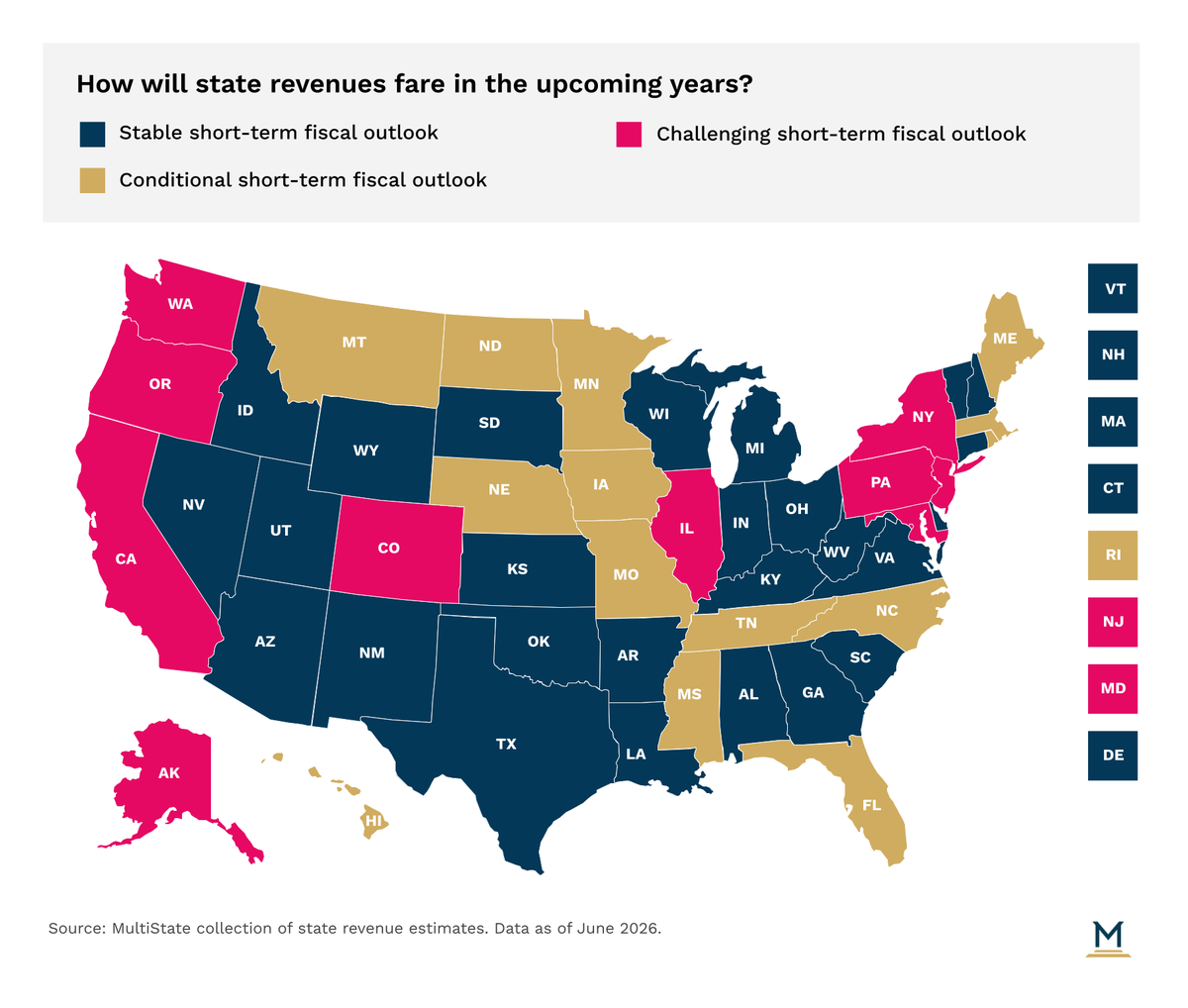
We also have 14 states rated as "conditional," which means a state's revenue health is worth watching and could lead to either future challenges or fiscal stability, depending on policy action or extra-governmental circumstances. As of June, these states are Florida, Hawaii, Iowa, Maine, Massachusetts, Minnesota, Mississippi, Missouri, Montana, North Carolina, North Dakota, Nebraska, Rhode Island, and Tennessee. In Florida's most recent forecast, the Sunshine State is projected to see its multibillion-dollar surplus turn into a multibillion-dollar deficit by FY2028. In Nebraska, legislators reallocated hundreds of millions of dollars from purpose-specific funds into the General Fund in April to help bridge a $646 million shortfall. Shortly thereafter, new estimates turned the small surplus senators created back into a deficit, which they will address next year.
|
Rainy Day Funds
Rainy day funds are state reserve accounts, also known as budget stabilization funds, that states build up during periods of revenue surplus to cushion against revenue shortfalls and economic downturns. These funds help states maintain essential services and avoid drastic budget cuts during recessions or unexpected fiscal challenges.
Conditional Fiscal Outlook
A conditional fiscal outlook means a state's revenue health is uncertain and could shift toward either fiscal stability or serious challenges depending on policy decisions, economic conditions, or external factors. These states require close monitoring as their budget situation could change significantly in either direction.
One Big Beautiful Bill Act
The One Big Beautiful Bill Act is a federal reconciliation law that reduces federal funding for state programs, particularly Medicaid and SNAP (Supplemental Nutrition Assistance Program), over the remainder of the decade. This reduction in federal support has added fiscal pressure to state budgets that previously relied on these federal transfers.
This is the second year in a row that the number of states with fiscal difficulties has increased. Last summer, we classified 34 states as stable, and two years ago 40 states were stable. While we've been tracking the effects of post-pandemic federal transfers, spending increases, and tax cuts for years now, the federal reconciliation law (One Big Beautiful Bill Act) has added to state fiscal pressure, with federal funding for Medicaid and SNAP to decrease over the rest of the decade. At the same time, many states have saved historically high amounts of reserves in rainy day funds, helping blunt any revenue challenges that may occur.
Tax policy can be one of the most challenging areas for government affairs executives. MultiState’s team understands the issues, knows the key players, and helps you effectively navigate and engage. We offer a customized, strategic solution to help you develop and execute a proactive multistate tax legislative agenda. Learn more about our Tax Policy Practice.
Which states have the worst fiscal outlook in 2026?
Ten states are facing serious short-term fiscal challenges in 2026: Alaska, California, Colorado, Illinois, Maryland, New Jersey, New York, Oregon, Pennsylvania, and Washington. California faces projected shortfalls totaling $24 billion through FY2028, while New Jersey's $7.2 billion surplus is expected to decline by nearly 50% in FY2027 and turn into a $750 million deficit by FY2028.
What is causing state budget deficits to increase in 2026?
State fiscal pressure has increased due to the effects of post-pandemic federal transfers winding down, state spending increases, and tax cuts implemented in recent years. The federal reconciliation law (One Big Beautiful Bill Act) has added further pressure by decreasing federal funding for Medicaid and SNAP over the rest of the decade.
How many states have a positive fiscal outlook in 2026 compared to previous years?
Only 26 states have a generally positive fiscal outlook in 2026, a significant decline from 34 stable states last summer and 40 stable states two years ago. This marks the second consecutive year that the number of states with fiscal difficulties has increased.
What are rainy day funds and how are states using them in 2026?
Rainy day funds are state reserve accounts that help cushion against revenue shortfalls and economic downturns. Many states have saved historically high amounts in these funds, which is helping to blunt revenue challenges that may occur despite the increasing fiscal pressures states are facing.
Why is California's budget situation concerning despite recent revenue growth?
California's revenues have exceeded expectations in recent years due to the AI boom, but this has raised concerns about revenue stability in the event of an economic downturn. The state is projected to face shortfalls totaling $24 billion through FY2028, which will likely require a combination of tax increases and spending cuts to address.
August 25, 2026 | Jose Perez

July 30, 2026 | Andrew Jones
July 17, 2026 | Andrew Jones