
Elections & Campaigns
Uncontested State Legislative Races Drop to Lowest Level Since 2018
October 16, 2026 | Bill Kramer
July 17, 2026 | Andrew Jones

Key Takeaways:
While most people think of Election Day as the time to pick representatives, at least 140 statewide ballot measures will also be decided this year. So far, about 27 of these will allow voters to decide on key tax policy measures. The first of 2026 was held back in May, when Louisiana voters rejected a constitutional amendment that would have allowed parishes to exempt business inventory from their property tax base. The next will be held on August 4, with Missourians headed to the polls, while most others will be decided this November on Election Day.
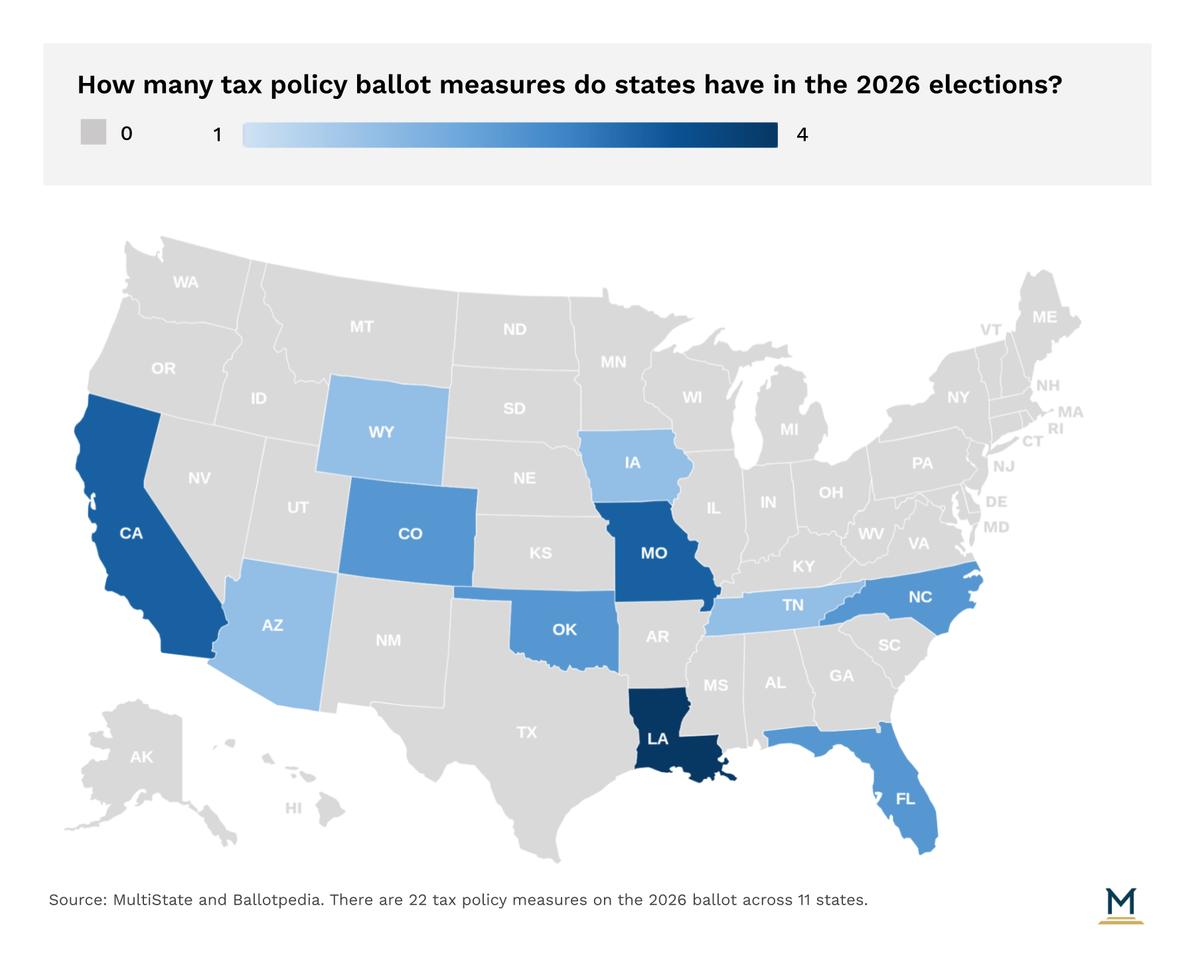
Several of these measures are part of states' push to reduce or eliminate the income tax or the property tax.
Missouri's Amendment 5 will ask voters to remove a constitutional cap on the sales tax base, approved by voters in 2016, so that legislators can reduce personal income taxes in next year's session.
Florida's Amendment 3 would increase the state's homestead property tax exemption to $250,000 and cap assessment (a property's taxable value) increases at 5% per year for non-homestead properties.
North Carolina will have measures to reduce both the property tax and the income tax at the same time. One amendment would reduce the constitutional limit on the income tax from 7% to 3.5% in North Carolina, and another would require the legislature to limit local property tax increases.
In Tennessee, a measure is on the ballot to prohibit the legislature from levying a statewide property tax in the future.
Ballot Measure
A ballot measure is a proposed law, constitutional amendment, or policy question that voters decide directly at the polls, rather than through their elected representatives. Also called propositions, initiatives, or referendums depending on the state.
Homestead Exemption
A homestead exemption reduces the taxable value of a primary residence for property tax purposes. For example, a $250,000 exemption means the first $250,000 of a home's value is not subject to property tax, lowering the homeowner's annual tax bill.
Assessment Cap
An assessment cap limits how much a property's taxable value can increase each year, regardless of market value changes. A 5% annual cap means property taxes can only rise based on a maximum 5% increase in assessed value per year, protecting owners from sudden tax spikes.
Wealth Tax
A wealth tax is levied on an individual's total net worth rather than income. Unlike income taxes that apply to annual earnings, wealth taxes apply to the total value of assets owned, including real estate, investments, and business holdings.
Another key measure to watch is Proposition 40 in California. That measure would impose a one-time 5% wealth tax on those with a net worth of over $1 billion. On the same ballot, California voters will decide Proposition 3, which would make the state's top personal income tax rates permanent (currently scheduled to expire in 2031).
California voters will face two significant tax measures. Proposition 40 would impose a one-time 5% wealth tax on individuals with a net worth over $1 billion. Proposition 3 would make the state's top personal income tax rates permanent, rather than allowing them to expire in 2031.
Other items on ballots across the country include measures to limit local sales taxes on groceries and to forbid taxes based on the miles a vehicle travels in Arizona, and an assessment cap in Oklahoma. While the deadlines to place measures on the ballot in many states have already passed, we could see a few more approved in the upcoming months.
Tax policy can be one of the most challenging areas for government affairs executives. MultiState’s team understands the issues, knows the key players, and helps you effectively navigate and engage. We offer a customized, strategic solution to help you develop and execute a proactive multistate tax legislative agenda. Learn more about our Tax Policy Practice.
What state tax ballot measures are voters deciding in 2026?
At least 140 statewide ballot measures are on the ballot in 2026, with approximately 27 focused on tax policy. These include measures to reduce or eliminate income taxes, increase property tax exemptions, impose wealth taxes, and limit local tax authority. Key votes are taking place in Missouri, Florida, North Carolina, Tennessee, California, Arizona, and Oklahoma.
What does Missouri Amendment 5 do for income tax reduction?
Missouri Amendment 5 would remove a constitutional cap on the sales tax base that voters approved in 2016, allowing legislators to reduce personal income taxes in next year's session. The measure is on the ballot for August 4, 2026.
How does Florida Amendment 3 change property tax exemptions?
Florida Amendment 3 would increase the state's homestead property tax exemption to $250,000 and cap assessment increases at 5% per year for non-homestead properties. The measure will be decided in November 2026.
What is California Proposition 40 and how does the wealth tax work?
California Proposition 40 would impose a one-time 5% wealth tax on individuals with a net worth exceeding $1 billion. The measure is on the November 2026 ballot alongside Proposition 3, which would make the state's top personal income tax rates permanent rather than allowing them to expire in 2031.
What property tax and income tax amendments are on North Carolina's 2026 ballot?
North Carolina has two constitutional amendments on the ballot: one would reduce the constitutional limit on the income tax from 7% to 3.5%, and another would require the legislature to limit local property tax increases. Both measures address tax reduction simultaneously.
October 16, 2026 | Bill Kramer

October 14, 2026 | Bill Kramer
September 29, 2026 | Bill Kramer