
State Government Affairs
When is a Bill Really "Dead"? State Legislative Process Deadlines Explained
May 5, 2026 | Sandy Dornsife
June 9, 2026 | Sandy Dornsife
Key Takeaways:
Each year, lawmakers introduce hundreds of thousands of bills in state legislatures across the country. Only a small fraction reach a governor's desk, and fewer still die there by veto. But the states where the veto pen falls hardest are not the divided governments where you might expect partisan friction — they are one-party trifectas, where a single party controls both legislative chambers and the governorship. Of the ten states with the highest veto rates in the 2025-2026 sessions, six are trifectas, and the two highest, Colorado and California, are Democratic trifectas where governors spent the session rejecting bills sent up by their own party's lawmakers.
While a governor’s power to veto may seem like a fundamental feature of American democracy, in actuality, the use of similar powers by British colonial governors made the veto a controversial tool in the early days of the country. The power was severely restricted and not implemented in many states for decades. New York waited until 1821 to grant this power to its governor, Illinois waited until 1848, and, believe it or not, North Carolina’s governor only obtained this authority in 1996.
State lawmakers considered 191,600 bills over the 2025-2026 sessions and sent fewer than 19,000 (9.7%) to their governors. Governors rejected 4.4% of those outright, so roughly 0.4% of all bills introduced died by veto. That national average hides wide variation: just five states account for three-quarters of all vetoes, and the concentration is steepest at the very top.
Colorado's veto rate of 7.98% more than doubles any other state's, followed by California at 3.31% and, after split-control Wisconsin, New York at 1.22% — all three Democratic trifectas.
State Veto Rates from the 2025-2026 Sessions
* Includes legislation considered in 2025/2026 biennial sessions and in 2026 legislative sessions
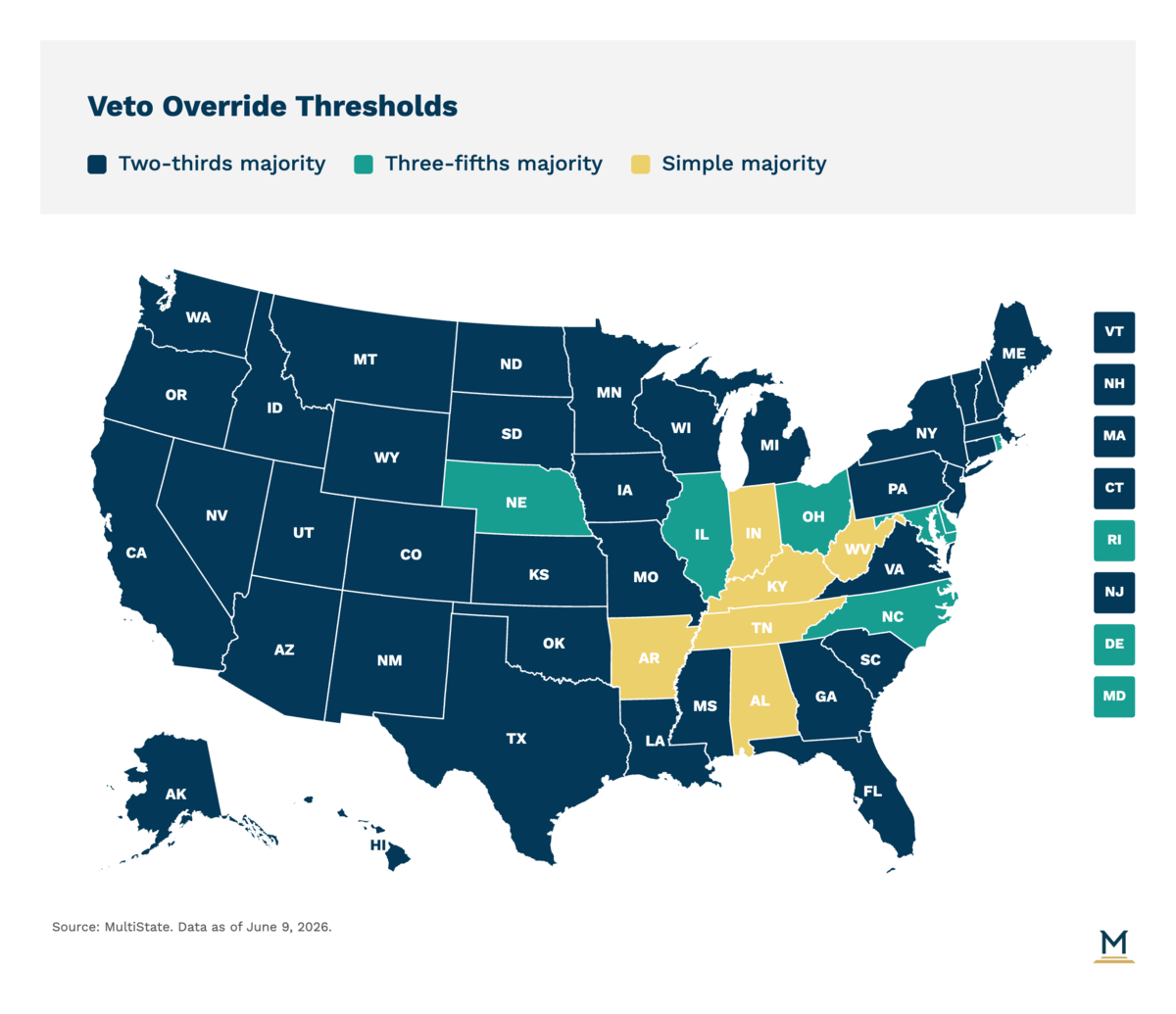
While all states grant the legislature the power to override a veto, the lengths to which they must go vary. Six states, including Kentucky, Tennessee, and Indiana, require a simple majority vote, but the vast majority of the remaining states, 37 in all, require a two-thirds supermajority vote, and the remaining seven states require a three-fifths supermajority.
Once these vetoes are issued, however, legislatures in these high-veto states generally do not respond with a correspondingly high rate of veto overrides. In fact, only two states among the top ten highest veto rate states — Kansas and Oklahoma — also appear among the nine states that successfully overrode gubernatorial vetoes during the session.
In Kansas, the Republican supermajority in the legislature overrode approximately two-thirds of the vetoes issued by Governor Laura Kelly (D). Kentucky, where only a bare majority of lawmakers are needed to override Governor Andy Beshear (D), has both the highest number and percentage of overridden vetoes. Kentucky Republicans have overridden almost every one of the governor’s vetoes.
With roughly 20 percent of states still in session and several more holding special sessions, the final veto and override totals for the 2025-2026 sessions are not yet settled. The preliminary numbers, though, point to two patterns. First, vetoes remain highly concentrated: a handful of states account for the bulk of veto activity, while most governors use the power sparingly. Second, a high veto rate does not translate into a high override rate. Overrides succeeded only where the vote math allowed: a low constitutional threshold, as in Kentucky, where a simple majority let Republicans override nearly all of Governor Beshear's vetoes, or a legislative supermajority large enough to clear a higher bar, as in Kansas. Elsewhere, most vetoes stood. Whether a legislature's appetite for overrides tracks more closely with its partisan makeup or with its override threshold is a question the full session data should help settle.
May 5, 2026 | Sandy Dornsife
March 9, 2026 | Lisa Kimbrough, Brock Ingmire
March 9, 2026 | David Shonerd