
State Government Affairs
How the Demographics of State Legislatures Have Changed Over Time
August 31, 2026 | Sandy Dornsife
July 1, 2026 | Max Rieper

Key Takeaways:
When a governor signs a bill, it becomes law. But when does the law actually take effect? In many cases, the answer is straightforward because the legislation itself specifies an effective date. Lawmakers may make a bill effective immediately if they believe a policy change is urgent, or they may delay implementation for months or even years, to give agencies, businesses, and citizens time to prepare for new requirements.
However, legislation does not always specify when it takes effect. In those cases, state constitutions and statutes provide default rules that determine when a freshly signed law becomes operative. While every state approaches the issue somewhat differently, most fall into one of four broad categories: states with fixed annual effective dates, states that tie effectiveness to legislative adjournment, states that use a set period following enactment, and states that largely leave the question to lawmakers on a bill-by-bill basis.
Want the full state-by-state breakdown? MultiState's 2026 State Effective Dates chart tracks the default effective date rule for all 50 states and D.C., with sources and a downloadable PDF. Explore the chart →
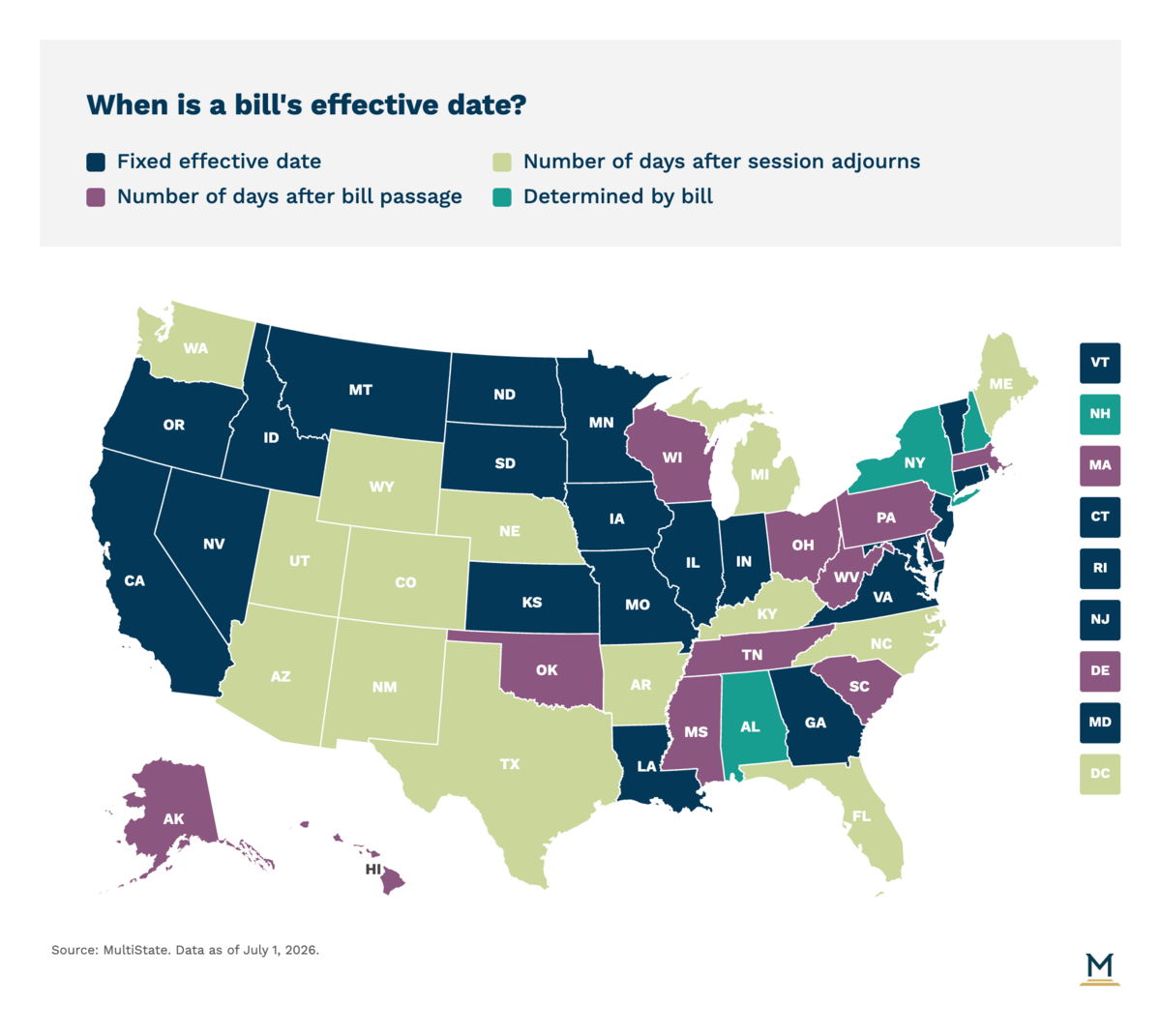
One group of states relies on fixed annual effective dates. In these states, legislation generally takes effect on the same date each year unless lawmakers provide otherwise.
Seven states (Georgia, Idaho, Indiana, Iowa, Kansas, South Dakota, Vermont, and Virginia) use July 1 as the default effective date for most legislation. Rhode Island also uses July 1 if the legislation was enacted before that date. If the bill was enacted after July 1, it becomes effective upon enactment.
Maryland uses June 1, while Louisiana, Minnesota, and North Dakota generally use August 1. Connecticut, Montana, and Nevada each use a default effective date of October 1, although Montana taxation bills take effect the following January 1. California and Oregon use January 1 of the following year. If an Illinois bill is passed before June 1 and does not specify its own effective date, it becomes effective on January 1 of the following year. However, if the governor doesn't sign the bill until after January 1, then it becomes effective when it is signed into law.
Not all states choose the first of the month, however. Missouri uses August 28, which is typically 90 days after the session adjourns. New Jersey celebrates Independence Day by having bills take effect on July 4, with fireworks ushering in new statutes.
A second group of states ties effective dates to legislative adjournment. Rather than selecting a fixed calendar date, these states provide that legislation becomes effective a certain number of days after lawmakers conclude their work for the year.
Bills in eight states (Arizona, Kentucky, Maine, Michigan, New Mexico, Texas, Washington, and Wyoming) generally take effect 90 days after the session adjourns. Nebraska’s constitution specifies that “No act shall take effect until three calendar months after the adjournment of the session at which it passed.” Florida, North Carolina, and Utah use shorter periods of 60 days, although the practical effect differs significantly because Florida and Utah typically conclude legislative sessions in the spring, while North Carolina lawmakers often remain in session until late summer or fall.
Arkansas and Colorado tie their effective-date rules to the referendum process. Citizens in those states generally have 90 days after legislative adjournment to gather signatures and challenge newly enacted laws. As a result, most legislation does not take effect immediately, preserving an opportunity for voters to place a measure on the ballot before it becomes operative. If enough signatures are gathered to qualify a referendum, the law's implementation may be suspended until voters have an opportunity to approve or reject it.
Some states calculate the effective date from enactment rather than adjournment, while a few require lawmakers to specify the effective date in each bill.
Five states (Alaska, Massachusetts, Ohio, Oklahoma, and West Virginia) generally make legislation effective 90 days after enactment, while Mississippi and Pennsylvania use 60 days, Tennessee uses 40 days, and South Carolina uses 20 days. Bills in Delaware and Hawaii become effective upon being enacted. Bills in Wisconsin take effect the day after publication by the Legislative Bureau, which typically takes place a day after the governor signs the bill.
Finally, Alabama, New Hampshire, and New York generally require lawmakers to specify an effective date in each bill.
Of course, these are general effective dates that can be subject to exceptions. Many states will have different effective dates for bills passed during a special session. Other states can have an immediate effective date for emergency bills or appropriations measures, typically requiring a supermajority vote.
MultiState’s team is actively identifying and tracking all issues so that businesses and organizations have the information they need to navigate and effectively engage. If your organization would like to further explore legislative tracking, please contact us.
What is the most common default effective date for state laws?
July 1 is the most common default effective date. This fixed annual date allows agencies, businesses, and citizens to anticipate when new legislation will become operative unless lawmakers specify otherwise in the bill itself.
How long after a legislative session ends do laws typically take effect in states that tie effectiveness to adjournment?
In most states that tie effective dates to adjournment, laws take effect 90 days after the session concludes. Eight states—Arizona, Kentucky, Maine, Michigan, New Mexico, Texas, Washington, and Wyoming—use this 90-day period, while Florida, North Carolina, and Utah use shorter 60-day periods.
Do all states allow laws to take effect immediately if lawmakers don't specify a date?
No, not all states allow laws to take effect immediately if lawmakers don't specify a date. Delaware and Hawaii make legislation effective upon being enacted. Alabama, New Hampshire, and New York generally require lawmakers to specify an effective date in each bill. Other states have specific default waiting periods, such as 90 days after enactment or after adjournment, depending on the state.
Why do Arkansas and Colorado wait 90 days after adjournment for laws to take effect?
These states tie their effective-date rules to the referendum process, giving citizens 90 days after legislative adjournment to gather signatures and challenge newly enacted laws through the ballot. This waiting period preserves voters' opportunity to place a measure on the ballot before it becomes operative, and if enough signatures are gathered, the law's implementation may be suspended until voters approve or reject it.
Which states calculate when a law takes effect based on when the governor signs it rather than when the session ends?
Some states calculate the effective date from enactment rather than adjournment. Alaska, Massachusetts, Ohio, Oklahoma, and West Virginia generally make legislation effective 90 days after enactment; Mississippi and Pennsylvania use 60 days; Tennessee uses 40 days; and South Carolina uses 20 days. Delaware and Hawaii make legislation effective upon being enacted, and Wisconsin uses the day after publication by the Legislative Bureau...
August 31, 2026 | Sandy Dornsife

May 5, 2026 | Sandy Dornsife

March 9, 2026 | Lisa Kimbrough, Brock Ingmire