Data Centers
State Lawmakers Look to "Behind-the-Meter" Policies for Data Centers
October 13, 2026 | Billy Culleton
July 15, 2026 | Kim Miller
Key Takeaways:
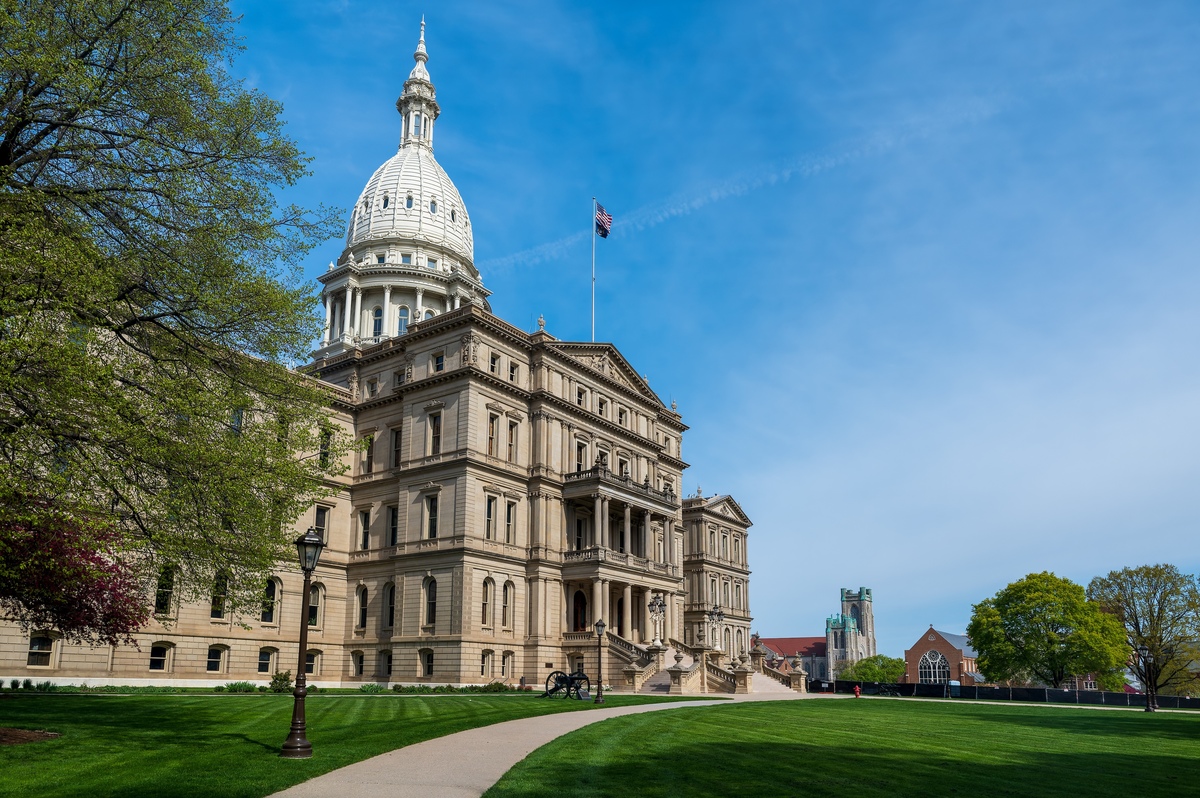
Last week, Michigan Democrats introduced a package of legislation to broadly regulate data centers. The legislation addresses data centers’ energy and water use, nondisclosure agreements (NDAs), and would establish labor standards for the construction and maintenance of data center workers.
Among the legislative package is a pair of bills (MI HB 6137 & SB 1050) that would require data center operators to enter into community benefit agreements before constructing or operating a data center in Michigan. These agreements would be legally binding contracts between a data center operator and a local government, utility provider, or other community stakeholder, requiring the operator to pay for or provide resources to benefit the local community.
If enacted, local governments would be prohibited from issuing any site plan approvals and permits, and the Public Service Commission (PSC) would be prohibited from approving any data center interconnection, until a community benefit plan has been approved by the local government in the jurisdiction where the data center will operate. Community benefit agreements would be required to address at least half of the following topics:
Community Benefit Agreement
A legally binding contract between a developer or operator and local stakeholders (such as governments, community groups, or residents) that requires the developer to provide specific benefits to the community in exchange for project approval. These agreements typically address local hiring, infrastructure improvements, environmental protections, and community investment.
Closed Loop Cooling System
A cooling technology that recirculates the same water continuously within a closed system rather than drawing fresh water and discharging it. This method significantly reduces water consumption compared to open loop systems that use water once and discharge it, making it more sustainable for high-demand facilities like data centers.
Demand Response Program
A utility program that incentivizes large energy consumers to reduce or shift their electricity usage during peak demand periods. Participants agree to temporarily decrease consumption when the grid is stressed, helping maintain grid stability and avoid blackouts while often receiving financial compensation or rate reductions.
Decommissioning
The process of safely dismantling, removing, and disposing of a facility and its equipment at the end of its operational life. For data centers, this includes removing servers, cooling systems, electrical infrastructure, and restoring the site, with financial assurance requirements ensuring funds are available to cover these costs.
Consumptive Use
Water use that removes water from available supplies without returning it to the source, typically through evaporation, incorporation into products, or consumption by humans or livestock. In data center contexts, this primarily refers to water lost through evaporative cooling processes that cannot be returned to the watershed.
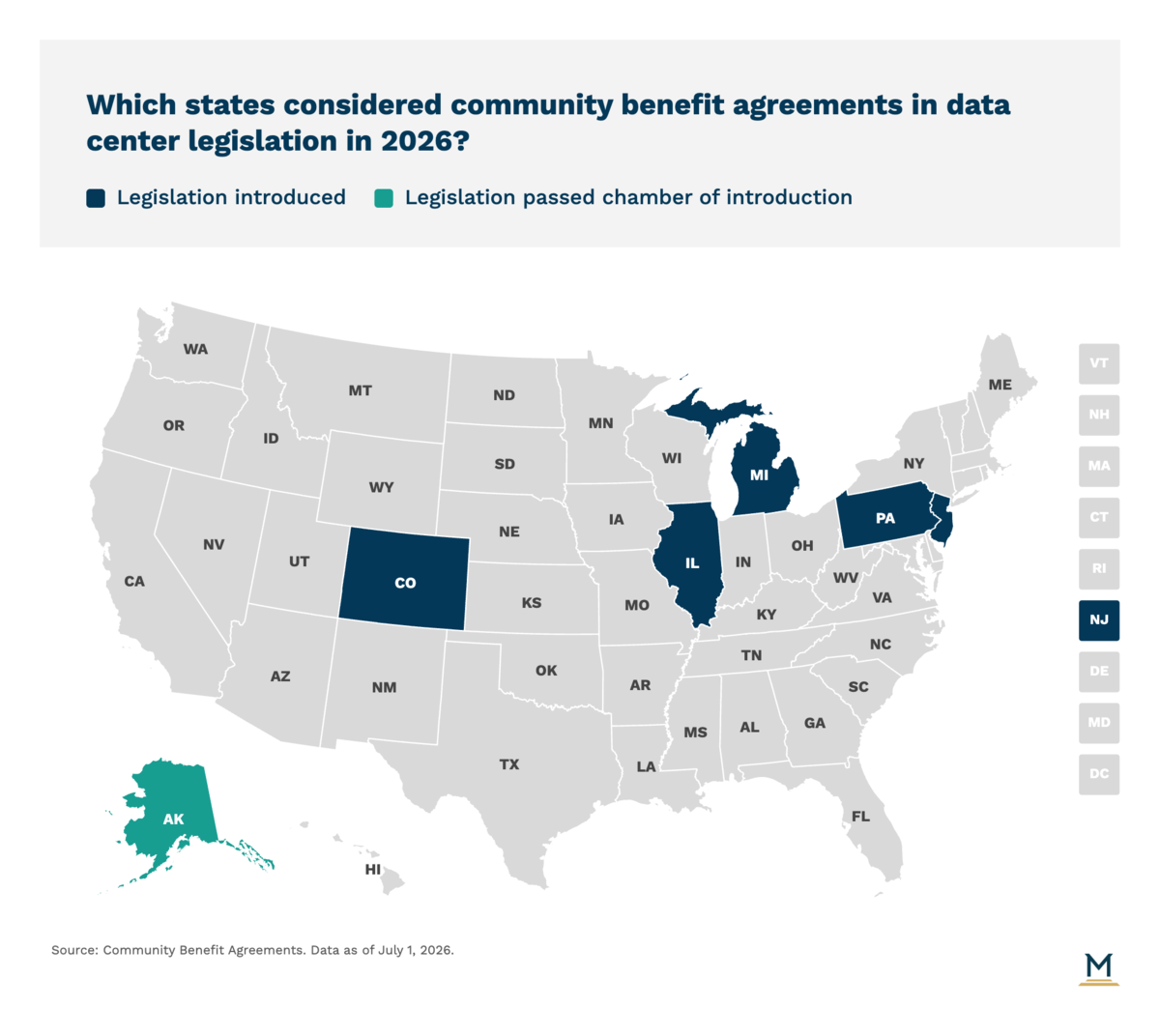
Michigan is not the first state to consider such an agreement as a condition for a data center to operate. Six other states have considered legislation requiring community benefit agreements for data centers this year. At the federal level, Representative Robert Bresnahan (R-PA) has introduced legislation (US HR 9262) that would require large data centers to enter into community benefit agreements with local governments to address local hiring, infrastructure impacts, and tax liabilities in order to be eligible for federal data center tax credits.
Lawmakers have introduced competing versions of data center energy legislation. In the Senate, lawmakers are considering legislation (MI SB 1047) that would establish strict financial and contractual requirements for utilities that provide power to data centers. These provisions include minimum 20-year contracts, 90% minimum billing of contract demands, and a $100,000 application fee. The Senate bill also requires data center operators to procure clean energy that comprises 90% of their annual energy usage and participate in a demand response program. The bill requires data centers to pay for their own energy needs to ensure other ratepayers do not bear the expense of providing power to data centers and requires data center operators to pay for any future decommissioning costs.
In the House, lawmakers are considering legislation (MI HB 6135) that would establish a new large-load commercial rate class for data centers. Data centers would be required to use this rate to enter into minimum 15-year contracts and pay for their own energy generation costs. Unlike the Senate bill, the House bill contains less strict financial and contractual requirements for data centers and does not contain clean energy provisions. House lawmakers are also considering legislation (MI HB 6142) that would prohibit the PSC from approving a contract for a data center unless it includes a decommissioning plan with financial assurance sufficient to cover the cost of decommissioning a data center. The PSC would be required to review these plans every three years.
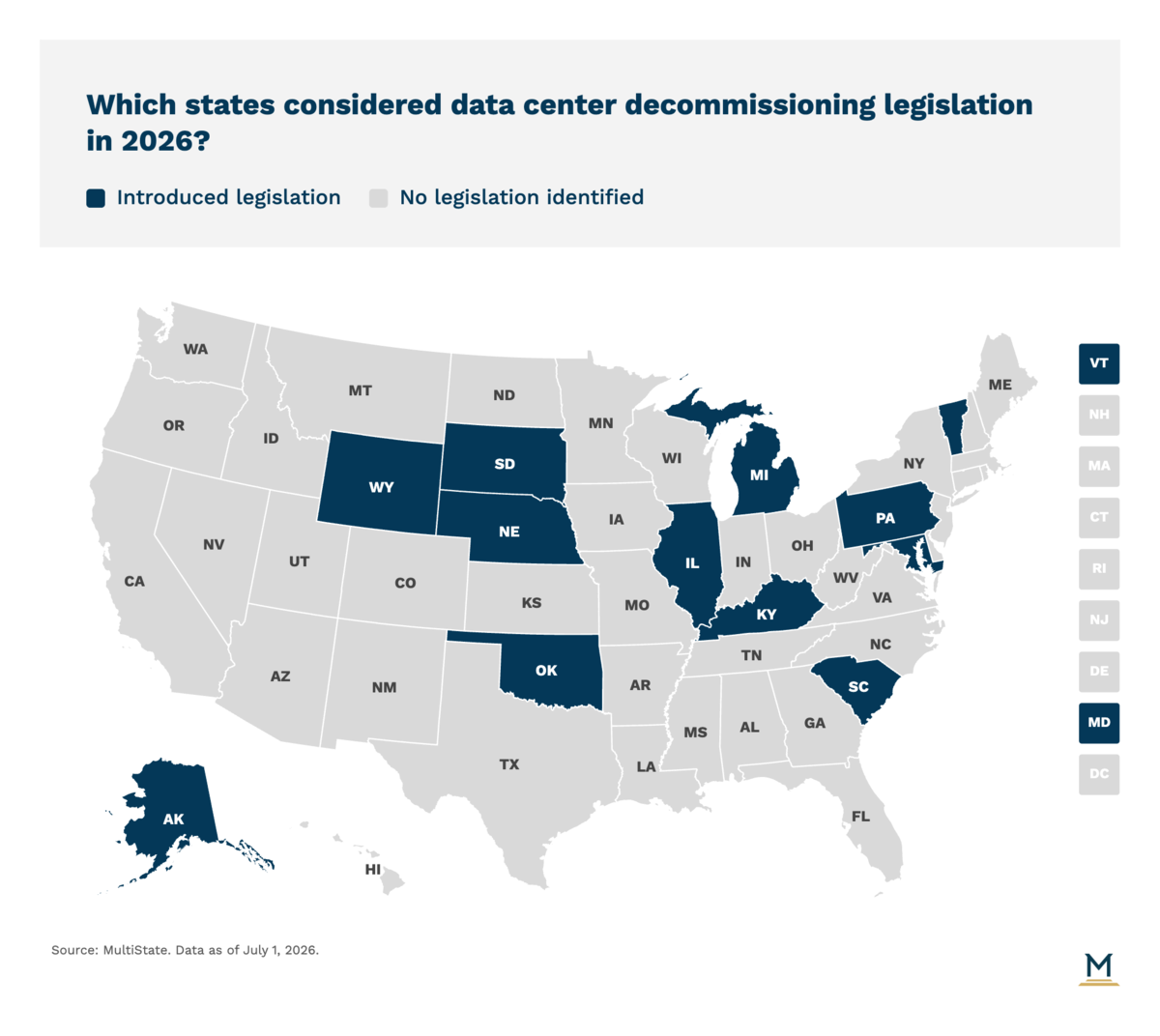
Decommissioning legislation has been considered in twelve states this year.
Michigan lawmakers are also considering competing legislation regarding data centers’ water use. In the Senate, lawmakers are considering legislation (MI SB 1046) establishing a new permit for any person that uses, or anticipates using, 550,000 gallons of water or more per day—a provision that will likely impact data centers as well as other high-volume water users. Applicants would be required to conduct at least three public hearings before submitting an application for water use, and consumptive use would be capped at 2 million gallons per day for permit holders. Large data centers can use up to 5 million gallons of water per day, but data centers are actively implementing less water-intensive cooling methods.
In the House, lawmakers are considering legislation that requires new data centers to use closed loop cooling systems or only use water sourced from a municipal water system.
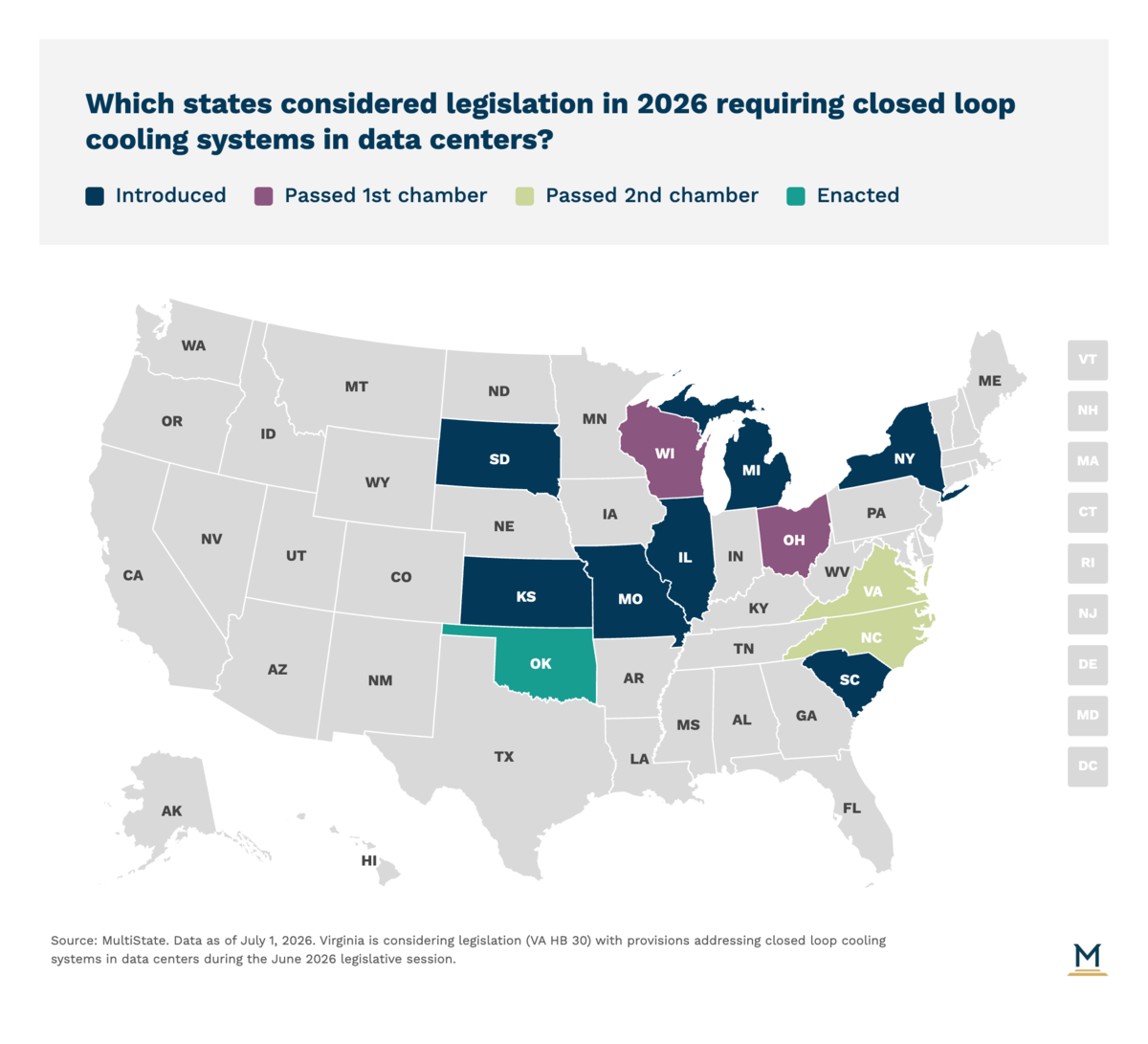
Legislation requiring closed loop cooling systems has become popular in state legislatures this year. Twelve states have considered legislation requiring new data centers to use closed loop cooling systems. Cooling systems are one of the primary drivers of data centers’ water consumption but are necessary to ensure computing equipment does not overheat.
In the House, lawmakers are considering legislation (MI HB 6139) requiring data centers to conduct acoustic engineering reports analyzing baseline ambient noise and projected construction and operational noise. The report would need to be provided to the PSC and the local government issuing the building permit.
Michigan lawmakers are considering legislation (MI HB 6140 & MI SB 1049) prohibiting elected officials and data center operators from entering into NDAs regarding data center construction if the project is receiving a tax incentive. The legislation contains a carveout allowing intellectual property information to be redacted.
Michigan lawmakers are also considering legislation (MI HB 6141 & MI SB 1048) prohibiting the PSC from approving data center contracts unless construction and maintenance work is performed under a labor agreement or a collective bargaining agreement. Notably, the International Brotherhood of Electrical Workers (IBEW) has urged members to reject data center moratorium legislation, arguing that data centers provide good paying construction jobs, improve working conditions, and create long-term union jobs.
Notably absent from this legislative package is data center tax and moratorium legislation. While Michigan lawmakers did not introduce any data center tax incentive legislation in this pack, lawmakers have considered legislation this year repealing tax incentives (MI HB 5396 & MI HB 5397), excluding data centers from certain property tax exemptions (MI HB 5776), and extending a tax exemption for data centers in brownfield zones (MI HB 5790, MI HB 5791).
Last year, states considered hundreds of data center bills, and we expect activity to continue growing in 2026. To stay on top of this rapidly evolving landscape, we've launched MultiState Policy Watch: Data Centers – a subscription featuring legislative analysis, trend summaries, and expert insights across energy, tax, water, zoning, and other policy areas impacting data centers. Sign up here.
What do Michigan's proposed community benefit agreements require data centers to do?
Michigan HB 6137 and SB 1050 would require data center operators to enter into legally binding community benefit agreements with local governments, utility providers, or other stakeholders before construction or operation. These agreements must address at least half of five specified topics: hiring local workers and contractors, water use, cost allocation for infrastructure upgrades, funding for community projects, and home efficiency improvements. Local governments would be prohibited from issuing permits and the PSC would be prohibited from approving interconnections until a community benefit plan is approved.
What are the differences between Michigan's Senate and House data center energy bills?
Michigan SB 1047 requires minimum 20-year contracts, 90% minimum billing, a $100,000 application fee, and mandates that data centers procure clean energy comprising 90% of annual usage. Michigan HB 6135 establishes a new large-load commercial rate class with minimum 15-year contracts but contains less strict financial requirements and does not include clean energy provisions. Both bills require data centers to pay for their own energy generation costs to protect other ratepayers.
Does Michigan's proposed legislation ban data centers from using open loop cooling systems?
Michigan House lawmakers are considering legislation that would require new data centers to use closed loop cooling systems or only use water sourced from a municipal water system. Michigan SB 1046 would establish a new permit for any entity using 550,000 gallons or more of water per day and cap consumptive use at 2 million gallons per day. Twelve states have considered legislation requiring new data centers to use closed loop cooling systems this year.
Can Michigan data center operators sign NDAs with local officials under the proposed legislation?
Michigan HB 6140 and SB 1049 would prohibit elected officials and data center operators from entering into NDAs regarding data center construction if the project is receiving a tax incentive. The legislation includes a carveout allowing intellectual property information to be redacted.
What labor requirements would Michigan impose on data center construction and maintenance?
Michigan HB 6141 and SB 1048 would prohibit the PSC from approving data center contracts unless construction and maintenance work is performed under a labor agreement or collective bargaining agreement. The International Brotherhood of Electrical Workers has supported labor standards for data centers while opposing moratorium legislation, citing good paying construction jobs and long-term union employment opportunities.
October 13, 2026 | Billy Culleton
-ffe156-400px.jpeg)
September 24, 2026 | Kim Miller
September 18, 2026 | Morgan Scarboro