
Financial Services & Commerce
Retailers Look to Policymakers to Navigate the Post-Penny Era
December 9, 2025 | Katherine Tschopp
July 30, 2026 | Kayla Susalla
Key Takeaways:
The 2026 legislative session brought a wave of new bills proposing domestic procurement requirements. As of July 2026, 196 bills were introduced requiring or recommending goods be produced in the U.S. Industries targeted include steel, iron, and timber. States also introduced restrictions on sourcing goods and services from certain foreign countries, reflecting a broader emphasis on evolving geopolitical priorities.
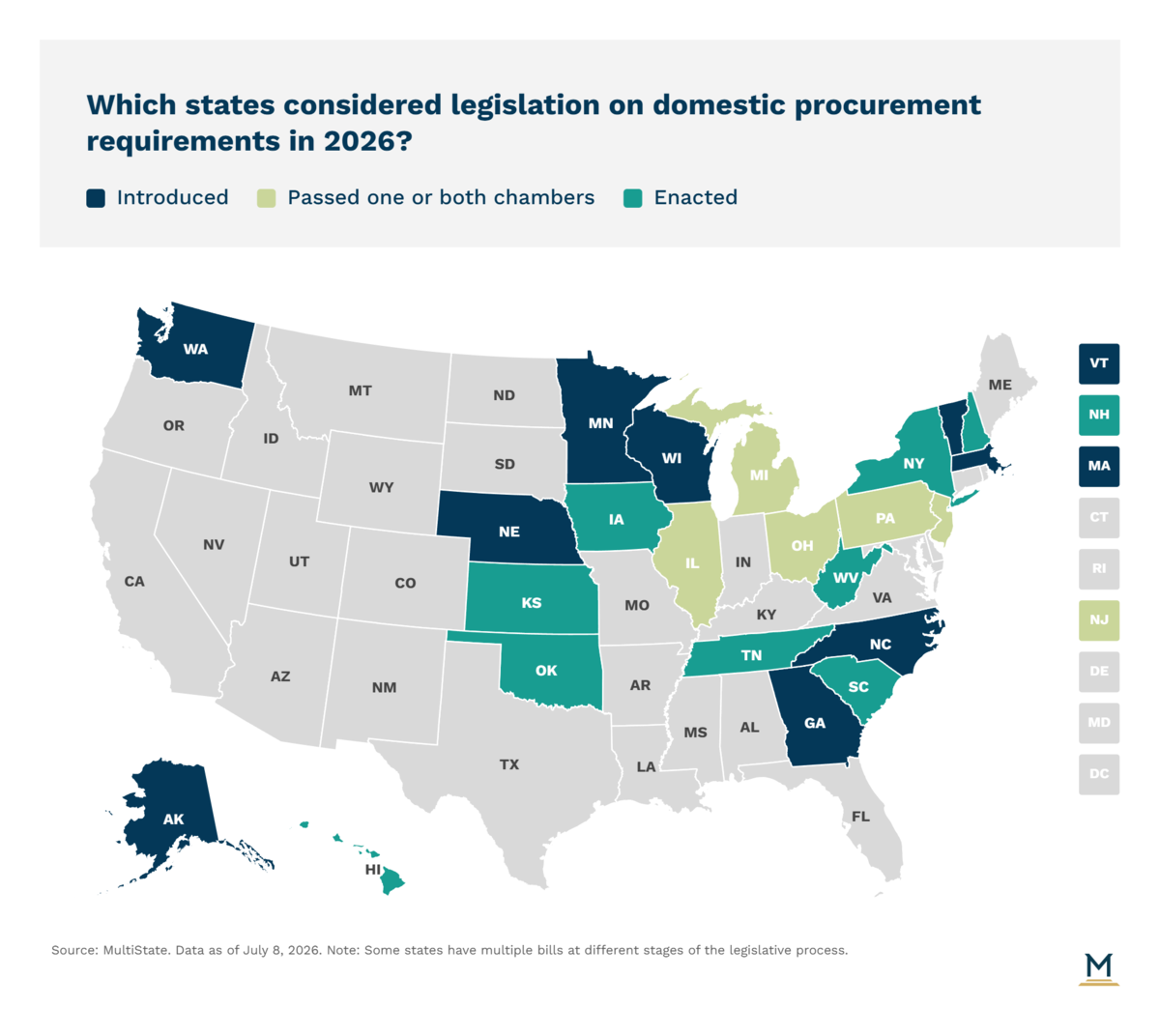
States across the country are considering or enacting legislation to require or encourage the use of domestically produced materials in public projects. The focus has been especially strong on steel, iron, and timber, with a variety of approaches and requirements emerging.
Several states proposed legislation to require steel be sourced from the U.S. Michigan (MI HB 5789), Ohio (OH HB 284), North Carolina (NC SB 296), Massachusetts (MA H 3411), Oklahoma (OK SB 168), Minnesota (MN HF 4989), South Carolina (SC HB 4709), and Washington (WA HB 1256) have all introduced proposals requiring U.S.-sourced steel for materials in public works construction projects. Iowa’s (IA HF 684) proposal requires state agencies to exclusively purchase steel manufactured in the United States. Some of these bills contain provisions to forgo the domestic procurement requirement if products are unavailable (MI HB 5789) or if the procurement requirements would not be in the public interest (NC SB 296). OK SB 168 sets a $100,000 threshold for the domestic procurement requirements to come into effect.
Instead of implementing an explicit mandate, some legislators tied funding and tax credits to ensure steel was made in the U.S. For example, Pennsylvania’s (PA HB 1018) legislation prohibits any public agency from using funds, grants, tax credits, or other tax incentives unless the steel was melted and manufactured in the U.S. Similarly, Iowa’s (IA HF 685) legislation requires that steel used in public contracts and purchased with state monies or tax credits be manufactured in the United States. Legislation proposed in West Virginia (WV HB 5675) creates a nonrefundable tax credit for businesses that replace foreign-manufactured goods with goods made by a qualified West Virginia manufacturer.
These proposals align with ongoing federal industrial policy initiatives. Tariffs on imported steel, federal domestic procurement requirements, and increased infrastructure spending have heightened policymakers' focus on expanding U.S. steel production. State procurement requirements reinforce these federal efforts by directing public purchasing toward domestic producers.
Domestic Procurement Requirements
Domestic procurement requirements are laws or policies that require government agencies to purchase goods and materials produced within the United States for public works projects and contracts. These requirements typically specify that materials like steel, iron, or timber must be manufactured, melted, or sourced domestically rather than imported from foreign countries.
Foreign Adversary
A foreign adversary is a country or government that a state or federal government identifies as posing a threat to national security or economic interests. In state procurement legislation, foreign adversaries commonly include China, Russia, Iran, North Korea, Cuba, and the Venezuelan regime of Nicolás Maduro. States often rely on federal guidance from agencies like the Commerce Department and FCC to determine which countries qualify as foreign adversaries.
Countries of Concern
Countries of concern is a term used in state legislation to identify nations from which government agencies are restricted or prohibited from purchasing goods and services. The designation typically includes countries that pose national security risks or have adversarial relationships with the United States. State definitions vary but generally align with federal entity lists maintained by the Commerce Department and Federal Communications Commission.
Covered Entity
A covered entity, in the context of state procurement restrictions, is a business or organization that is domiciled in, controlled by, or has substantial ties to a foreign adversary or country of concern. State laws prohibit public agencies from entering into contracts with covered entities to protect national security and prevent foreign influence over critical infrastructure and government operations.
Ohio (OH HB 284), North Carolina (NC SB 296), Massachusetts (MA S 2167), West Virginia (WV HB 2177), Oklahoma (OK SB 168), South Carolina (SC HB 4709), and Washington (WA SB 6298) introduced legislation to establish requirements or preferences for domestically sourced iron. Provisions establishing domestic procurement requirements for iron were often included in bills that set such requirements for steel, as steel is primarily made of iron. As governments invest in roads, bridges, utilities, and public buildings, policymakers are increasingly viewing procurement rules as a mechanism to increase domestic metals production.
Some states also introduced legislation mandating procurement of domestic wood. Washington (WA HB 1726) introduced legislation to prioritize lumber procured from Washington state lumber mills for public works projects. Similarly, New Hampshire (NH SB 529) introduced legislation requiring a preference for U.S. sourced lumber on all state-funded building projects. Increased construction demand, supply chain disruptions, and broader efforts to promote locally sourced building materials have led some states to prioritize in-state or domestic lumber for public projects.
Another prominent theme in domestic procurement requirements proposals was prohibiting the acquisition of goods and services from “countries of concern,” “foreign adversaries,” or “covered entities.” States' definitions of these terms tended to vary. For example, GA SB 64 defines a “covered foreign entity” as an entity domiciled in or under the control of China or Russia, and a “foreign adversary” as Cuba, Iran, Russia, North Korea, and Venezuelan politician Nicolás Maduro. OK HB 4193 defines “foreign adversary” as China, Russia, Iran, North Korea, Cuba, the Venezuelan regime of Nicolás Maduro, and Syria. States also heavily relied on federal guidance when determining countries they deemed of concern, such as the Commerce Department’s entity list and the covered list by the Federal Communications Commission. These bills primarily prohibited public agencies from entering into contracts with foreign countries of concern. Specific goods or property were also targeted, such as drones, technology, and critical infrastructure, from being acquired from countries of concern. These restrictions mirror a shift in procurement policy from emphasizing cost efficiency toward prioritizing national security.
As reshoring manufacturing jobs remains a primary objective of the current administration, we will likely continue to see bills proposing domestic procurement requirements for major manufacturing sectors, such as steel, iron, and other construction materials. While steel and iron are expected to remain primary targets because of ongoing infrastructure investment and trade policy, lawmakers may also expand procurement preferences to additional industries—including critical minerals, manufactured goods, and emerging technologies—particularly where national security or economic competitiveness concerns intersect with public purchasing.
MultiState’s team is actively identifying and tracking State Government Affairs issues so that businesses and organizations have the information they need to navigate and effectively engage. If your organization would like to further track these or other related issues, please contact us.
What states introduced legislation requiring U.S.-sourced steel for public works projects in 2026?
Michigan, Ohio, North Carolina, Massachusetts, Oklahoma, Minnesota, South Carolina, and Washington introduced proposals requiring U.S.-sourced steel for materials in public works construction projects. Iowa introduced legislation requiring state agencies to exclusively purchase steel manufactured in the United States. Some bills include exceptions if products are unavailable or if requirements would not be in the public interest.
How are some states using tax credits and funding restrictions to enforce domestic steel procurement?
Pennsylvania's legislation prohibits public agencies from using funds, grants, tax credits, or other tax incentives unless steel was melted and manufactured in the U.S. Iowa's legislation requires that steel used in public contracts and purchased with state monies or tax credits be manufactured in the United States. West Virginia proposed creating a nonrefundable tax credit for businesses that replace foreign-manufactured goods with goods made by a qualified West Virginia manufacturer.
Which states have proposed domestic procurement requirements for timber and lumber?
Washington introduced legislation to prioritize lumber procured from Washington state lumber mills for public works projects. New Hampshire introduced legislation requiring a preference for U.S. sourced lumber on all state-funded building projects. These proposals reflect increased construction demand, supply chain disruptions, and efforts to promote locally sourced building materials.
How do states define "foreign adversaries" or "countries of concern" in procurement restriction bills?
State definitions vary but typically include China, Russia, Iran, North Korea, Cuba, and the Venezuelan regime of Nicolás Maduro. Georgia defines a "covered foreign entity" as an entity domiciled in or under the control of China or Russia. States also rely on federal guidance such as the Commerce Department's entity list and the Federal Communications Commission's covered list when determining countries of concern.
What types of goods are states specifically targeting in foreign adversary acquisition prohibitions?
States are primarily prohibiting public agencies from entering into contracts with foreign countries of concern, with specific focus on drones, technology, and critical infrastructure. These restrictions mirror a shift in procurement policy from emphasizing cost efficiency toward prioritizing national security.
December 9, 2025 | Katherine Tschopp
August 7, 2025 | Katherine Tschopp

April 4, 2025 | Bill Kramer