Data Centers
What States Are Doing About Local Data Center Authority
October 23, 2026 | Troy Flanagan
November 1, 2026 | Billy Culleton
-bf52bc-1200px.jpg)
Key Takeaways:
The election of state utility regulators, typically an obscure down-ballot race, is quickly becoming more relevant than ever this year as higher energy bills and data centers become top issues for voters. On November 3rd, voters in nine states will have the chance to elect a total of 14 officials to serve on their state's public utility/service commission (PUC or PSC).
PUCs serve a quasi-judicial function in ensuring that public utility customers are provided with a safe, reliable, and affordable service. Commissioners often hear rate disputes between investor-owned utilities and customers, issue outage reports after major storms, and review consumer advocate filings. Since they are the go-between for providers and customers, PUCs have to balance the rights and needs of the parties that go before them.
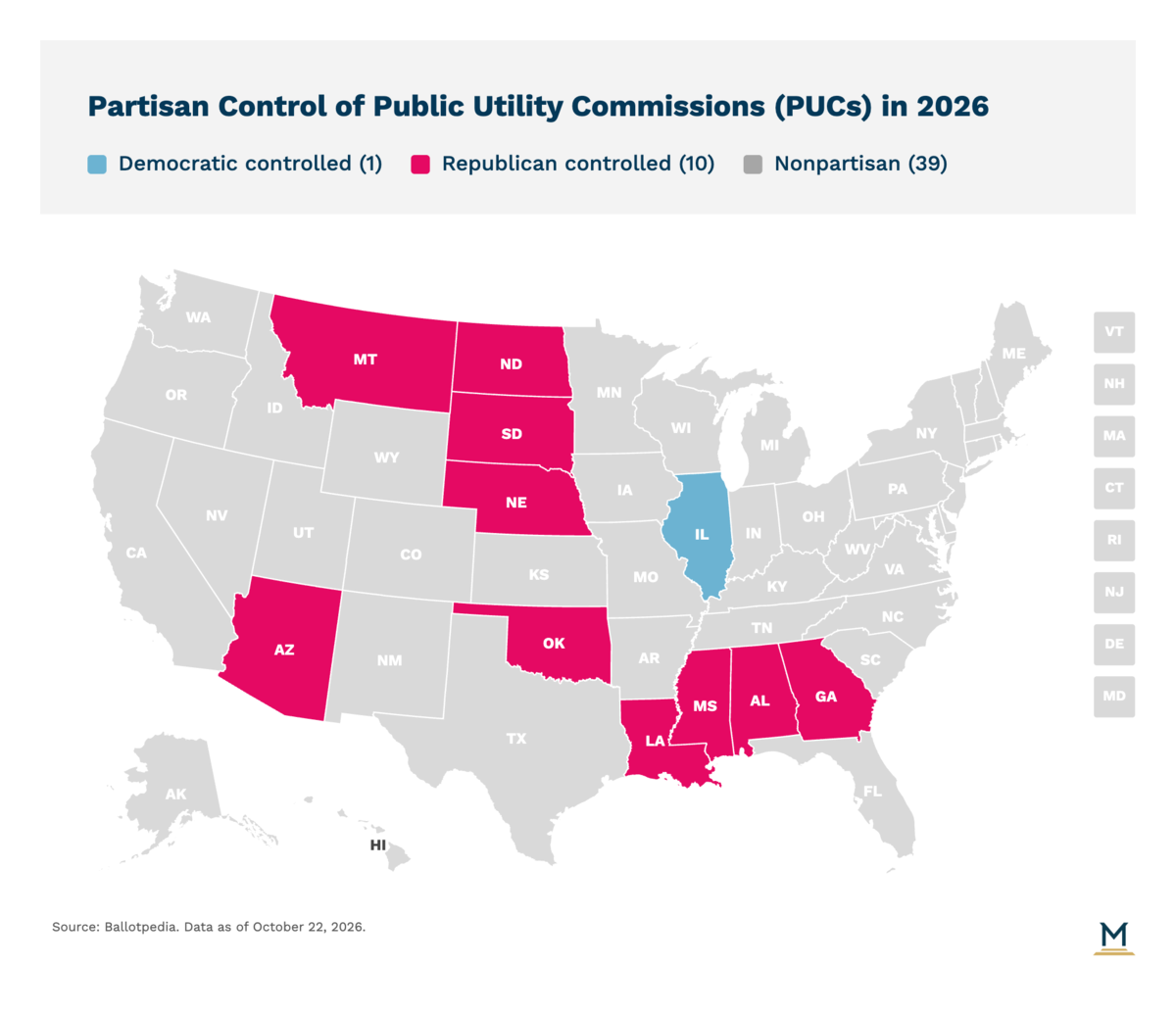
Most state PUCs are officially nonpartisan entities with governor-appointed commissioners. Virginia and South Carolina appoint commissioners via the legislature, while North Carolina and Tennessee use a hybrid approval approach. For the 11 commissions that are partisan, all except for Illinois are elected.
Public Utility Commission (PUC) / Public Service Commission (PSC)
A Public Utility Commission (PUC) or Public Service Commission (PSC) is a state-level regulatory agency responsible for overseeing the rates, services, and operations of public utilities such as electricity, gas, water, and telecommunications. These commissions ensure that utility services are provided safely, reliably, and at reasonable rates, and they often resolve disputes between utilities and customers.
Cost Allocation Agreement
A cost allocation agreement is a regulatory arrangement that determines how the costs of new energy generation or grid infrastructure are distributed among different customer groups, such as residential, commercial, and industrial users. These agreements are typically reviewed and approved by state utility commissions to ensure fairness and prevent undue financial burden on any one group.
For this year's election, we could see a blue wave trickle down to the PUC level. Georgia's PSC is the most likely to see a change in party control in 2027. Last year, two Democratic challengers for Georgia's PSC District 2 & 3 races each won a stunning victory over their incumbent Republicans. This year, Democrats are looking to add on that success by taking control over the entire Commission by holding District 3 and winning over District 5.
Georgia is already expected to see high voter turnout due to its U.S. Senate and gubernatorial races. One important thing that separates Georgia from the rest of states here: while commissioners must reside in one of five districts, they are elected statewide. In a recent debate, Commissioner Peter Hubbard, the Democratic incumbent running in District 3, highlighted this fact in his pitch to voters: "vote for Peter Hubbard and Shelia Edwards to flip the commission to a Democratic majority who will lower your bills and hold Georgia Power and data centers accountable."
In Louisiana, the 3-2 Republican-controlled PSC is less likely to see a complete partisan change, but it's not out of the question. Republican state Representative Stephanie Hilferty remains the favorite to win the District 1 seat being vacated by Eric Skrmetta. Even though this seat is safe for Republicans, the unaffiliated third-party candidate Chris Justin could make this race closer than expected. Louisiana has seen intense interest from hyperscale data center developers in recent years. Meta has invested $50 billion in its hyperscale data center development in Richland Parish while Applied Digital announced plans this year to develop a $3.6 billion data center campus in Rapides Parish. The Louisiana PSC would have to approve any cost allocation agreements for new energy generation and grid facilities that support data centers.
Nebraska's Public Service Commission could have its first Democratic commissioner come January. District 2, which includes Omaha and the eastern half of Douglas County, is an open-seat race between Democratic candidate Wendy DeBoer and Republican Dennis McCann. Nebraska's PSC District 2 is almost entirely in Nebraska Congressional House District 2, which is widely expected to see Democrats flipping that seat held by retiring Republican U.S. Rep. Don Bacon.
And finally, Democrats in Arizona have seized on the data center energy issue in their quest to break Republicans' unanimous control over its Corporate Commission. ACC Democratic candidates Clara Pratte and Jonathon Hill want to investigate Arizona Public Service, the largest investor-owned utility in the state, over claims that its residential and commercial customers have paid $587 million between 2023-2025 for costs associated with serving data centers. The Republican incumbent on the ballot, Kevin Thompson, has defended the ACC and argued on social media that "growth pays for growth." Arizona elects its commissioners at-large and voters get to choose two candidates to vote for on November 3rd.
Ultimately, many of these races could get swept up by the momentum in other statewide races. Gubernatorial, U.S. Senate, and Congressional races often drive a lot of voters to the polls on midterms. Who shows up to the polls or who's already mailed in their ballot will be a driving force in whether Democrats have the numbers to flip some of these seats in red states. The other states holding races — Montana, North Dakota, Oklahoma, and South Dakota — while generally seen as safer Republican holds, could also see some unexpected results given the political environment. As always, we'll know more as soon as the results come trickling in on Election Night.
If you want to learn more about these races and other statewide offices impacting energy, visit our Utility Regulators guide on MultiState's election website. This page includes interactive charts and maps on public utility commissions, oil and gas commissions, and so much more.
Federal and state elections and redistricting can have significant policy and regulatory implications for businesses and organizations. If your organization would like to further track federal and state elections, please contact us.
Which state utility commission races are most likely to change partisan control after the November 3rd elections?
Georgia's PSC is the most likely to see a change in party control. Democrats are looking to hold District 3 and win District 5 to take majority control of the entire Commission.
How are Georgia Public Service Commission members elected, and who is on the ballot in 2026?
Georgia PSC commissioners must reside in one of five districts but are elected statewide. Democratic incumbent Peter Hubbard is running in District 3, and Democrats are also fielding Shelia Edwards in District 5 in an effort to flip the Commission to a Democratic majority.
What role does a state public utility commission play in approving costs related to data center energy use?
State public utility commissions must approve cost allocation agreements for new energy generation and grid facilities that support data centers. In Arizona, Democratic candidates have raised claims that residential and commercial customers paid $587 million between 2023 and 2025 for costs associated with serving data centers.
What data center investments has Louisiana attracted, and how does the state's PSC factor into those projects?
Meta has invested $50 billion in hyperscale data center development in Richland Parish, and Applied Digital announced plans to develop a $3.6 billion data center campus in Rapides Parish. The Louisiana PSC would have to approve any cost allocation agreements for new energy generation and grid facilities that support those data centers.
How does Nebraska's PSC District 2 race connect to the broader congressional election in that area?
Nebraska's PSC District 2, which includes Omaha and the eastern half of Douglas County, is an open-seat race between Democrat Wendy DeBoer and Republican Dennis McCann. The district falls almost entirely within Nebraska Congressional House District 2, which is widely expected to see Democrats flip the seat held by retiring Republican U.S. Rep. Don Bacon.
October 23, 2026 | Troy Flanagan

October 20, 2026 | Bill Kramer
October 20, 2026 | Mary Kate Barnauskas