
State Government Affairs
Education Policy Groups 101: National Policymaker Networks to Know If You Care About Education Policy
October 22, 2026 | Brian Peterson
December 10, 2025 | Bill Kramer

Key Takeaways:
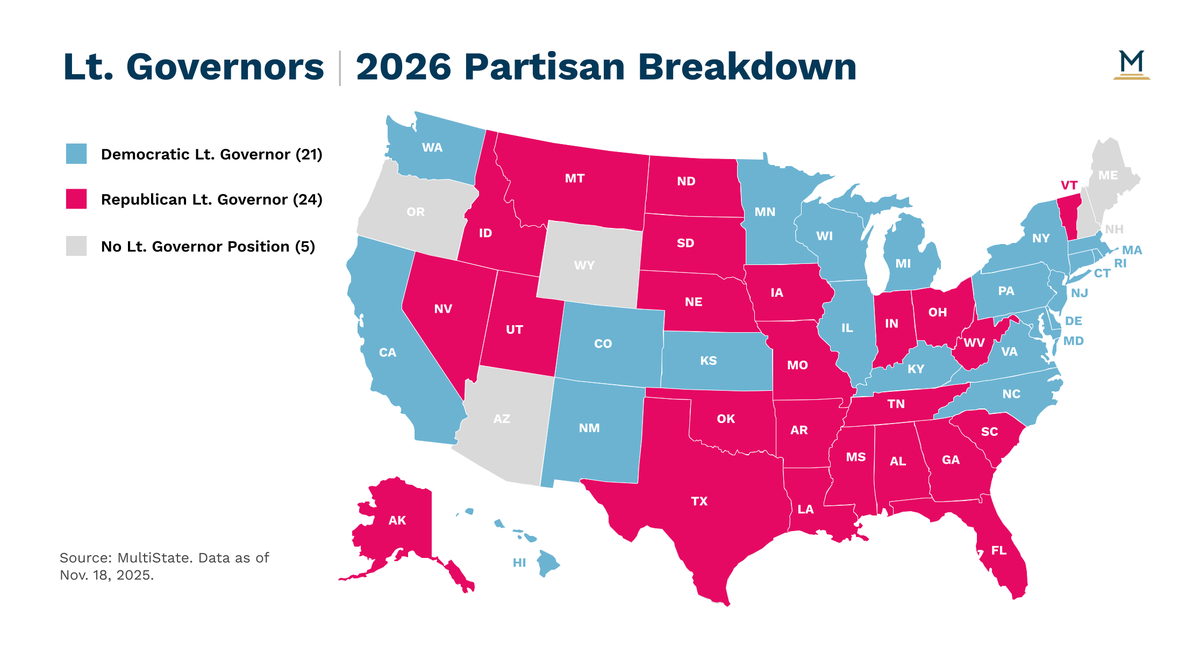
Virginia recently elected a new lieutenant governor as state senator Ghazala Hashmi (D) defeated John Reid (R) for the open seat. The commonwealth’s current lieutenant governor, Winsome Earle-Sears (R), lost her race for governor to Abigail Spanberger (D). As we noted, the Virginia statewide elections were a reverse of 2021 when Gov. Youngkin (R) led a GOP sweep of statewide offices. While the responsibilities vary by state, the lieutenant governor position is an important political stepping stone on the way to a gubernatorial bid, as Lt. Gov. Earle-Sears attempted to do.
The Virginia outcome highlights the political significance of the lieutenant governor's office — a position whose structure and power varies considerably across states. Only 45 states have a lieutenant governor, of which 43 are elected to that position. The two exceptions are Tennessee and West Virginia, where the senate president serves as the lieutenant governor. Notably, only 17 states elect a lieutenant governor independently, while 26 states elect the governor and lieutenant governor on a joint ticket (similar to how U.S. President and Vice President run on a joint ticket and are not elected separately).
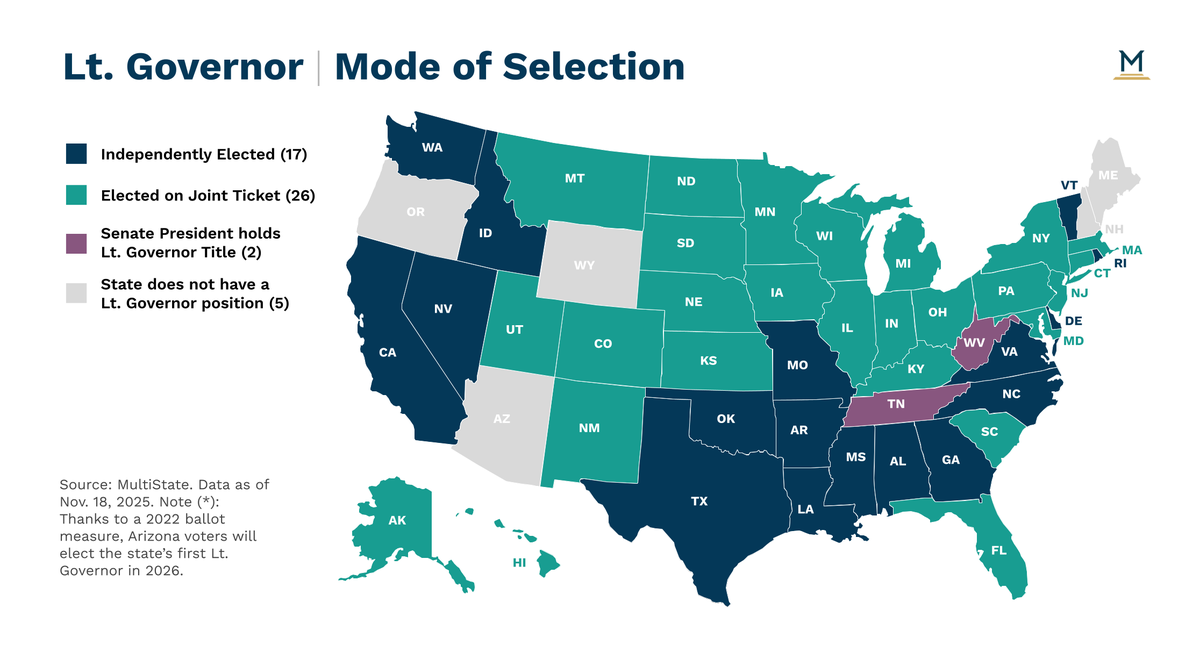
States that elect lieutenant governors independently — including Virginia, North Carolina, and Idaho — risk the kind of intra-party or inter-party conflicts that joint-ticket states typically avoid. For example, from 2021 until this year, North Carolina’s Gov. Roy Cooper (D) had a lieutenant governor, Mark Robinson (R), who was frequently at odds with much of his political agenda. It was the rare case where the highest and second-highest offices in the executive branch of a state were held by members of different political parties.
But even when parties align, a governor and lieutenant governor that are elected independently can have unaligned priorities. Back in 2021, during the pandemic, Idaho Governor Brad Little (R) had to leave the state for official business. In Idaho, when the governor leaves the state, the lieutenant governor takes on the duties of governor in their stead. However, in the midst of the pandemic, Lt. Gov. Janice McGeachin (R) issued her own executive order to ban COVID-19 vaccine or testing mandates for state agencies and public schools. Gov. Little immediately responded to McGeachin’s order, calling it political grandstanding and promising to reverse it (which he did). Subsequently, a debate ensued over whether the lieutenant governor can serve as acting governor when the governor is “effectively” or “physically” absent from the state.
New York is another state that did not have a joint ticket for governor and lieutenant governor. Current Governor Kathy Hochul (D) herself succeeded to the governorship after the resignation of Gov. Cuomo (D) in 2021 before securing election for a full term in 2022. During her tenure as governor, her first lieutenant governor, Brian Benjamin, resigned from office after a bribery indictment, and current Lt. Gov. Antonio Delgado may challenge Gov. Hochul in next year’s gubernatorial primary. But this year, Gov. Hochul signed a budget bill into law hoping to avoid any of these types of scenarios in the future. The law will shift New York from nominating lieutenant governors in separate primaries and will instead adopt the “joint ticket” model found in 25 other states. Starting in 2026, the candidates for the two offices will form a joint ticket before the primary election, similar to how presidential elections typically work.
Next year, in addition to the 36 gubernatorial elections, we’ll also see elections in 30 states for lieutenant governors. This is actually one additional election than usual because Arizona will elect its first lieutenant governor next year after voters approved a constitutional amendment in 2022 establishing the lieutenant governor’s office. This will bring the total number of states with a lieutenant governor to 46 in 2027.
This article appeared in our Morning MultiState newsletter on November 18, 2025. For more timely insights like this, be sure to sign up for our Morning MultiState weekly morning tipsheet. We created Morning MultiState with state government affairs professionals in mind — sign up to receive the latest from our experts in your inbox every Tuesday morning. Click here to sign up.
October 22, 2026 | Brian Peterson

October 20, 2026 | Bill Kramer

October 20, 2026 | Mary Kate Barnauskas