
Elections & Campaigns
The Biggest Governor Turnover Since 2010
October 20, 2026 | Bill Kramer
March 9, 2026 | Sandy Dornsife
Key Takeaways:
Over seven months have passed since President Donald Trump first encouraged Texas to redraw its congressional maps in order to increase the number of Republican seats in the House of Representatives. While several states, including Louisiana, Georgia, Utah, and Ohio were already in the midst of mid-decade redistricting due to pre-existing lawsuits and court orders against their current maps, President Trump's actions in Texas instigated new redistricting actions in eight other states. Judicial challenges to these actions have quickly followed. With the November election approaching, the clock is ticking on whether or not these cases can be resolved in time.
Read our previous coverage on these redistricting cases:
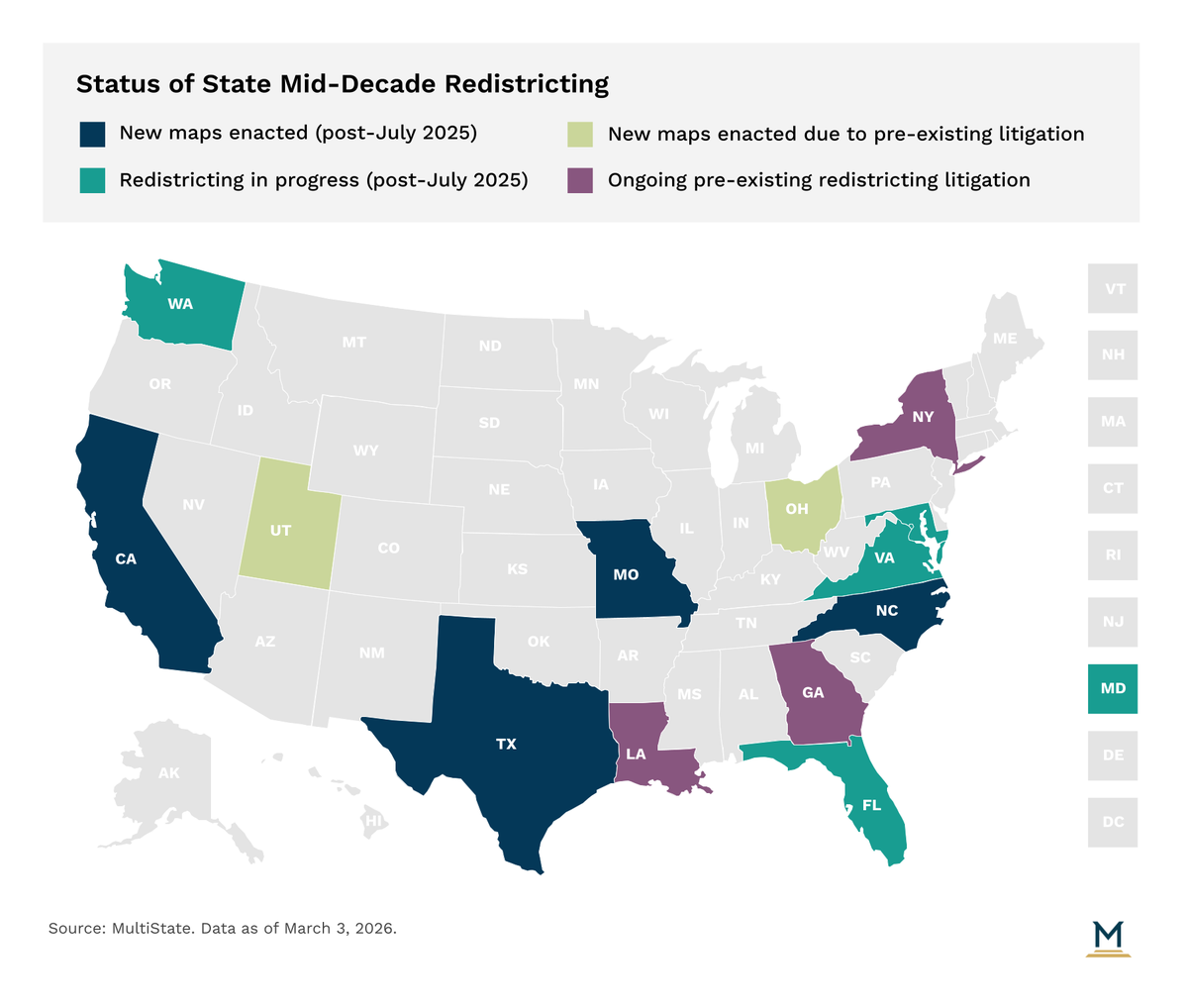
Since this summer, four states, including California, Missouri, North Carolina, and Texas have managed to adopt updated congressional maps that would likely increase either Republican or Democratic seats in the House.
California passed a ballot measure on November 4, 2025 that permits maps passed by the legislature in August to take effect. The new plan would purportedly allow Democrats to win 47 seats instead of 41 under the current plan (Democrats won 43 seats under the existing plan in 2024). The California Republican Party and the U.S. Department of Justice challenged the new map, alleging that it violated prohibitions against racial gerrymandering by attempting to increase the voting power of the Latino population. A federal three-judge panel rejected the claim, asserting that the new map consisted of partisan and not racial gerrymandering. While Republicans appealed the decision to the U.S. Supreme Court, the Court denied the case, effectively clearing the way for its use in the 2026 elections.
Need to track how redistricting changes affect your state priorities? As congressional maps shift across the country, understanding the political landscape in your priority states is essential for effective government affairs strategy. MultiState's political and policy research service helps organizations navigate these changes. Learn more about our Political & Policy Research Service →
Missouri's Governor Mike Kehoe called a special session at the end of August 2025 to redraw congressional maps to give Republicans an additional seat in the House of Representatives. The resulting map was enacted on September 28; however, since that time, the map has faced a variety of legal challenges. The NAACP filed a case against the new maps, contending that the Governor only has the authority to call a special session for "extraordinary occasions," and the redistricting map did not rise to such a standard. This month, however, a Cole County judge ruled that the Governor did have the authority to call the special session. Voters have also launched their own opposition to the map through a petition with approximately 300,000 signatures calling for a referendum election on the new maps. Trials were held this month in two separate cases related to the referendum, one challenging the state's ballot language as prejudicial and another to determine whether the new map should be suspended pending the referendum vote. While the results of these cases will likely be delivered soon, they will undoubtedly be appealed.
In October 2025, North Carolina's legislature passed a new congressional map designed to increase Republican representation in Congress by one seat. The maps were immediately challenged by voting rights groups as being unconstitutional racial discrimination; however, a federal-three judge panel denied a preliminary injunction against the maps, stating that the plaintiffs had not shown that they were likely to succeed on the merits of the claim. While it was thought that the plaintiffs would appeal the case to the Supreme Court, the case was unexpectedly dropped in January, meaning that use of the new map in November is all but assured.
Donald Trump's pressure on the state of Texas proved successful and a new congressional map targeting five Congressional Democratic seats was enacted on August 29, 2025. Plaintiffs already suing Texas regarding their previous map amended their complaints to challenge the new map based on violations of both the Voting Rights Act and the Constitution. A three-judge panel ruled that the new map was an unconstitutional racial gerrymander in October; however, the state appealed the case to the Supreme Court, which granted a stay against enforcement of the previous ruling until the Court is able to consider the state's request. Unless the Supreme Court takes further action, the newest congressional map will be used in the 2026 election.
Four other states are attempting to follow through with their own mid-decade redistricting in response to President Trump's campaign. Virginia legislators are seeking to have constituents vote on a constitutional amendment authorizing the legislature to undertake mid-decade redistricting that could create up to four more Democratic seats in Congress. While a lower court struck down the amendment, the Supreme Court ruled that the special election could proceed while litigation continued. In Florida, the House Select Committee on Congressional Redistricting began creating new maps in December of 2025, and Governor Ron DeSantis called for a special session to discuss the redistricting to begin on April 21, 2026. A bid to block the Governor's move was rejected by the Florida Supreme Court this month. Both Maryland and Washington have also introduced legislation in 2026 calling for their own redistricting, although both face steep challenges. While Maryland was successful in passing a bill through the House calling for its own redistricting, its path through the Senate is not quite as smooth, and the composition of Washington's legislature makes it unlikely that a constitutional amendment there would garner the two thirds majority necessary in each house to pass.
At the heart of many of the redistricting suits is the question as to whether or not the new maps constitute legal partisan gerrymandering or unconstitutional racial gerrymandering. The U.S. Supreme Court was due to provide guidance on this issue during its last session in Louisiana v. Callais, however the court ordered the case to be re-argued in October 2025. In Louisiana, the courts invalidated the state's voting district maps on the basis of racial discrimination. However, once those maps were redrawn, plaintiffs argued that the new maps, themselves, were unconstitutional racial gerrymanders as they were motivated primarily by racial concerns. The Supreme Court's decision will dictate how states must balance the prohibition against racial gerrymandering with the strategies necessary to prevent disenfranchisement of minority populations. Considering that many of the Supreme Court's decisions are not released until June, state redistricting plans could remain in turmoil right up to November.
Federal and state legal activity can have significant policy and regulatory implications for businesses and organizations. If your organization would like to further track federal and state legal activity, please contact us.
October 20, 2026 | Bill Kramer

October 20, 2026 | Mary Kate Barnauskas

October 16, 2026 | Bill Kramer