Elections & Campaigns
The Biggest Governor Turnover Since 2010
October 20, 2026 | Bill Kramer
December 10, 2025 | Bill Kramer
-238a17-1200px.jpg)
Key Takeaways:
Missouri is already gearing up to be ground zero of the ballot measure wars of 2026. Ballot measures are a unique aspect of direct democracy in many states — particularly the back and forth between legislatures and the voters on who has the upper hand to enact new policies. A year out from the November 2026 midterm elections, Missouri is already shaping up to be a perfect example of this battle as well as highlighting many of the high-profile issues heading to the ballot these days. The state's 2026 ballot is likely to feature fights over reproductive rights, minimum wage, and redistricting — while voters simultaneously decide whether to make citizen initiatives harder to pass in the future.
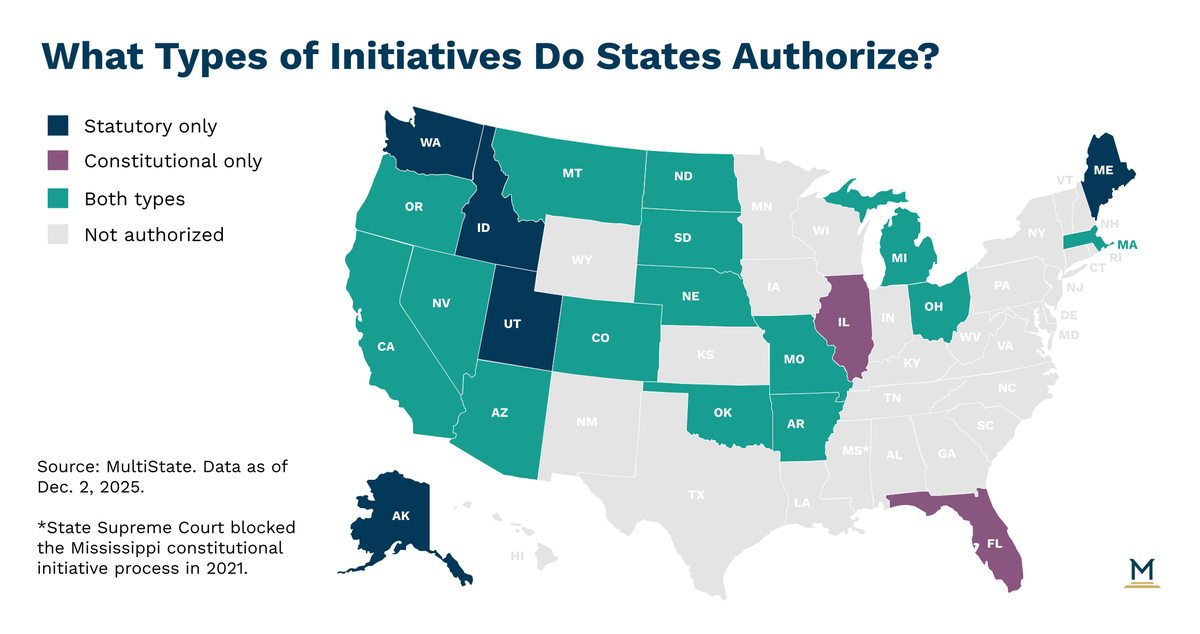
In 2024, voters approved a series of high-profile measures to legalize sports betting (Amendment 2), establish a constitutional right to reproductive freedom (Amendment 3), and increase the state’s minimum wage and require paid sick leave for employees (Proposition A).
In response, lawmakers have already placed a proposed constitutional amendment on the 2026 ballot (Amendment 4) which, if approved by voters, would require citizen-initiated constitutional amendments to receive majority approval not just statewide, but in each of Missouri's eight congressional districts separately. Ballotpedia's analysis found that every citizen-initiated constitutional amendment since 2020 would have failed under Amendment 4's requirements because none achieved majorities in all eight districts (specifically, all would have failed in the state’s conservative District 7). The League of Women Voters of Missouri has stated that the requirement would make passing citizen initiatives "almost impossible."
Additionally, lawmakers fought back against Proposition A this year by repealing the voter-approved paid sick leave requirements as well as the indexing of the minimum wage to inflation (MO HB 567). In response, Prop A proponents are planning to place a constitutional amendment restoring those policies before the voters on the 2026 ballot. Since Prop A was an initiated statute, lawmakers can amend and repeal those statutes enacted by the voters; as a constitutional amendment, only the voters themselves could repeal the policies if approved in 2026.
But paid leave and minimum wage disputes have played out via the ballot for years. One of the latest flashpoints on the ballot has been around abortion post-Dobbs decision. Last year, voters approved a constitutional amendment to enshrine the right to an abortion up to the point of fetal viability. This year, lawmakers sent their own amendment onto the 2026 ballot (also designated Amendment 3) that would repeal that guarantee. A judge forced the Missouri Secretary of State to revise the language of the ballot measure, which originally stated that it would “amend” instead of “repeal” the reproductive rights guarantee in the state constitution. The 2026 ballot measure also includes language to prohibit gender transition procedures for minors.
Beyond these recurring fights, a newer trend is emerging: mid-decade redistricting. In September, lawmakers in Missouri approved a new congressional district map to eliminate one of two seats held by Democrats representing Missouri in Congress for the 2026 midterm election. Hours after the map was approved by lawmakers, opponents submitted a referendum proposal for the 2026 ballot to repeal the law setting the new districts. If opponents are able to gather the required 106,000 signatures by a December 11 deadline, the law and the new map itself would need to be put on hold until after that 2026 referendum vote.
To make that more difficult, the governor waited until two weeks after passage to sign the bill into law. Missouri’s other statewide officeholders joined in when the secretary of state held off approving the referendum for signature gathering until October 14, giving opponents less than two months to collect the required signatures. The secretary has also told the group that the 90,000 signatures gathered after lawmakers passed the new maps would not count. Finally, the state’s attorney general filed a lawsuit against the referendum group, arguing that the referendum is unconstitutional.
Missouri lawmakers are demonstrating all four of the strategies I outlined in the “Anti-Ballot Measures Playbook.” Next year’s Amendment 3 is a version of raising the threshold to approve a ballot measure, the secretary of state has tried to make it harder to qualify for the ballot and has crafted a ballot measure description in a way that the courts ruled inappropriate, lawmakers repealed and amended policy directly approved by voters, and, finally, adding the popular gender transition for minors ban to the abortion measure is a form of “ballot candy” (i.e., adding a popular provision in boost the chances of the unpopular main objective policy).
Regardless of whether the redistricting referendum lands on the ballot, 2026 is already going to be another big ballot measure election in Missouri and an excellent illustration of the conflict between lawmakers and voters when it comes to ballot measures. We’ve highlighted many of the strategies used by both sides above in other states over the past few years. And Missouri is unlikely to be the only such case.
This article appeared in our Morning MultiState newsletter on December 2, 2025. For more timely insights like this, be sure to sign up for our Morning MultiState weekly morning tipsheet. We created Morning MultiState with state government affairs professionals in mind — sign up to receive the latest from our experts in your inbox every Tuesday morning. Click here to sign up.
October 20, 2026 | Bill Kramer
October 20, 2026 | Mary Kate Barnauskas

October 16, 2026 | Bill Kramer