-bf52bc-400px.jpg)
Data Centers, Elections & Campaigns, Energy & Environment
Democrats Try to Flip Utility Commissions Over Energy Costs
November 1, 2026 | Billy Culleton
November 4, 2026 | Morgan Scarboro
Key Takeaways:
The election results are clear: Democrats made major gains at nearly every level of government on Tuesday. While much of the focus has been on the new Congressional makeup, political dynamics in the states have shifted even more dramatically. Democrats broke up longtime GOP trifectas by breaking into traditional red states like Texas, Ohio, Georgia, and Iowa and added to their own trifecta control through Minnesota, Michigan, Nevada, Wisconsin, Pennsylvania, and Arizona (based on current projections). Democrats also picked up the governorship in Georgia, Ohio, Iowa, Texas, and (maybe) Kansas.
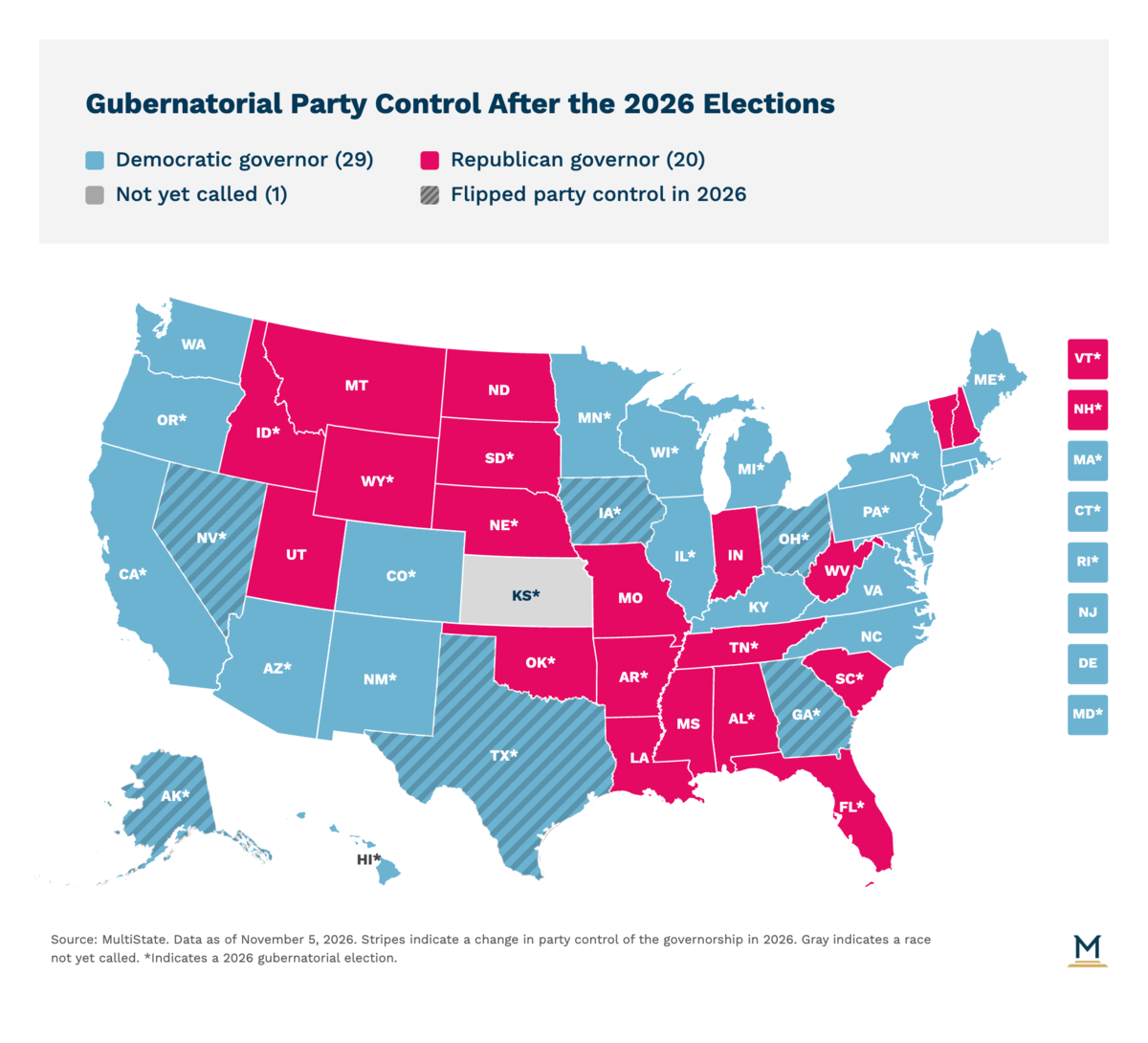
For data centers specifically, the biggest implications will likely be in Georgia and Texas. There is a large concentration of existing or planned data centers in both of these states, and both Governor-elect Hinojosa (D - TX) and Governor-elect Bottoms (D - GA) support temporary moratoriums. Additionally, Democrats took the Texas House, and Democrats broke up the Republican supermajority in Georgia. Though data centers have not proven to be a majorly partisan issue, incoming Democratic leadership will make it easier to push through moratoriums or stricter regulations.
Data center moratorium
A data center moratorium is a temporary halt on the approval or construction of new data centers within a jurisdiction. These moratoriums are typically enacted by local or state governments to allow time for further study of the impacts of data centers on energy, water, zoning, and community resources.
From my perspective, data centers were not a major factor in many of these executive-level elections. The blue wave was so significant across the country that it's impossible to generally extrapolate data-center specific impacts. Additionally, many candidates on both sides of the aisle have coalesced around one or two positions: increased regulations or temporary moratoriums. And in many states, candidates in both parties took the same general stance. But even in places where they didn't take the same position, the outcome varied. In the Pennsylvania gubernatorial race, Gov. Shapiro (D) was re-elected on a platform of data center regulation (and has talked publicly about their benefits), while his opponent Stacy Garrity supported a moratorium. I do suspect that data centers played a larger role in some of the state-level legislative races, but that's not unexpected as many of those races hinge on hyperlocal disagreements.
While it might be difficult to extrapolate from executive-level elections, voters were loud and clear at the ballot box. Of the 35 local ballot measures related to data centers, voters approved 34 new restrictions or moratoriums on data centers (included in the count is voters disapproving of new deals with data centers). The single holdout was Harwood, North Dakota, where voters struck down a proposal to require additional city review of new industrial projects, including data centers.
Continued constituent disapproval coupled with at least 1,000 new legislators across the country (not party flips, actually new members!) sets up 2027 as a massive year for data center policy.
Last year, states considered hundreds of data center bills, and we expect activity to continue growing in 2026. To stay on top of this rapidly evolving landscape, we've launched MultiState Policy Watch: Data Centers – a subscription featuring legislative analysis, trend summaries, and expert insights across energy, tax, water, zoning, and other policy areas impacting data centers. Sign up here.
Which states are most likely to see new data center regulations after the recent election results?
Georgia and Texas are predicted to face the biggest implications for data centers. Both Governor-elect Hinojosa in Texas and Governor-elect Bottoms in Georgia support temporary moratoriums, Democrats took the Texas House, and Democrats broke up the Republican supermajority in Georgia.
How did local ballot measures on data centers turn out in the recent election?
Of 35 local ballot measures related to data centers, voters approved 34 new restrictions or moratoriums. The only exception was Harwood, North Dakota, where voters struck down a proposal to require additional city review of new industrial projects, including data centers.
Do data center moratoriums break along party lines?
Data centers have not proven to be a majorly partisan issue, and many candidates on both sides of the aisle have coalesced around increased regulations or temporary moratoriums. In many states, candidates in both parties took the same general stance.
What happened in the Pennsylvania governor's race regarding data center policy?
Gov. Shapiro was re-elected on a platform of data center regulation and has talked publicly about their benefits, while his opponent Stacy Garrity supported a moratorium. The two candidates took different positions on data centers, but Shapiro prevailed.
Why is 2027 expected to be a major year for state data center legislation?
Continued constituent disapproval of data centers, combined with at least 1,000 new legislators across the country, sets up 2027 as a massive year for data center policy. The 34 approved local ballot measures restricting data centers further signals strong voter sentiment heading into the next legislative cycle.
November 1, 2026 | Billy Culleton
October 23, 2026 | Troy Flanagan
October 13, 2026 | Billy Culleton