-ffe156-400px.jpeg)
Data Centers
Voters in Six States Will Decide Future of Data Center Construction
September 24, 2026 | Kim Miller
October 13, 2026 | Billy Culleton
Key Takeaways:
The sheer power demand from data centers has recently pushed state lawmakers to consider new policies that allow large energy users to access dedicated power sources without everyday ratepayers shouldering the cost. These arrangements, called "behind-the-meter" or "bring-your-own-power," share the same goal: addressing public concern over rising electricity costs while giving data center developers alternatives to lengthy utility interconnection queues.
While utilities and large-load users have long negotiated power purchase agreements for generation, state policymakers are seeking to make behind-the-meter arrangements more common and easier to establish. This type of legislation saw more activity in 2025 than in 2026 but is likely to remain of interest to state lawmakers as more data centers connect to the grid.
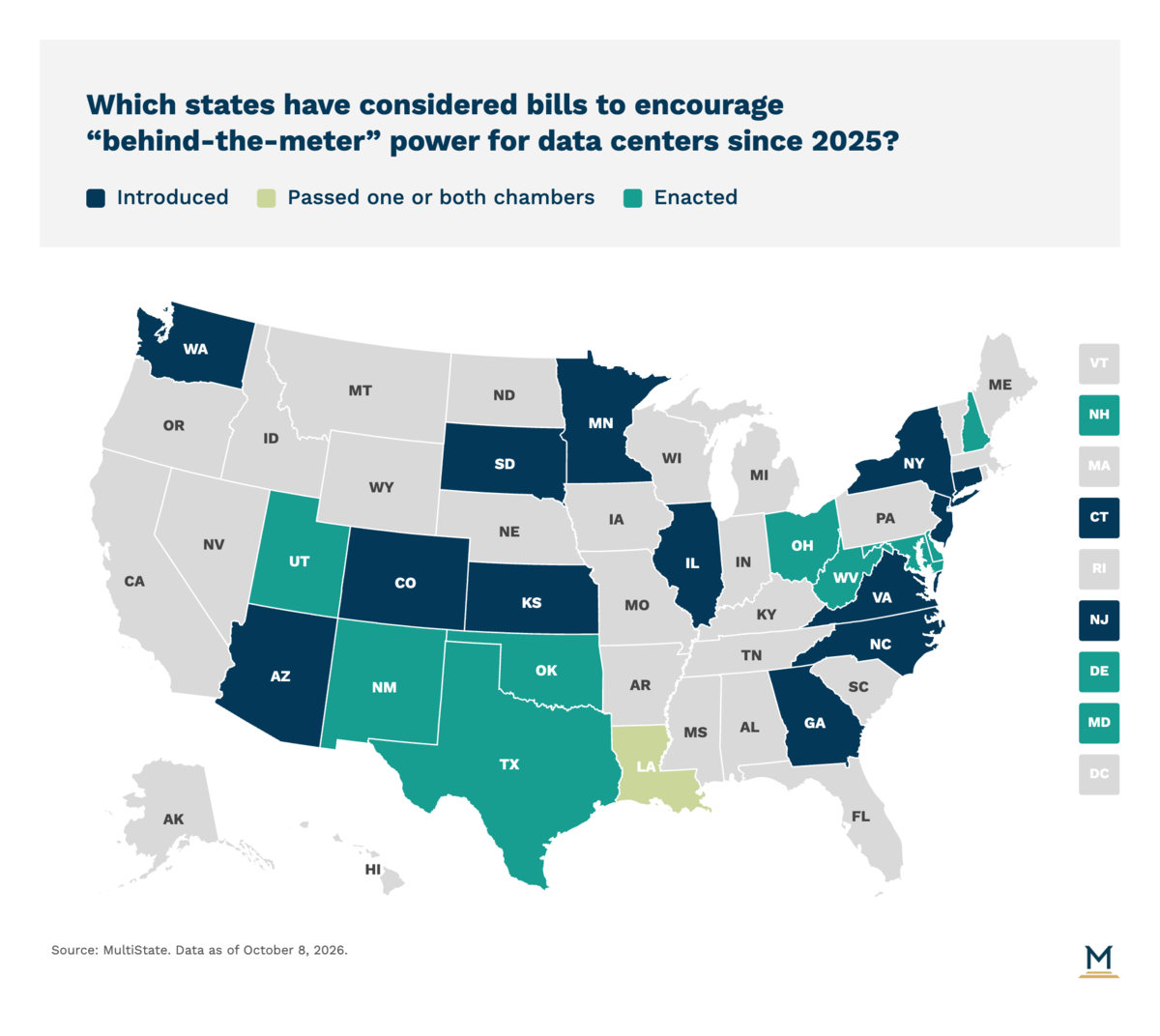
Last year, seven states enacted legislation allowing data centers to source their own energy.
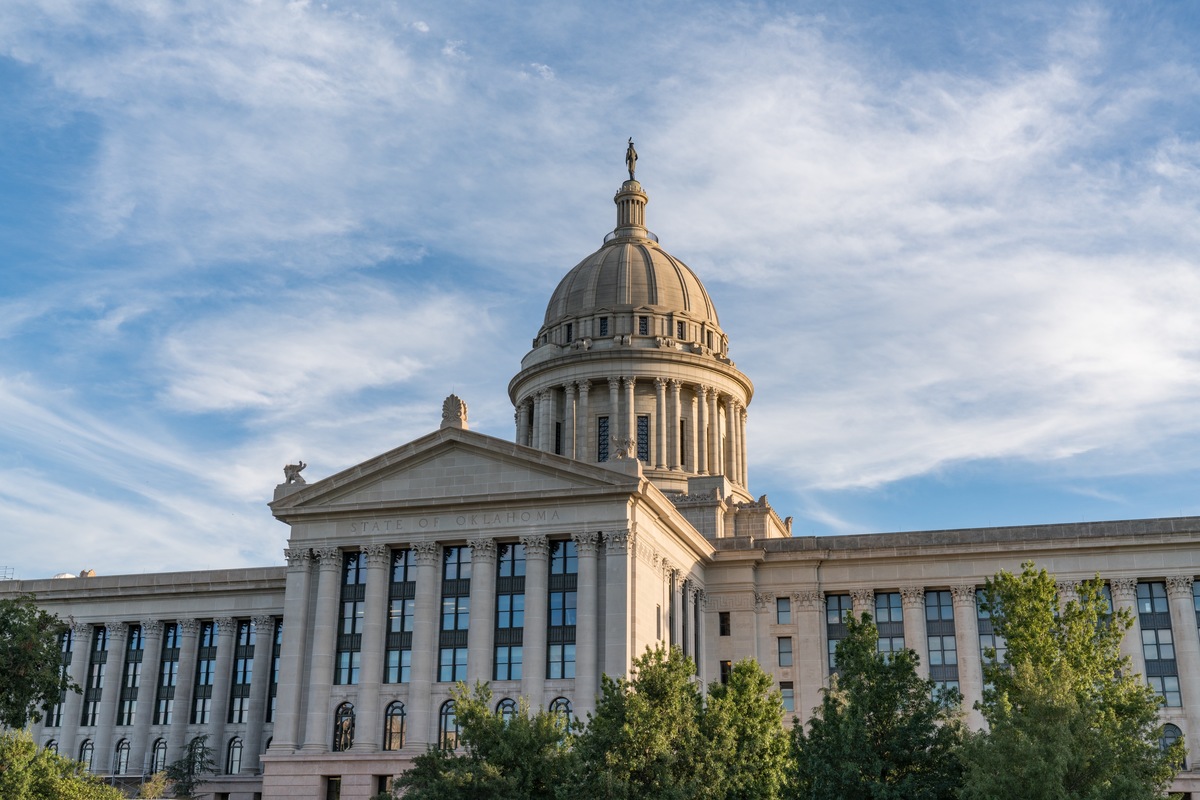
In May 2025, Oklahoma Governor Kevin Stitt (R) signed SB 480, which exempts large users from being defined as public utilities if they provide their own electricity. The bill also allows data centers to contract with regulated and non-regulated utilities to house onsite generation.
Ohio lawmakers followed suit by enacting a sweeping energy bill (HB 15) that removes barriers for large energy users to self-generate power, either directly or through a third party. In addition, the bill removed previous rules requiring self-generation sources to be located on a customer's premises.
In Utah, lawmakers created a pathway for behind-the-meter generation by allowing large-load users to enter the competitive market if an agreement is not reached with the utility within 90 days. SB 132 allows data centers to source energy from the grid through a third-party supplier or from a source entirely separate from the grid.
Texas, a state known for its energy production, also enacted a major bill in 2025 that addressed behind-the-meter options for data centers. SB 6, which broadly sets standards for how data centers can interconnect with the grid, allows large-load users to connect directly to an existing stand-alone generation source. The bill also requires utility regulators to direct data centers to source energy from backup generators during emergency power situations.
Finally, New Hampshire lawmakers allowed off-grid power generation for large users, with the main caveat being that they have to be completely independent of the grid (HB 672). Bills that create this type of arrangement, called "consumer-regulated electricity" (or CRE) were also considered in Maryland (HB 1219 & SB 947), Illinois (HB 4163), New Jersey (A 5431), and New York (S 8037). However, none of these bills advanced out of their committee of origin.
Behind-the-Meter
Behind-the-meter refers to energy generation or storage systems that are located on the customer's side of the utility meter, allowing large users like data centers to generate or source their own electricity independently from the main utility grid. These arrangements can reduce reliance on the grid and help avoid passing costs onto other ratepayers.
Consumer-Regulated Electricity (CRE)
Consumer-regulated electricity (CRE) is a system where large energy users, such as data centers, operate their own private electricity networks or source power independently, rather than relying solely on traditional public utilities. This model allows for greater flexibility and can help large users avoid regulatory and cost structures imposed on standard utility customers.
Some behind-the-meter bills explicitly make it possible for multiple large users to source off-grid power through microgrids. As part of their efforts to attract more data center development, West Virginia lawmakers created a microgrid program (HB 2014) that allows data centers to operate in certified microgrid districts. The law gives the state authority over local governments in regulating microgrids as part of its effort to attract data center users to West Virginia.
In New Mexico, lawmakers enacted microgrid legislation that is more regulatory in nature. HB 93 allows customers to enter agreements with investor-owned utilities in the state for microgrid operation, including generation and distribution for onsite use.
By the time legislative sessions kicked off in January 2026, data centers had become one of the most contentious issues facing lawmakers, especially at the local level, where moratoriums were being enacted. Because of this, the politics of enacting laws that speed up the process for data centers to connect to the grid became more challenging.
New Jersey lawmakers enacted a pro-clean-energy measure (A 796) that directs the state's Board of Public Utilities to create energy rates that encourage large loads to bring their own generation and storage, as long as it comes from non-carbon-emitting sources. Additionally, lawmakers in Arizona (HB 4097) and Virginia (SB 751 & HB 1087) considered bills that provide pathways for large users to source behind-the-meter power.
In Louisiana, a failed attempt (SB 490) to create a pathway for behind-the-meter power sourcing encouraged the Louisiana Public Service Commission (LPSC) to open its rulemaking docket on private-use electrical networks.
Meanwhile, proposals in Connecticut and Maryland made behind-the-meter generation a requirement to enter the market rather than an option that data centers could exercise. Maryland's SB 596 and HB 940 banned large-load customers from connecting to the grid unless 25% of their capacity is met by either backup storage or a demand-response program. Connecticut's HB 5469 requires load customers of 50 MW and above to receive 100% of their electricity from a colocated source or off-grid supplier.
While this year saw intense pushback against data centers, it is not yet clear how that will affect long-term development plans or shape energy demand. Many tech companies are still moving forward with plans to construct data centers across the country. As long as data centers continue to connect to the grid, questions about how to power them are sure to follow.
This year, PJM, the Mid-Atlantic grid operator serving the largest concentration of data centers, asked the Federal Energy Regulatory Commission (FERC) to approve a rule that would require data centers to bring their own power to the grid. If approved, states would each have to implement their own rules governing how costs would be allocated across the rate base. In states such as Arkansas, where behind-the-meter arrangements have already been made, there is also growing pressure on utilities not to spread data center costs to residential ratepayers. These policies are likely to play a central role as lawmakers consider both how to accommodate growing data center demand and how to address high household energy costs.
Last year, states considered hundreds of data center bills, and we expect activity to continue growing in 2026. To stay on top of this rapidly evolving landscape, we've launched MultiState Policy Watch: Data Centers – a subscription featuring legislative analysis, trend summaries, and expert insights across energy, tax, water, zoning, and other policy areas impacting data centers. Sign up here.
Which states passed laws allowing data centers to source their own power rather than relying solely on the utility grid?
Oklahoma, Ohio, Utah, Texas, New Hampshire, West Virginia, and New Mexico all passed legislation in 2025 creating pathways for data centers or large-load users to source their own energy. Oklahoma's SB 480 exempts large users from being defined as public utilities if they provide their own electricity, Ohio's HB 15 removes barriers for large energy users to self-generate power, and Utah's SB 132 allows data centers to source energy from a third-party supplier or a source entirely separate from the grid.
What does Texas SB 6 require data centers to do during emergency power situations?
Texas SB 6 requires utility regulators to direct data centers to source energy from backup generators during emergency power situations. The bill also allows large-load users to connect directly to an existing stand-alone generation source and broadly sets standards for how data centers can interconnect with the grid.
What is the difference between how Maryland and Connecticut approached behind-the-meter requirements for large energy users in 2026?
Maryland's SB 596 and HB 940 banned large-load customers from connecting to the grid unless 25% of their capacity is met by either backup storage or a demand-response program. Connecticut's HB 5469 goes further, requiring load customers of 50 MW and above to receive 100% of their electricity from a colocated source or off-grid supplier.
What did PJM ask FERC to approve regarding data center power sourcing?
PJM, the Mid-Atlantic grid operator, asked the Federal Energy Regulatory Commission to approve a rule that would require data centers to bring their own power to the grid. If approved, states would each have to implement their own rules governing how costs would be allocated across the rate base.
Which states considered consumer-regulated electricity bills for large users but did not advance them out of committee?
Maryland, Illinois, New Jersey, and New York all considered bills creating consumer-regulated electricity arrangements, but none of these bills advanced out of their committee of origin. New Hampshire did pass such a measure, HB 672, which allows off-grid power generation for large users on the condition that they be completely independent of the grid.
September 24, 2026 | Kim Miller
September 18, 2026 | Morgan Scarboro
September 1, 2026 | Morgan Scarboro, Izzy Aaron