
Elections & Campaigns
The Biggest Governor Turnover Since 2010
October 20, 2026 | Bill Kramer
March 13, 2026 | Sandy Dornsife
Key Takeaways:
During election years, legislative sessions often serve as proxy venues for early campaign efforts. Legislators up for re-election in the states may introduce legislation to bolster their visibility among voters by addressing the perceived major obstacles of the time. The buzzword for this year is obvious: “affordability.”
Democrats, and even some Republicans, have become focused on the message of affordability in hopes of leveraging current high prices into electoral victories. Republicans holding trifecta control at the federal level face a different challenge; they must push back on claims that Democrats are exaggerating economic pain while also demonstrating responsiveness to constituents feeling real cost pressures. State legislators have used a diverse array of legislative tactics this year in order to appear responsive to affordability concerns across multiple areas of the economy.
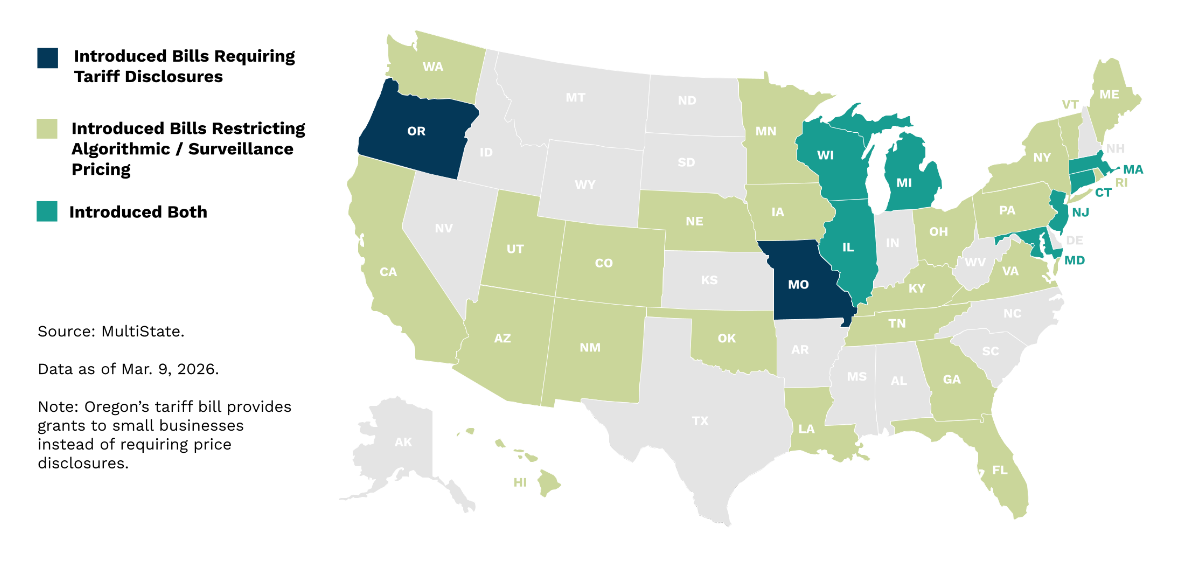
One strategy state lawmakers, particularly Democrats, are pursuing is to focus on highlighting the economic costs of tariffs. Lawmakers in nine states have introduced over fifteen bills addressing tariffs. Tariffs are generally a federal matter, making this an unusual area of state legislative activity. Lawmakers in Connecticut (CT SB 4) and Massachusetts (MA H 5036) have introduced legislation that would require car manufacturers to affix a label that discloses estimated costs of the tariffs to their vehicles. In Missouri (MO SB 804, MO SB 958) and Wisconsin (WI AB 437, WI SB 438), Democrats in the minority have introduced legislation that would require sellers in the state to include the cost of a tariff on all invoices and receipts. A bill in Oregon (OR HB 4061) has seen the most movement so far, having cleared the first chamber. This bill would provide micro-enterprise tariff adjustment grants to small businesses for costs increased by federal tariffs.
Alternatively, members of both parties have blamed new pricing technology for contributing to the affordability issue.
State legislatures have been flooded with bills seeking to restrict the use of algorithmic pricing. Of course, no debate these days is complete without mentioning artificial intelligence (AI), and algorithmic pricing often uses AI-driven software to continuously update prices based on various factors such as demand and competitor prices, sometimes even offering different customers different prices on the same product at the same time.
Opponents argue that this software is intended to maximize profits and could even facilitate price collusion among competing sellers. While most of these bills are proposed by Democrats, many Republicans have seen this issue as an opportunity to address constituent cost concerns. Republicans in Illinois (IL HB 4717), Ohio (OH SB 328), Tennessee (TN SB 1807), and Utah (UT SB 293) have all sponsored bills addressing algorithmic pricing.
Beyond retail pricing, many of these bills extend algorithmic restrictions to the workplace, prohibiting the use of automated systems or surveillance data in setting employee wages. Examples include Colorado (CO HB 1210) and Maryland (MD HB 148).
With housing costs making up one of the most significant percentages of monthly household expenses, it is no surprise that legislators have also taken aim at the significant increases in rent over the past five years. The increase in demand and lack of supply have driven prices up for both home purchases and rental units. Governor Wes Moore (D) has addressed high housing costs as one of the pillars of his affordability campaign in Maryland. Gov. Moore supports a bill (MD SB 389) that would remove zoning and financial barriers to the creation of jobs and housing near public transit, expanding the housing market within reasonable commuting distance. This echoes major housing reform efforts in other states, like California.
Georgia Rep. Tangie Herring (D) also introduced a bill (GA HB 1166) that would ease zoning restrictions to create more affordable housing in the state. Similar to the debate over algorithmic pricing, attempts to control housing costs have proven to have bipartisan appeal. In Congress, the 21st Century ROAD to Housing Act, sponsored by Arkansas U.S. Rep. French Hill (R), advanced to the U.S. Senate. The bill combines elements from at least 43 other pieces of legislation, twenty-seven of which have bipartisan sponsors aimed at addressing housing affordability.
Taken together, the volume and variety of affordability-related legislation this year reflects legislators acutely aware that cost-of-living concerns will define the 2026 electoral landscape. Whether these bills pass is almost beside the point. For many lawmakers, introduction is the message. Advocates and government affairs professionals should expect the affordability frame to persist and expand as sessions progress, particularly if federal tariff and housing policies remain unsettled.
MultiState’s team is actively identifying and tracking elections and campaigns issues so that businesses and organizations have the information they need to navigate and effectively engage. If your organization would like to further track these or other related issues, please contact us.
October 20, 2026 | Bill Kramer

October 20, 2026 | Mary Kate Barnauskas

October 16, 2026 | Bill Kramer