
Elections & Campaigns, Tax & Budgets
Why Chicago's Budget Crisis Matters for the City's Mayoral Race
August 25, 2026 | Jose Perez
April 1, 2026 | Mary Kate Barnauskas

Key Takeaways:
Last week, the Oklahoma House of Representatives approved two measures that would put the question of Medicaid expansion back on the ballot. In 2020, Oklahoma voters approved a citizen-initiated constitutional amendment that expanded Medicaid under the Affordable Care Act to adults with incomes below 133 percent of the federal poverty level. Because the measure is enshrined in the state constitution, lawmakers cannot make changes to the program without voter approval, setting up a dynamic playing out in several states where legislatures are seeking to revisit voter-approved Medicaid expansion.
Lawmakers have proposed two approaches. One of the proposals (OK HB 4440) would remove Medicaid expansion from the state constitution and place it in statute, allowing lawmakers to repeal or amend the provisions in the future. The second measure (OK HJR 1067) would amend the state constitution to authorize the legislature to end Medicaid expansion if the federal financial participation rate for the program drops below 90 percent. The measures now head to the Senate, and if approved, would be placed on the ballot for a special election on August 25, 2026, for voters to approve or reject. If voters were to approve both measures, the statutory approach would take effect over the conditional trigger. Governor Kevin Stitt (R) framed the effort as necessary to “protect the program for those who really need it” in his State of the State address this year.
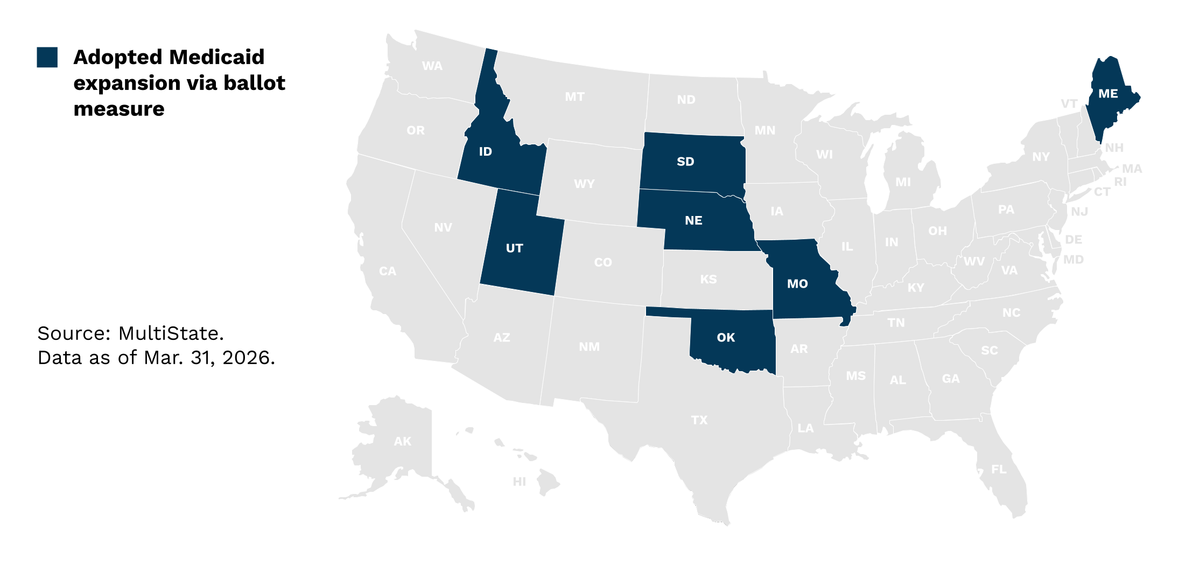
Citizen-initiated ballot measures have played a central role in the expansion of Medicaid in states where legislatures and governors did not act. Starting with Maine in 2017, voters in seven states used the process to adopt expansion. Notably, voters in Oklahoma, Missouri, and South Dakota adopted expansion via constitutional amendments, while other states used statutory measures, which are generally easier for legislatures to revise. With Medicaid spending increasing and federal funding cuts expected over the next decade, states like Oklahoma are seeking adjustments to voter-approved measures.
Lawmakers in South Dakota have already placed a similar measure on the November 2026 general election ballot that would end Medicaid expansion if federal funds dropped below 90 percent. Ten states already have similar “trigger” laws that automatically scale back Medicaid expansion if federal funding drops below a specific threshold. South Dakota lawmakers have had previous success in making changes to Medicaid expansion via the ballot. Voters approved a legislatively referred constitutional amendment in 2024 to allow the South Dakota Legislature to impose work requirements on the Medicaid expansion population.
The Missouri General Assembly is considering a similar approach (MO HJR 154) this session. The measure would eliminate a constitutional provision that prohibits imposing greater eligibility burdens or restrictions on the Medicaid expansion population and establish work requirements that mirror federal standards. The Missouri House passed the measure, and it is now awaiting action in the Senate with adjournment scheduled for mid-May.
As we have covered previously, ballot measures are often a blunt instrument in policymaking. They can enact sweeping policy changes, but they can be difficult to refine once enacted. That dynamic is now at play in the Medicaid expansion debate. Expansion ballot measures have historically been popular with voters, but state leaders in Oklahoma, South Dakota, and Missouri are making the case that fiscal and policy conditions have changed enough to warrant revisiting these measures. Whether voters agree will be tested directly at the ballot box, starting with Oklahoma's special election in August 2026.
The ever-evolving state health policy landscape will continue to influence how health care organizations make business decisions. MultiState’s team pulls from decades of expertise to help you effectively navigate and engage. MultiState’s team understands the issues, knows the key players and organizations, and we harness that expertise to help our clients effectively navigate and engage on their policy priorities. We offer customized strategic solutions to help you develop and execute a proactive multistate agenda focused on your company’s goals. Learn more about our Health Care Policy Practice.
August 25, 2026 | Jose Perez

August 11, 2026 | Katherine Tschopp

July 17, 2026 | Andrew Jones