
Data Centers
What States Are Doing About Local Data Center Authority
October 23, 2026 | Troy Flanagan
March 13, 2026 | Morgan Scarboro, Billy Culleton
-eee9cd-1200px.jpeg)
Key Takeaways:
Moratoriums on data center construction have started to take hold at the local level, but efforts by states to adopt similar moratoriums haven't gained much traction this year. Local governments across the political spectrum, from New Orleans to Chandler, Arizona, have passed ordinances that temporarily pause new data center construction. These local leaders are often hearing directly and persistently from constituents about their concerns with these projects (although, as we've noted in the past, these projects also generate significant revenues for localities).
At the federal level, Vermont Senator Bernie Sanders is calling for a similar nationwide moratorium and has found some support among progressive colleagues, but this issue does not fall neatly along partisan lines.
At the state level, the picture is similarly mixed. Although they haven't gained much traction, state-level proposals have picked up in the last month. As of this writing, MultiState is tracking 14 bills introduced across 11 states that would impose statewide moratoriums on data center construction, typically to allow agencies to study impacts on energy, water, and local communities. Proposed timeframes range from three months (IL HB 4172) to four years (VT SB 205). None of the statewide proposals has passed their originating chamber.
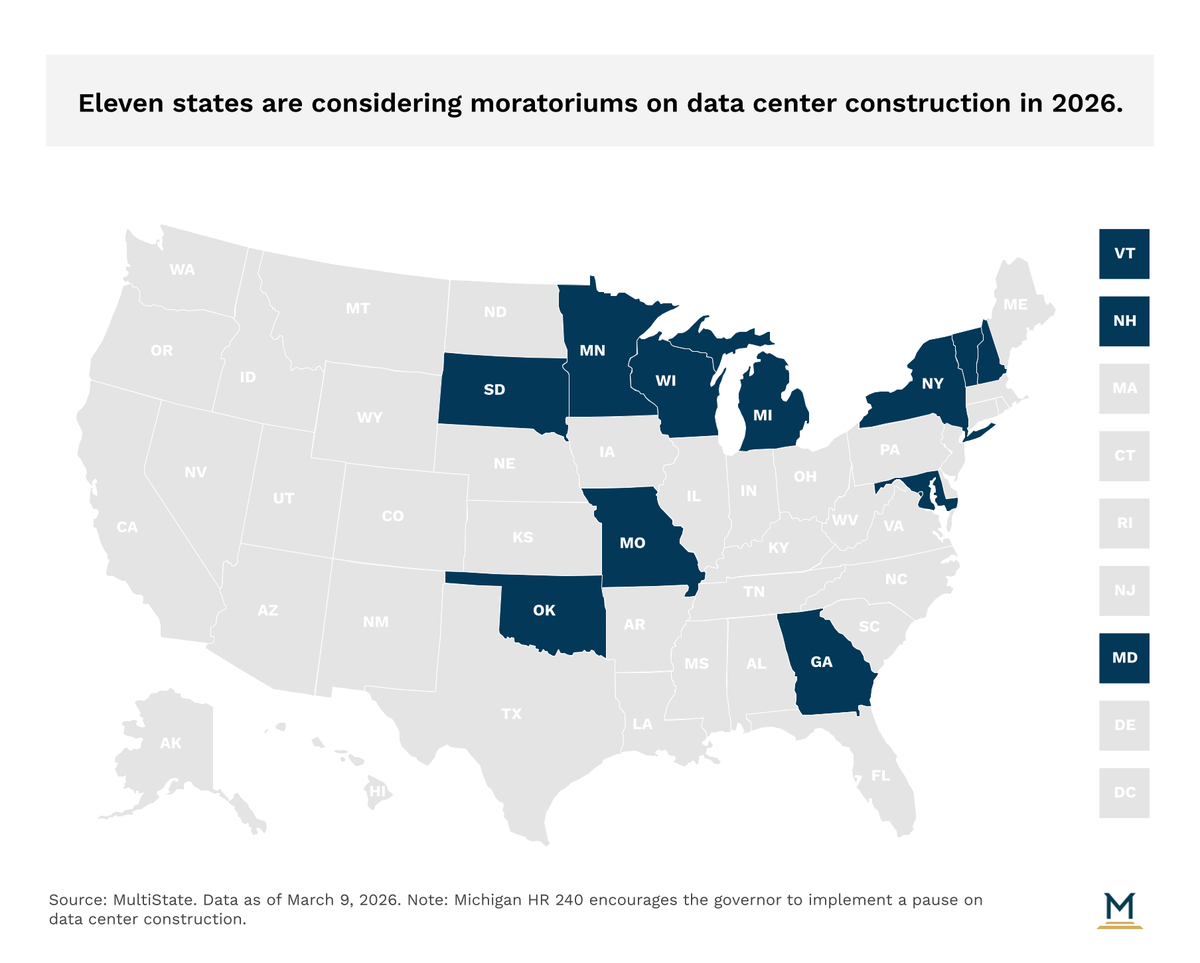
Statewide moratoriums face a different political calculus: legislators must weigh community concerns against tax revenue and economic development interests. In South Dakota, lawmakers considered two bills (SD SB 232 & SD HB 1301) to impose a one-year moratorium on expanding or building new large data centers. The sponsor of HB 1301, a member of the minority party, framed the bill as a planning tool rather than a block on economic development. Opponents countered that statewide moratoriums improperly limit local government authority. State lawmakers ultimately passed SD SB 135, which prohibits the state from limiting local governments' authority to regulate or ban data centers. It didn't kill the moratorium concept, but instead granted that authority to localities.
Majority-party sponsorship doesn't seem to guarantee success either. A few examples:
Local moratoriums, however, seem to have succeeded because they take a narrower approach that is largely driven by motivated, involved groups of citizens. Polling supports this theory: people are not strongly opposed to the construction of data centers in general, but most would oppose a project built within three miles of their residence. Dozens of localities have instituted temporary moratoriums, but protests and zoning denials of specific projects have been even more disruptive.
With local moratoriums and zoning decisions now shaping the data center landscape as much as state legislation, the action isn't just in state legislatures — it's in city halls and county boards across the country. MultiState's local government monitoring service tracks ordinances, zoning decisions, and policy activity at the local level so your team never misses a development that matters. Learn more about MultiState's local government monitoring service →
Despite rapid growth, the policy landscape for the industry remains challenging and unpredictable. While the Trump administration has been broadly supportive of data center development as a key driver of U.S. competitiveness in AI, state and local policymakers are charting their own courses (and their positions don't map neatly onto familiar partisan lines). Perhaps most critically, effective engagement requires monitoring not just Congress and 50 state legislatures, but thousands of local jurisdictions where motivated community groups have proven they can move the needle.
Last year, states considered hundreds of data center bills, and we expect activity to continue growing in 2026. To stay on top of this rapidly evolving landscape, we've launched MultiState Policy Watch: Data Centers — a subscription featuring legislative analysis, trend summaries, and expert insights across energy, tax, water, zoning, and other policy areas impacting data centers. Sign up here. For a comprehensive overview of the state data center policy landscape, see our State Data Center Policy 101 resource →
October 23, 2026 | Troy Flanagan
October 13, 2026 | Billy Culleton
-ffe156-400px.jpeg)
September 24, 2026 | Kim Miller