Key Takeaways:
- In 2026, nearly 100 state PFAS bills have been introduced across 17 states, with an additional 280 bills carried over from 2025. These bills address forever chemicals state laws through product bans, water remediation funding, and impact studies.
- PFAS bans on consumer products are expanding to include cookware, cosmetics, cleaning products, dental floss, and food packaging in states like Kansas, Missouri, and Ohio. Kentucky HB 196 requires manufacturers to report products with intentionally added PFAS sold in the state.
- PFAS restrictions on firefighting foam are gaining traction, with Florida HB 1019 phasing out foam containing PFAS between 2026 and 2029 and Missouri HB 1925 prohibiting its sale starting in 2028. Maine LD 222 provides funding for the disposal of firefighting foam containing forever chemicals.
- Republican-led states are increasingly joining efforts to restrict PFAS use, and the issue may gain additional momentum from Make America Healthy Again proponents. States continue to address PFAS through water quality measures, including Illinois HB 5475 requiring PFAS sampling for major facilities and Virginia SB 386 mandating testing of sewage sludge.
The introduction and passage of legislation addressing perfluoroalkyl and polyfluoroalkyl substances (PFAS) has been a priority for states across the country for the last several years (read all of our past coverage of PFAS).
What Are PFAS (Forever Chemicals)?
PFAS, also known as “forever chemicals,” do not break down naturally, can accumulate over time, are toxic at small levels, and are found in a wide range of consumer products such as food packaging, cookware, textile articles, cleaning products, cosmetic products, dental floss, juvenile products, menstruation products, upholstered furniture, and various other products used by consumers each day. PFAS are also found in plastics, drinking water, and firefighter personal protective equipment (PPE) and firefighting foam.
State Legislative Approaches to PFAS Regulation
States are addressing this issue via bans or restrictions on PFAS in consumer products and in firefighting PPE and firefighting foam, through funding of PFAS remediation projects in the water supply and on military installations, and by creating studies to address the broad impacts of PFAS. So far during the 2026 legislative session, nearly 100 bills have been introduced throughout 17 states. In addition, nearly 280 bills throughout 23 states have been carried over from the 2025 legislative session.
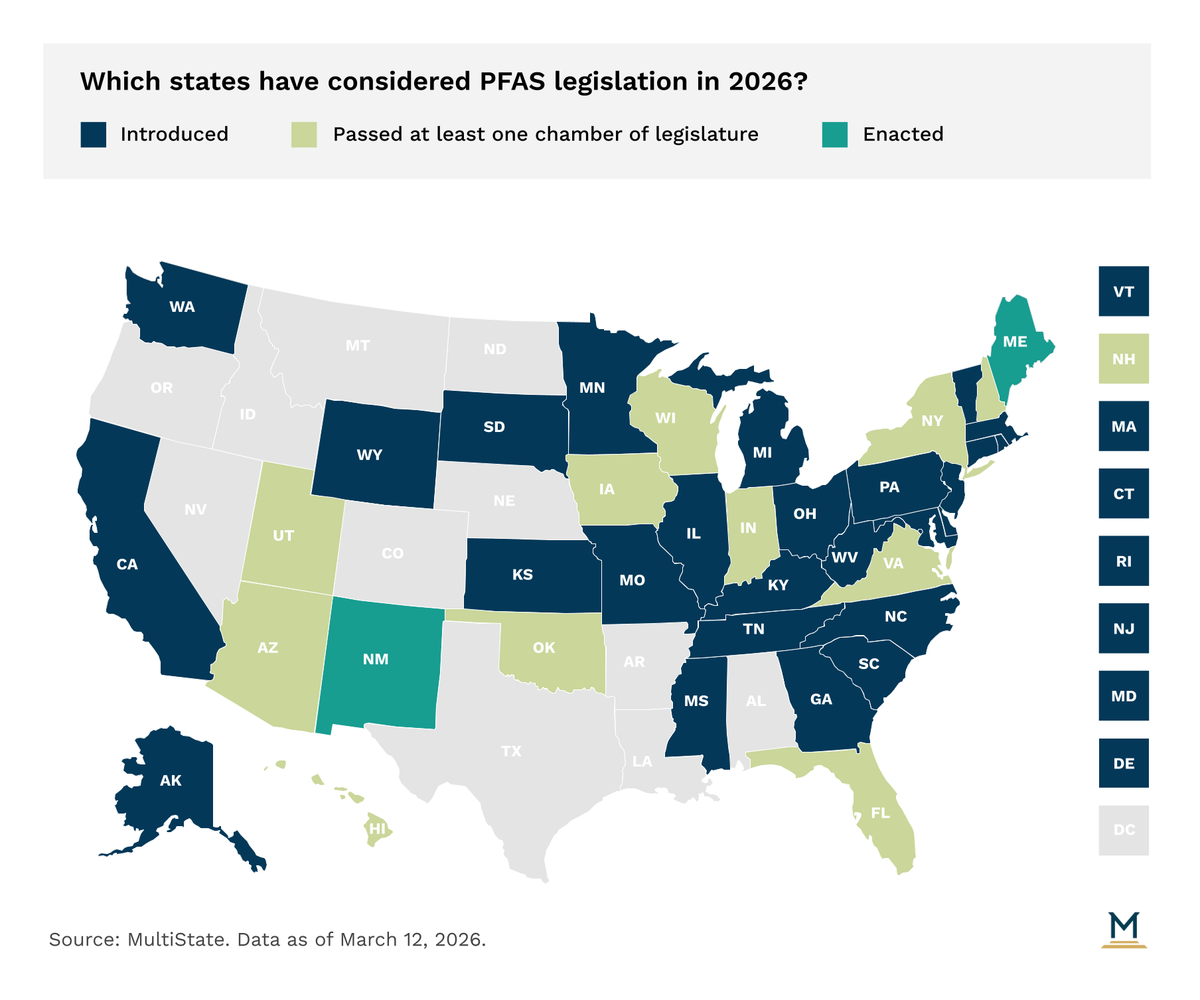
2026 PFAS Bills by State and Product Category
Below are bills of interest in the PFAS space so far this year.
Firefighting Foam and Equipment Regulations
- Florida: FL HB 1019. Phase out the use, sale, and possession of firefighting foam containing PFAS between 2026 and 2029, and require entities to report inventories and submit disposal plans for such foam.
- Maine: ME LD 222. Issues funding to contract for the take-back and disposal of firefighting and fire-suppressing foam containing PFAS.
- Missouri: MO HB 1925. Prohibit, beginning January 1, 2028, the manufacture, sale, or distribution of firefighting foam to which PFAS have been intentionally added, with exceptions for certain federally required uses at airports and for military applications.
Environmental Monitoring and Remediation Requirements
- Illinois: IL HB 5475. Require National Pollutant Discharge Elimination System (NPDES) permits for major facilities to include periodic sampling for PFAS, and prohibit the issuance of a permit for the land application of sludge or biosolids unless the application includes PFAS sample results.
- Virginia: VA SB 386. Require, beginning January 1, 2027, any owner of a sewage treatment works land applying, marketing, or distributing sewage sludge in the state to collect representative samples of the sewage sludge intended to be land applied, marketed, or distributed and have such samples analyzed by an accredited laboratory for PFAS, using U.S. Environmental Protection Agency (EPA) Method 1633, an applicable EPA revision, or another method approved by the EPA that may be allowed by the Department of Environmental Quality.
- New Mexico: NM HJM 3. Requests the Environmental Improvement Board to report on the implementation of the PFAS Protection Act that was enacted last year, and the efficacy of its rules.
Consumer Product Restrictions and Bans
- Kansas: KS HB 2674. Prohibit the sale of cookware, food packaging, and dental flosses containing intentionally added PFAS, beginning in 2027, and prohibit the sale of cosmetics and cleaning products containing intentionally added PFAS, beginning in 2028.
- Kentucky: KY HB 196. Require manufacturers of products sold in Kentucky containing intentionally added PFAS to report product and substance information to the state, and prohibit the sale of non-compliant products.
- Missouri: MO HB 2400. Prohibit the sale of cookware, cleaning products, and cosmetics containing intentionally added PFAS beginning January 1, 2027.
- New Jersey: NJ S 673 and NJ A 3744. Prohibit the sale of packaging containing PFAS.
- New Jersey: NJ S 670 and NJ A 3725. Expand the existing "Toxic Packaging Reduction Act" to prohibit the intentional introduction of additional substances in packaging, and products that are packaged in packaging, including PFAS.
- Ohio: OH HB 743. Prohibit the sale of specified products (including carpets, cleaning products, cookware, cosmetics, dental floss, feminine hygiene products, textile furnishings, ski wax, fabric treatments, upholstered furniture, and juvenile products) that contain intentionally added PFAS beginning January 1, 2028.
- Vermont: VT HB 911. Prohibit the use and sale of pesticides and pesticide packaging that contain PFAS.
- Virginia: VA HB 864. Prohibit the manufacture, sale, or delivery of a cosmetic product that contains certain intentionally added ingredients, including (but not limited to) PFAS.
Future Outlook for PFAS Legislation
Multiple legislatures are still in session through April, May, and June, and it is likely that more PFAS bills will pass state legislatures and become enacted. We expect to see legislation restricting the use of PFAS in firefighting foam become more prominent as well. PFAS is still a growing issue and Republican-led states are starting to join in on restricting its use. We are watching for the possibility of Make America Healthy Again (MAHA) proponents to start targeting PFAS, as well.
Tracking State Energy and Environment Legislation
MultiState’s team is actively identifying and tracking Energy and Environment issues so that businesses and organizations have the information they need to navigate and effectively engage. If your organization would like to further track these or other related issues, please contact us.