Legal, Employment & Labor
The New Economics of College Athletics (An Update on Name, Image, and Likeness Laws)
September 29, 2026 | Marvin Yates
April 29, 2026 | Geoff Hawkins
-0c60df-1200px.jpeg)
Key Takeaways:
The NCAA Men’s and Women’s basketball tournaments may be known as March Madness, but the real chaos in college basketball takes place in April. That’s when the basketball “transfer portal” opens up, and bidding wars for the services of college athletes take place to determine next season’s rosters. This is a new phenomenon in college sports, made possible by the passage of California’s name, image, and likeness (NIL) law in 2019. What started out as a way for student athletes to be paid for helping advertise businesses has become a free market pay for play model without many guardrails.
For decades, the NCAA model prohibited student-athletes from being compensated for their services on the field or for activities outside their sport. In one case, Olympic skier Jeremy Bloom was deemed a professional because of his skiing endorsements and banned from playing football at the University of Colorado. But colleges were profiting from players’ popularity by selling merchandise with player numbers and licensing team logos to popular video games.
As the conversation around player compensation grew louder, California lawmakers enacted the Fair Pay to Play Act (SB 206) in September 2019, the first state to prevent a college or athletic association from prohibiting a player from profiting from their name, image, or likeness. The law included disclosure requirements and provisions preventing conflicts with team contracts. It wasn't scheduled to take effect until 2023, giving the NCAA and conferences time to change eligibility rules.
But that four-year ramp became much shorter, as states realized that their universities could be put at a competitive disadvantage if they weren’t able to allow players to profit off their NIL rights. Florida reacted by passing an NIL law in 2020 with a July 2021 effective date. Just before that law was set to take effect, and with a number of other states having passed NIL laws, the NCAA announced interim rules that allowed for student-athletes to profit off their NIL rights. The NCAA never adopted permanent rules, however. As of today, 35 states have active NIL policies based on statute or executive order. Some states, including Florida, repealed their NIL laws following the NCAA interim rules so their policies wouldn't be more restrictive than the NCAA's interim rules.
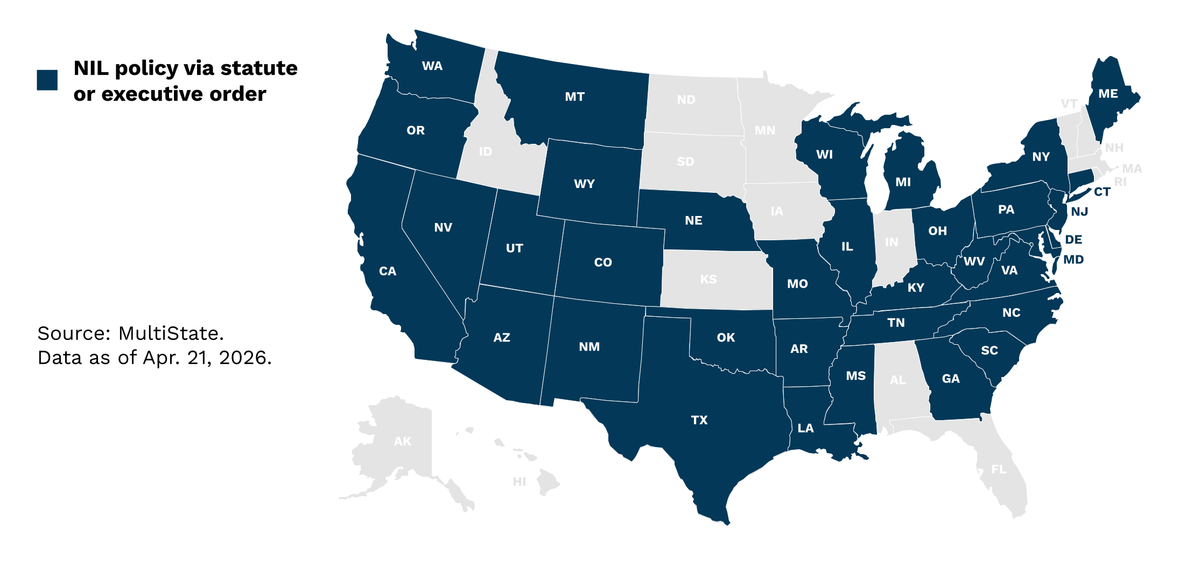
With a patchwork of state laws, NIL rules vary by state. States differ on a number of topics, including disclosure requirements, which industries are off-limits for endorsement deals, contract confidentiality, and whether high school athletes may utilize NIL. As the NIL landscape continued to evolve, several states amended their initial NIL laws to allow schools to assist in finding NIL contracts for their athletes.
As a result of a 2025 lawsuit settlement (House v. NCAA), schools can now directly compensate their student athletes — another significant change in the treatment of college athletes. Each school can pay its student athletes a total of $20.5 million in the 2025-26 school year. The cap will rise each year, reaching $32.9 million by the end of the 10-year agreement. This pool of money is in addition to NIL deals.
Schools now have to decide how to split their revenue share money. So far, schools are distributing the vast majority of that money to football and men’s basketball programs, as they drive much of the revenue for athletic department budgets. For example, Texas Tech has allocated 74% to football, 17-18% to men’s basketball, 2% to women’s basketball, 1.9% to baseball, and the remaining 4-5% to all other sports. This could lead to claims under Title IX, which requires equitable treatment of male and female athletes in federally funded programs, although it’s unclear how courts would rule. Female athletes have challenged the lawsuit settlement that created the direct compensation system, and a federal appeals court has yet to rule on their case.
As college athlete compensation becomes more formalized, new issues have arisen.
One reality many athletes are facing now is income tax. With some student athletes earning multimillion-dollar contracts, student athletes are now facing serious state tax bills. And student athletes who play games in other states may find themselves liable to that visitor state’s income tax. Legislators in seven states, apparently worried about that disadvantage, have filed bills to exempt some or all NIL earnings from state income taxes. So far, Arkansas is the only state to enact such a law.
Even President Trump has gotten involved in the issue, signing an executive order earlier this month titled “Urgent National Action to Save College Sports” (EO 14400). The order defines and prohibits “fraudulent” NIL deals as those above fair market value, including through the use of third parties like NIL collectives that have sprung up to raise money for individual schools’ athletes. The order would enforce its provisions by withholding federal funds from schools that do not comply.
In the absence of a federal law, states continue to play a central role in shaping college athletics. Can state legislatures provide frameworks that provide these young athletes with protections from agents, boosters, and schools? And as compensation for college athletes can now come directly from schools, one major unanswered question is the employment status of student athletes. The Institute for State Policy Leaders is bringing together state lawmakers and experts in the field to discuss these issues and more for a “Chaos in College Sports” webinar on April 30 moderated by MultiState’s Marvin Yates. You can find more information on the webinar here.
MultiState’s team is actively identifying and tracking employment and labor issues so that businesses and organizations have the information they need to navigate and effectively engage. If your organization would like to further track these or other related issues, please contact us.
September 29, 2026 | Marvin Yates
September 21, 2026 | Kayla Susalla
July 30, 2026 | Sandy Dornsife