
Data Centers
State Lawmakers Look to "Behind-the-Meter" Policies for Data Centers
October 13, 2026 | Billy Culleton

Key Takeaways:
In the midst of widespread discussions about data center moratoriums, data centers have an emerging ally: unions. A number of unions, including the International Brotherhood of Electrical Workers (IBEW), are actively encouraging members to oppose bans on data centers, as these new projects have the "potential to provide high-quality union jobs.”
As we have previously discussed, state lawmakers have shown growing interest in imposing data center moratoriums. Just this week, New York Governor Hochul issued an executive order implementing a statewide moratorium on new data centers for one year, the first statewide ban to be implemented. But one of the primary arguments against these proposals is that delaying or preventing data center construction could result in the loss of construction jobs and other economic opportunities for local communities.
The International Brotherhood of Electrical Workers (IBEW) has issued a grassroots call to members to oppose federal legislation that imposes bans on data center construction and to support strong labor standards for data center projects. While the IBEW has echoed priorities around energy regulations for data centers, they have also expressed concerns that data center moratoriums will remove opportunities for union workers and hamper economic growth across the country.
Instead of moratoriums, the IBEW supports the following labor-related proposals for data center projects:
While most state data center legislation focuses on energy and water use, some proposals incorporate labor provisions similar to those supported by the IBEW.
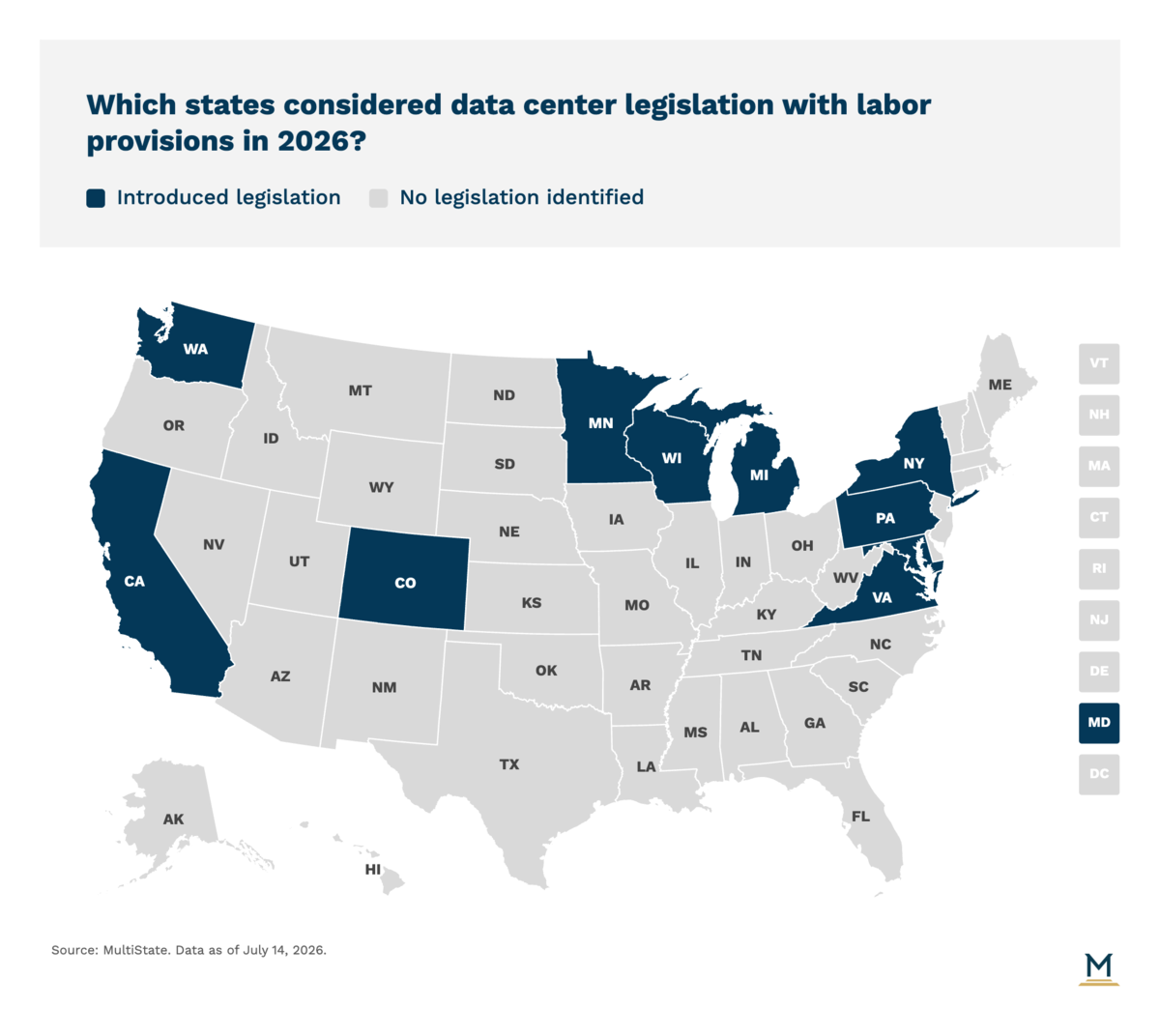
In California, lawmakers are considering legislation (CA SB 887) that would allow the Governor to certify data center projects as environmental leadership development projects. To receive this designation, applicants must enter into a legally binding community benefit agreement with community-based organizations, such as labor unions, workforce development organizations, and community foundations. In addition to the labor requirements, this legislation also requires data center operators to bear the full cost of interconnection, use zero-carbon energy storage, use water-efficient or waterless cooling systems, and recover all electrical grid investments, including any costs incurred for new generating capacity.
In Michigan, lawmakers are considering legislation requiring construction and maintenance work for data centers to meet certain labor provisions. Lawmakers recently introduced legislation (MI SB 1048) prohibiting the Public Service Commission (PSC) from approving any special contract or electricity rate for a data center unless the project has an apprenticeship program for construction workers registered with the US Department of Labor, pays prevailing wages, and performs work under a project labor agreement or collective bargaining agreement. Michigan lawmakers are also considering legislation (MI HB 5777) requiring that construction contracts for large-scale data centers that receive a government economic development incentive to include prevailing wage provisions for workers.
Prevailing Wage
The prevailing wage is the hourly wage, benefits, and overtime paid to the majority of workers in a particular occupation within a specific geographic area. These rates are typically determined by state or federal labor departments and are often required for workers on government-funded or publicly subsidized construction projects.
Project Labor Agreement
A project labor agreement (PLA) is a pre-hire collective bargaining agreement between contractors, subcontractors, and labor unions that establishes terms and conditions of employment for a specific construction project. PLAs typically include provisions for wages, benefits, work rules, dispute resolution procedures, and commitments to avoid work stoppages.
Community Benefit Agreement
A community benefit agreement (CBA) is a legally binding contract between a developer and community organizations that requires the developer to provide specific benefits to the local community in exchange for support of a project. These benefits may include local hiring commitments, living wages, affordable housing, environmental protections, or funding for community programs.
Collective Bargaining Agreement
A collective bargaining agreement is a written contract between an employer and a labor union that outlines the terms and conditions of employment for unionized workers. These agreements typically cover wages, hours, benefits, workplace safety, grievance procedures, and other employment terms negotiated between the parties.
Other states are also considering tying tax incentives to labor standards. In Minnesota, lawmakers are considering legislation (MN HF 4153) that conditions data center tax incentives on construction and refurbishment workers being paid the prevailing wage. In Washington, lawmakers considered similar legislation (WA HB 2655) that would have required data centers receiving tax exemptions to comply with prevailing wage standards.
However, labor-related provisions in data center legislation can still face challenges. In Maryland, lawmakers considered legislation (MD HB 1532) that would have required data centers to use local workers to the maximum extent possible. Although this bill was ultimately enacted, lawmakers removed the local hiring requirement before final passage.
It remains to be seen how aggressively lawmakers will pursue labor-related requirements for data center projects. These provisions could gain traction, particularly in more union-friendly states, as debates continue. Labor standards represent a growing, if still early, trend in state data center legislation.
Last year, states considered hundreds of data center bills, and we expect activity to continue growing in 2026. To stay on top of this rapidly evolving landscape, we've launched MultiState Policy Watch: Data Centers – a subscription featuring legislative analysis, trend summaries, and expert insights across energy, tax, water, zoning, and other policy areas impacting data centers. Sign up here.
What labor standards are unions pushing for in data center projects?
Unions like the IBEW are advocating for labor agreements that ensure fair wages, safe working conditions, and local hiring; registered apprenticeship and training programs; and responsible bidder requirements that prioritize worker-first contractors. These standards are being promoted as an alternative to data center moratoriums, which unions argue would eliminate high-quality union job opportunities.
Which states are considering prevailing wage requirements for data center construction?
Michigan, Minnesota, and Washington have all considered legislation tying prevailing wage standards to data center projects. Michigan's SB 1048 would prohibit special electricity rates unless projects pay prevailing wages and use project labor agreements. Minnesota's HF 4153 would condition data center tax incentives on construction and refurbishment workers being paid the prevailing wage. Washington considered similar legislation that would have required data centers receiving tax exemptions to comply with prevailing wage standards.
What does California SB 887 require from data centers seeking environmental leadership certification?
California SB 887 would require data center applicants to enter into legally binding community benefit agreements with organizations such as labor unions, workforce development groups, and community foundations. The legislation also mandates that projects bear full interconnection costs, use zero-carbon energy storage, implement water-efficient or waterless cooling systems, and recover all electrical grid investments.
Are data center labor requirements passing in state legislatures?
Labor-related provisions in data center legislation face mixed outcomes. In Maryland, lawmakers considered legislation (MD HB 1532) that would have required data centers to use local workers to the maximum extent possible. Although this bill was ultimately enacted, lawmakers removed the local hiring requirement before final passage.
Why are unions opposing data center moratoriums?
Unions argue that data center moratoriums eliminate opportunities for high-quality union jobs and hamper economic growth by preventing construction projects that would employ union workers. The IBEW has issued grassroots calls for members to oppose federal legislation imposing data center bans while supporting strong labor standards as an alternative approach.
October 13, 2026 | Billy Culleton
-ffe156-400px.jpeg)
September 24, 2026 | Kim Miller
September 18, 2026 | Morgan Scarboro