
Employment & Labor
Work-Based Learning Programs Gain Momentum as States Address Workforce Shortages
June 29, 2026 | Izzy Aaron
September 21, 2026 | Kayla Susalla

Key Takeaways:
As states grapple with evolving AI landscapes, legislators have proposed several bills addressing how it should be used in the workplace. In the 2026 legislative session, states considered 155 bills addressing AI in the workplace, with proposals ranging from applicant notification requirements to mandatory bias assessments and restrictions on employee monitoring. Across these proposals, four themes stand out: transparency, accountability, worker privacy, and workforce protection.
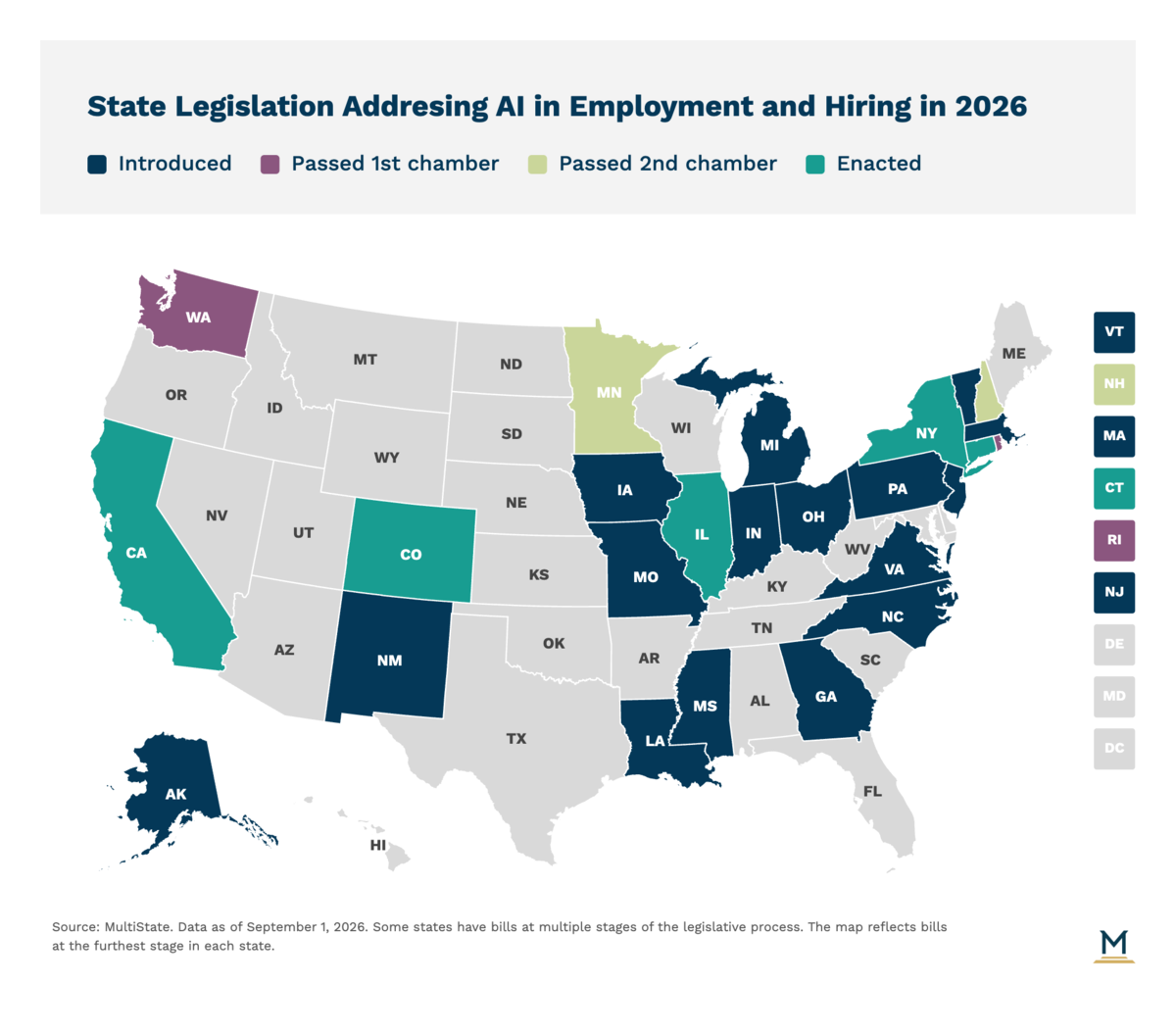
Some employers have adopted AI systems that monitor employees, such as cameras, app-based tracking, and keyboard and mouse monitoring. Most legislative proposals aim to alert employees that they are being tracked and give them the option to provide consent. Lawmakers in California (CA SB 238) and Washington (WA HB 2144) proposed bills that would require employers to disclose when they are using electronic monitoring, and Michigan’s SB 1077 would require employers to obtain consent for electronic monitoring. CA SB 238 passed the Senate but did not advance further, while WA HB 2144 and MI SB 1077 died in committee and did not pass either chamber.
New Jersey lawmakers proposed NJ A 4981, which would prohibit using an AI system to set performance standards or productivity quotas likely to contribute significantly to harming worker health and safety. The bill would also prohibit using AI to monitor employees in restrooms, locker rooms, or other non-work areas, and surveil employees outside of work times or on personal devices. Restrictions on using surveillance tools on employees’ personal devices was another common theme this session, as proposed in VT HB 262 and MA S 35. NJ A 4981, VT HB 262, and MA S 35 died in committee and did not pass either chamber.
Legislators also introduced legislation restricting employer use of certain monitoring practices, such as facial or emotional recognition, as noted in MN SF 4686, NY S 10290, and WA HB 1672. These bills died in committee, but lawmakers in California sent legislation (CA AB 1883) to Gov. Gavin Newsom’s desk, which would prohibit an employer from using a workplace surveillance tool that uses artificial intelligence to collect neural data or recognize an individual’s emotional state.
In response to growing concerns that AI will replace workers, several states have proposed AI task forces and skills training initiatives for workers. A bill proposed in New York (NY A 9581) would require businesses that employ over 100 people or are publicly traded to annually report to the Department of Labor on the impact of artificial intelligence on their hiring and nature of their artificial intelligence use. It would also impose a civil penalty of up to $500 for each day a business fails to comply with the reporting requirement, but grants a business the right to cure the violation within 90 days. The bill passed both chambers, but was not signed into law. In Connecticut, CT HB 5497 would establish a task force to study the effects of artificial intelligence on the trades industry, including job displacement. CT HB 5497 passed the House but died in the Senate. And in Minnesota, lawmakers introduced legislation (MN HF 5055) that would create an artificial intelligence readiness account fund to engage businesses in managing AI impacts while supporting adoption and workforce training for affected workers. MN HF 5055 died in committee and did not pass either chamber.
Bias Assessment
A bias assessment is a review process that evaluates whether an artificial intelligence system or automated decision-making tool produces discriminatory effects, particularly in employment decisions such as hiring or promotions. The assessment aims to identify and mitigate any unintended biases that may disadvantage certain groups, ensuring compliance with anti-discrimination laws and promoting fairness in automated processes.
Many employers use AI to identify candidates whose qualifications best match a position. While proponents view these tools as an efficient way to process large numbers of applications, concerns remain that AI-driven screening could unintentionally exclude or disadvantage certain groups of applicants. Lawmakers in Minnesota (MN HF 4537/ MN SF 4573), Iowa (IA SF 2414), and New York (NY A 10251) introduced legislation that would require employers to notify applicants that their applications are being screened by AI, but these bills died in committee and did not pass either chamber. Colorado enacted CO SB 189, which would require deployers of a covered automatic decision making tool to notify applicants of its use and to provide a detailed explanation following an adverse outcome. CO SB 189 also grants applicants the right to correct inaccurate personal data and request a meaningful human review of an adverse consequential decision. Lawmakers in Connecticut enacted CT SB 5, which requires employers to notify employees and applicants when automated decision-making tools are used with an explanation of adverse decisions and an opportunity to correct data.
And lawmakers in New York (NY A 9654) and Michigan (MI SB 1077) proposed legislation that would give applicants the option to opt out of AI application screening, but these bills died in committee and did not pass either chamber.
Another way legislators are attempting to mitigate potential discrimination from AI is by requiring employers to conduct bias or impact assessments. Impact or bias assessments review decisions of AI models to ensure there are no discriminatory effects from using it in hiring or to evaluate current employees. Legislation introduced in North Carolina (NC HB 1161), Michigan (MI HB 5579), New Jersey (NJ A 4981), New York (NY S 10290), Massachusetts (MA H 77), and Vermont (VT HB 262) would require employers who use AI systems or automated employment tools to file an impact or bias assessment. Lawmakers in some states, such as Arkansas (AK SB 2) and Illinois (IL HB 3567) specifically proposed requiring state agencies to conduct impact assessments on automated employment decisions.
In addition to requiring employers to conduct a bias audit, Pennsylvania’s legislation (PA HB 594) would require employers to obtain consent to use an automated decision tool, and New Jersey’s A 2726 would prohibit the sale or use of an automated employment decision tool unless it is subject to an annual independent bias audit. All of these bills died in committee and did not pass either chamber.
Taking a novel policy approach, New York lawmakers proposed NY A 5429, which would impose a 2 percent surcharge on income on corporations that terminate employees or substantially reduce hours due to a system or process that uses algorithms, computation models, artificial intelligence techniques, robotic hardware or a combination. In contrast, a District of Columbia council member proposed DC B 776, which would designate DC as the “Tech for Good” capital of the US, and establish a real property tax abatement for qualified public-interest technology companies, with the amount of the abatement tied to credits earned for hiring new employees. Taking a different approach to incentivizing employee retention, New Jersey lawmakers proposed NJ A 5316, which would establish various tax credits for employers to maintain worker headcount, retrain employees, hire employees who were displaced by AI, and expand their business operations in designated AI economic opportunity zones. Though these proposals share the goal of safeguarding American jobs, they differ in the mechanisms they use to achieve it. These bills did not advance past either chamber.
As AI continues to evolve and becomes more integrated across industries, legislation regulating its use in the workplace will likely continue to expand. States that have not yet enacted laws addressing AI in the workplace may look to other states’ legislative approaches for guidance. Future proposals may place greater emphasis on transparency, human oversight, and protections for worker privacy, while also addressing the potential displacement of workers.
MultiState’s team is actively identifying and tracking employment and labor issues so that businesses and organizations have the information they need to navigate and effectively engage. If your organization would like to further track these or other related issues, please contact us.
Which states require employers to notify job applicants when AI is used to screen their applications?
Colorado enacted SB 189, which requires deployers of a covered automatic decision making tool to notify applicants of its use and provide a detailed explanation following an adverse outcome. Lawmakers in Connecticut enacted SB 5, which requires employers to notify employees and applicants when automated decision-making tools are used, with an explanation of adverse decisions and an opportunity to correct data. Several other states including Minnesota, Iowa, and New York proposed similar notification requirements, but those bills died in committee.
Do any state laws require bias assessments before using AI in hiring decisions?
Multiple states, including North Carolina, Michigan, New Jersey, New York, Massachusetts, and Vermont, proposed legislation requiring employers to conduct bias or impact assessments on AI systems used in employment decisions, but all of these bills died in committee and did not pass either chamber. Some states, such as Arkansas and Illinois, specifically proposed requiring state agencies to conduct impact assessments on automated employment decisions.
What restrictions exist on employers using AI to monitor employees?
California sent legislation (AB 1883) to the governor's desk that would prohibit employers from using workplace surveillance tools that use AI to collect neural data or recognize emotional states. New Jersey proposed A 4981, which would prohibit using AI to monitor employees in restrooms, locker rooms, or other non-work areas, and restrict surveillance outside work times or on personal devices, but this bill died in committee. Several states including Vermont and Massachusetts also proposed restrictions on surveillance tools used on employees' personal devices.
Are there any state laws that give job applicants the right to opt out of AI screening?
New York and Michigan proposed legislation that would give applicants the option to opt out of AI application screening, but both bills died in committee and did not pass either chamber. Colorado's SB 189 does not provide an opt-out right, but it does grant applicants the right to request a meaningful human review of an adverse consequential decision and to correct inaccurate personal data.
What penalties do states impose on employers who fail to comply with AI workplace laws?
New York proposed A 9581, which would impose a civil penalty of up to $500 for each day a business fails to comply with reporting requirements on AI's impact on hiring, though the bill would grant businesses 90 days to cure violations. The bill passed both chambers but was not signed into law. New York also proposed A 5429, which would impose a 2 percent surcharge on corporate income when employees are terminated or hours are substantially reduced due to AI systems, but this bill did not advance past either chamber.
June 29, 2026 | Izzy Aaron
-0c60df-400px.jpeg)
April 29, 2026 | Geoff Hawkins

September 16, 2025 | Lauren Johnson