Data Centers
Gubernatorial Candidates Split on Data Center Policy in 2026
September 18, 2026 | Morgan Scarboro
September 24, 2026 | Kim Miller
-ffe156-1200px.jpeg)
Key Takeaways:
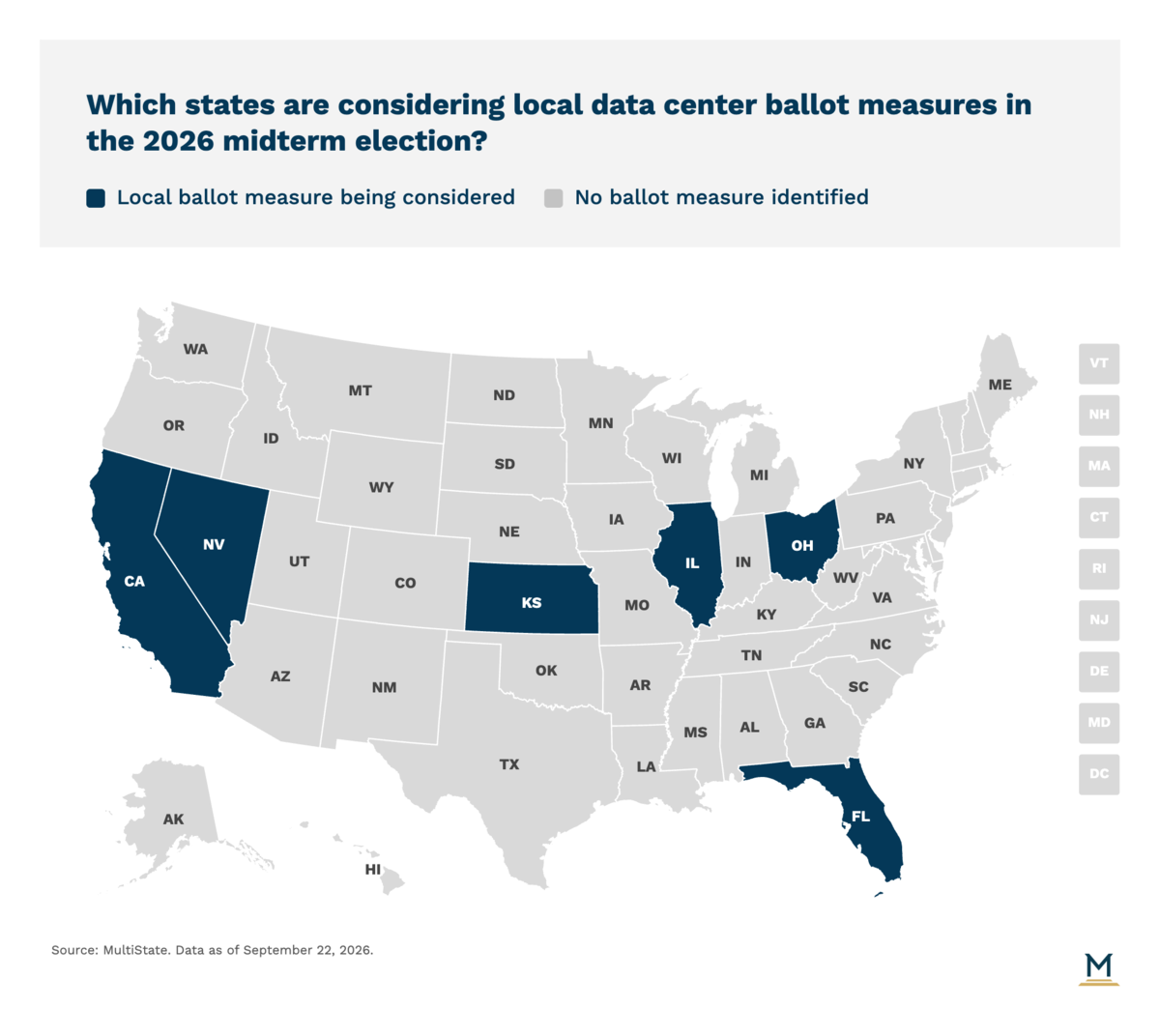
Residents in 28 localities across six states will consider data center ballot measures in the upcoming November elections. These measures propose bans or moratoriums on data center construction, while others seek to make existing restrictions more permanent and have the potential to put residents at odds with local officials.
In Emporia, voters will decide whether to prohibit the construction, installation, operation, and maintenance of “high impact data centers” in all zoning districts. The measure defines these facilities as data centers with a peak electrical load exceeding 10 MW or a daily water draw exceeding 100,000 gallons. The thresholds are notably lower than those used in many recent proposals targeting larger data center developments.
The measure has also prompted litigation. City officials sought judicial review over whether the proposed ordinance is a proper subject for the citizen-initiative process. A court ordered the question placed on the November ballot, but legal questions concerning the measure remain pending. If voters approve the ordinance, it cannot take effect until those issues are resolved or a court otherwise permits implementation.
In El Dorado, voters will consider a similar proposal prohibiting high-impact data centers, but adds a provision allowing the moratorium to remain in effect for ten years, and stipulates that only another vote could repeal or amend the moratorium. The proposal would also prohibit certain battery energy storage systems due to concerns about fire.
El Dorado officials also sought judicial review of the citizen-initiated proposal. In August, the district court determined that the proposed ordinance concerned a legislative function of municipal government and could proceed through the citizen-initiative process, clearing the way for the measure to appear on the November ballot.
High Impact Data Center
A high impact data center, as defined in the Kansas ballot measures, is a facility with a peak electrical load exceeding 10 megawatts or a daily water draw exceeding 100,000 gallons. These thresholds are lower than those used in many other proposals and are intended to target larger-scale data center developments.
In Bloomington, voters will decide whether to impose a moratorium on large scale data centers in the city. The ballot measure is proceeding despite a six-month moratorium passed by the City Council earlier this year. The ballot measure does not specify the length of the moratorium. One resident who spoke in support of the ballot measure stated that he wanted to ensure that officials “on the county level and on the state level understand that the people in this community do not want data centers here that are unregulated, that don’t have any guardrails.”
Elsewhere in Illinois, voters will have the chance to weigh in on new data center development. Voters in four cities in Madison County will consider advisory measures asking whether local officials should permit the construction and operation of new data centers.
Nine measures ask voters whether data centers should be prohibited based on their projected electrical demand, while three jurisdictions will consider outright prohibitions on data center construction regardless of electrical demand.
These ballot measures are another flashpoint in growing skepticism towards data centers in Ohio, where at least 125 data center moratoriums are currently in effect. Local jurisdictions across the country have considered or implemented data center moratoriums, frequently with the goal of studying the impact that data centers will have on their community.
The November ballot measures give residents an opportunity to weigh in directly on whether data center development should proceed in their communities at all. In some jurisdictions, voters will decide whether their concerns can be addressed through limits based on electricity demand while in others, voters will consider prohibiting new data centers regardless of energy needs.
In Edgewater, Florida, voters will decide whether to amend the city's charter to prohibit the permitting, construction, expansion, or operation of new data centers within city limits. Voters will consider this ballot measure following the enactment of a data center ban by the Edgewater City Council earlier this month.
Council members stated that they enacted the ban to prevent a data center from being approved before the November election. The ballot measure is moving forward despite the council's action, as proponents argue that a future city council could reconsider the prohibition and that amending the city charter would provide a more durable restriction on future data center development.
There has been speculation that opposition to data centers will play a substantial role in the midterm elections. Some voters have stated that opposition to data centers in their community is their primary concern this election, causing some to consider voting for candidates they may not otherwise support, however, recent polling suggests that concerns about data centers and AI are not a big concern for many voters.
Last year, states considered hundreds of data center bills, and we expect activity to continue growing in 2026. To stay on top of this rapidly evolving landscape, we've launched MultiState Policy Watch: Data Centers – a subscription featuring legislative analysis, trend summaries, and expert insights across energy, tax, water, zoning, and other policy areas impacting data centers. Sign up here.
What states have data center ballot measures in November 2026?
Twenty-eight localities across six states—Kansas, Illinois, Ohio, Florida, Virginia, and one additional state—will have data center ballot measures on the November 2026 ballot. These measures range from outright construction bans to advisory questions about whether local officials should permit new data center development.
What is the difference between Emporia and El Dorado Kansas data center ballot measures?
Both Kansas cities propose prohibiting "high impact data centers" exceeding 10 MW peak electrical load or 100,000 gallons daily water draw. El Dorado's measure includes a ten-year moratorium period and requires another vote to repeal or amend it, while Emporia's measure does not specify a time limit but faces pending legal questions that must be resolved before it can take effect.
How many data center moratoriums are currently active in Ohio?
At least 125 data center moratoriums are currently in effect across Ohio jurisdictions. In November 2026, voters in 14 Ohio localities will consider ballot measures, with nine asking whether to prohibit data centers based on electrical demand and three proposing outright prohibitions regardless of energy needs.
Can a city council overturn a data center ban approved by voters?
In Edgewater, Florida, ballot measure proponents argue that amending the city charter through a voter-approved measure would provide more durable protection than the city council's recent data center ban. They contend that a future city council could reconsider a council-enacted prohibition, making a charter amendment a more permanent restriction.
Are data centers a major issue for voters in the 2026 midterm elections?
Recent polling suggests that concerns about data centers and AI are not a primary concern for many voters in the 2026 midterms. However, some individual voters have stated that opposition to data centers in their community is their primary concern this election, with some considering voting for candidates they may not otherwise support based on this issue alone.
September 18, 2026 | Morgan Scarboro
September 1, 2026 | Morgan Scarboro, Izzy Aaron
August 19, 2026 | Ben Seitelman