Data Centers
Gubernatorial Candidates Split on Data Center Policy in 2026
September 18, 2026 | Morgan Scarboro
September 1, 2026 | Morgan Scarboro, Izzy Aaron
Key Takeaways:
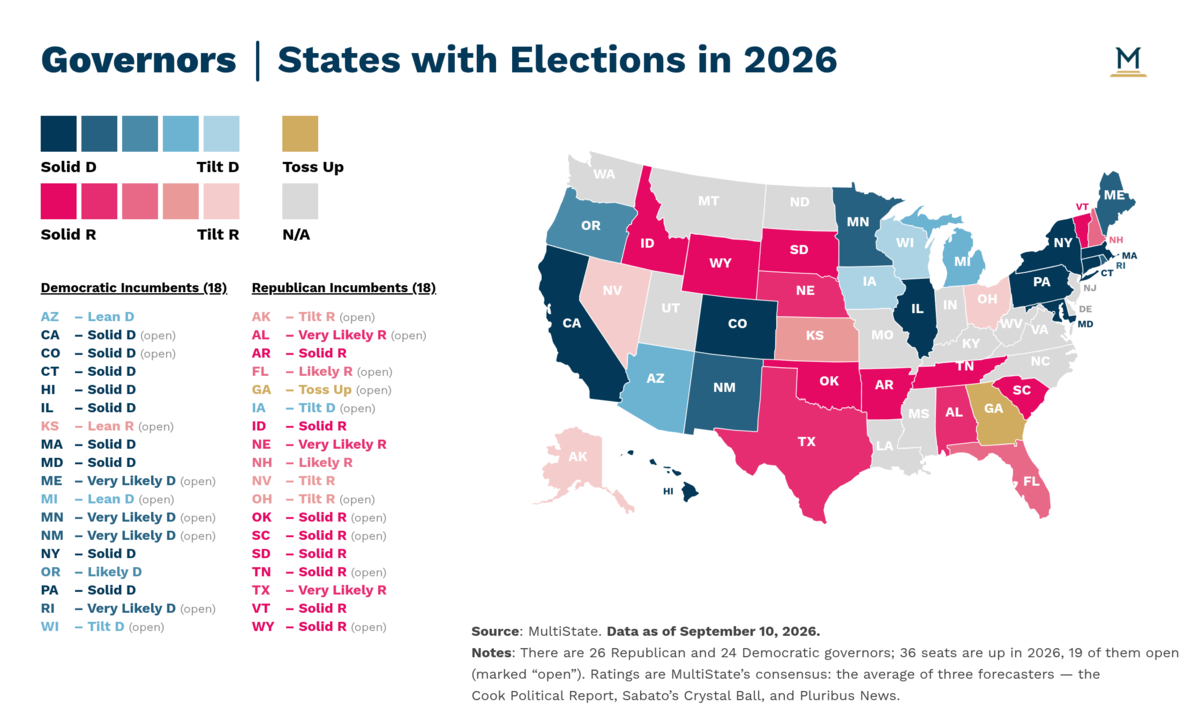
As gubernatorial campaigns heat up, candidates are weighing in on data center policy. There are 36 gubernatorial elections this November, and 18 states have open elections (where there is no incumbent in the race). Candidates across both parties are calling for residential ratepayer protections, new power generation, increased local control, and, in some cases, temporary moratoriums.
Gubernatorial candidates are debating how quickly data centers should expand and who should pay for that growth. Candidates generally fall into three categories: those who support continued data center development, those who support development with additional requirements, and those who would oppose or pause new development.
A few candidates have put their full support behind data center development, highlighting the economic and national security benefits.
Tennessee Republican Senator and gubernatorial candidate Marsha Blackburn states that data centers are important for the state’s economy, including “communities that want to host a data center.” However, she does emphasize that companies must be thoughtful about where they build.
Arkansas Gov. Sarah Huckabee Sanders (R) has also promoted data center development as an economic opportunity. Following the announcement of AVAIO Digital's $6 billion data center hub, Sanders said the investment would make Arkansas a “technology powerhouse that can compete with any state in the nation” and highlighted the reduced regulatory timeline and new incentives for data centers.
In South Carolina, Republican gubernatorial candidate Alan Wilson has similarly expressed conditional support for data centers, arguing that communities that want them should be able to host them. He also framed data centers as a national security issue, stating, "I'd rather have our data controlled out of Berkeley than Beijing to protect your kids."
Alabama Republican candidate Sen. Tommy Tuberville has dismissed the opposition to data centers as “nonsense” and framed the resistance as part of a broader effort by China to slow US technological development.
A majority of candidates support continued data center development, but are calling for new regulations. One of the most common positions is that data centers should be responsible for meeting any incremental energy demands and infrastructure costs that they create.
In Texas, incumbent Republican Governor Abbott has called for data centers to bring their own power and pay for their own infrastructure. During a June campaign stop, Abbott stated, “Any AI data center even thinking about coming here — they got to bring their own money, bring their own power, reuse their own water and do it in a way that reduces the cost of electricity for residents across our state.” He has also called for eliminating tax breaks for data centers and prohibiting the construction of new facilities in rural Texas neighborhoods. However, the Governor has taken a step further and halted approvals for any new data centers connecting to the grid while the state undertakes an audit.
Pennsylvania Democratic Gov. Josh Shapiro has taken a similar approach through his Responsible Infrastructure Standards, or GRID for short. The standards would require developers to “build, bring or buy” the cumulative electric capacity needed to meet their energy demand, and also pay the full cost of that capacity. The standards also require developers to cover costs associated with their interconnection and electricity service.
Other candidates have focused on preventing data centers from increasing costs for residents.
Iowa Democratic nominee Rob Sand said that “anyone building in Iowa is contributing to Iowa, not extracting from us” and companies should “pay their own way, including covering any increase in costs on utilities so that your bills don’t go up one cent.”
Michigan Democratic candidate Jocelyn Benson has similarly tied data center development to affordable energy costs, saying projects should only come to Michigan if they deliver “affordable, low energy costs for our residents.”
Democratic Oregon Gov. Tina Kotek has increasingly emphasized the need for stronger safeguards. In July, she said Oregon "needs to stop being a cheap date.” Kotek has underscored concerns over energy and water costs, as well as whether communities are receiving sufficient benefits from new development. Governor Kotek does support local moratoriums while the state considers next steps.
Oklahoma Republican gubernatorial candidate Mike Mazzei proposed conditions for new data center development, including local approval, power self-generation, and closed-loop cooling.
Moratorium
A moratorium is a temporary halt or suspension of a particular activity or development, often imposed by government authorities to allow time for review, planning, or the establishment of new regulations. In the context of data centers, a moratorium typically pauses new construction or permitting to address concerns such as energy use, environmental impact, or community readiness.
In July, New York Democratic incumbent Gov. Kathy Hochul announced the first statewide moratorium on new hyperscale data centers, including a permitting pause of up to one year to “build a nation-leading regulatory framework that protects ratepayers, the environment, the energy grid and communities across the state.” Other candidates are also calling for moratoriums or pauses on new data center development, arguing that states and communities need additional time to establish rules before allowing further development.
In Kansas, Democratic candidate Cindy Holscher proposed a moratorium on data centers, stating, “We have to get these guardrails in place. We are having our people and our resources exploited.”
New Hampshire Governor Ayotte (R) has recently announced her support for a moratorium, saying “It does not make sense at all to site a data center in New Hampshire. We don't have the energy for it. It is not the appropriate location. I would support a moratorium on them because right now they do not make sense at all in terms of energy, environment or location.”
Pennsylvania Republican Stacy Garrity has similarly called for a total pause on new data center development, arguing that a pause would “give local officials time to update zoning ordinances” and “establish safeguards for communities that could become sites for future projects.”
Last year, states considered hundreds of data center bills, and we expect activity to continue growing in 2026. To stay on top of this rapidly evolving landscape, we've launched MultiState Policy Watch: Data Centers – a subscription featuring legislative analysis, trend summaries, and expert insights across energy, tax, water, zoning, and other policy areas impacting data centers. Sign up here.
Which gubernatorial candidates support moratoriums on data center development in 2026?
New York Governor Kathy Hochul announced the first statewide moratorium on new hyperscale data centers in July 2026, including a permitting pause of up to one year. Kansas Democratic candidate Cindy Holscher, New Hampshire Governor Ayotte, and Pennsylvania Republican Stacy Garrity have also called for moratoriums or pauses on new data center development to establish regulatory guardrails.
What are gubernatorial candidates proposing to protect residential ratepayers from data center energy costs?
Several candidates are proposing that data centers cover their own infrastructure and energy costs to prevent rate increases for residents. Texas Governor Abbott has called for data centers to bring their own power and pay for their own infrastructure, while Iowa's Rob Sand and Michigan's Jocelyn Benson have stated that data center projects should not increase utility bills for residents by even one cent.
What is Pennsylvania's GRID standard for data center development?
Pennsylvania's GRID (Responsible Infrastructure Standards) requires data center developers to "build, bring or buy" the cumulative electric capacity needed to meet their energy demand and pay the full cost of that capacity. The standards also require developers to cover all costs associated with their interconnection and electricity service.
Which states have gubernatorial candidates calling for data centers to generate their own power?
Texas Governor Abbott has explicitly called for data centers to bring their own power and eliminate tax breaks for facilities that don't. Oklahoma Republican candidate Mike Mazzei has proposed requiring power self-generation as a condition for new data center development, and Pennsylvania Governor Shapiro's GRID standards require developers to build, bring, or buy their own electric capacity.
How are gubernatorial candidates framing data centers as a national security issue in 2026?
South Carolina Republican candidate Alan Wilson has framed data centers as a national security priority, stating he would rather have U.S. data controlled domestically than by foreign adversaries. Alabama Senator Tommy Tuberville has dismissed opposition to data centers as driven by efforts to slow U.S. technological development and has characterized resistance as benefiting competing nations.