Elections & Campaigns
Democrats' Special Election Edge Still Points to a Big Year (Democratic Wave?)
October 14, 2026 | Bill Kramer
October 16, 2026 | Bill Kramer
Key Takeaways:
We're well into the summer, hitting record temperatures in DC, and over half the states have now completed their primary elections in this pivotal 2026 election year. So far, 28 states have held primary elections (including South Dakota and Oklahoma, with upcoming runoffs scheduled). What stands out at this point in the primary election cycle?
One notable trend, which indicates the level of optimism on the Democratic side of the aisle, is the number of elections this November that will have a challenger from both parties. Generally, an average of 39.7% of state legislative elections go uncontested by one of the two major political parties, essentially ceding the election to the other party. This is a persistent feature of state-level elections, as gerrymandered maps and the political polarization of the rural/urban divide harden partisan lines across the country. That average across the eight even-numbered election cycles from 2010 to 2024 is actually a bit higher — 40.6% — if you restrict it to only the 28 states that have held primaries so far this year.
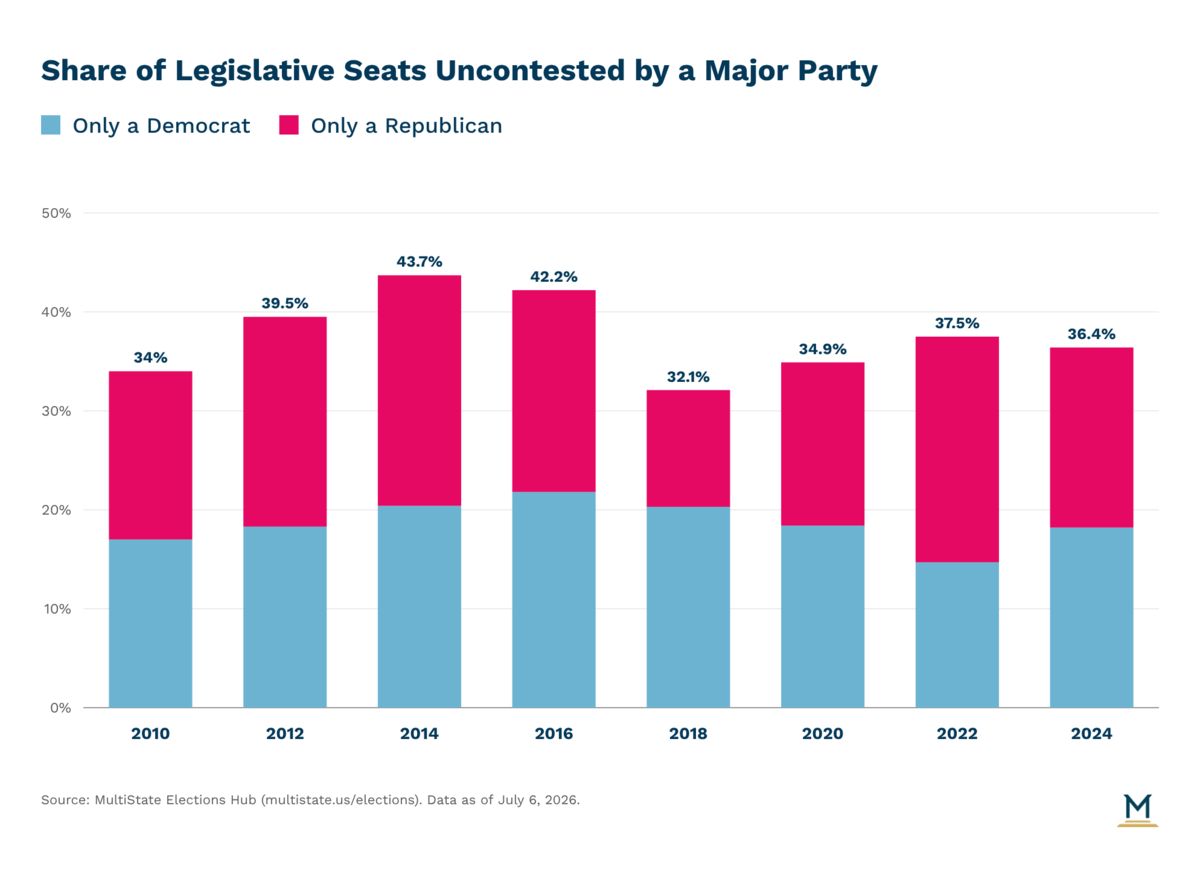
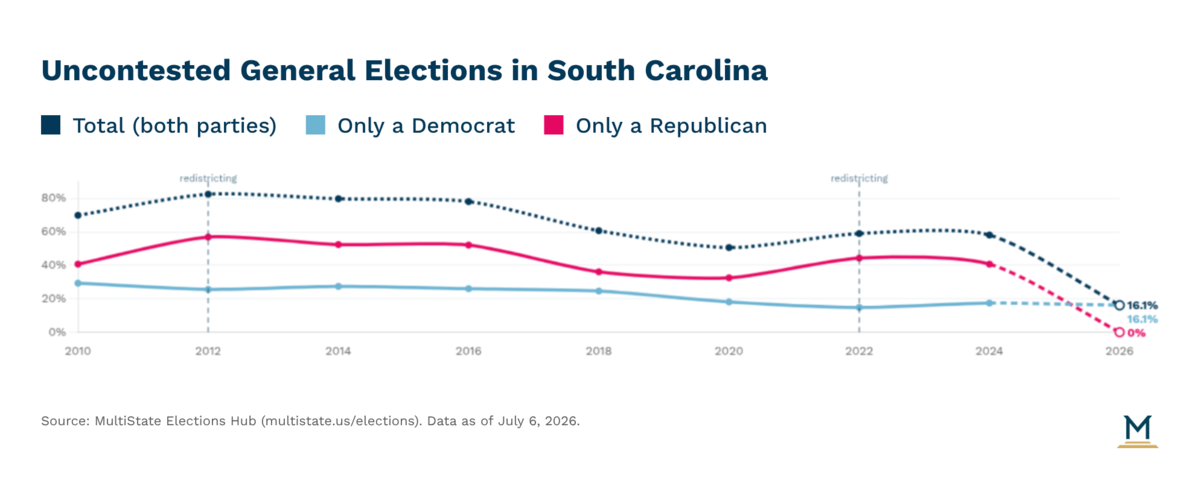
But at this point in the primary calendar, only 32.6% of general elections are set to go uncontested, among the lowest of the 2010-2026 period, on par with 2018's 31.7% (more on how that election cycle went below). When you break that number down by party, you can see that Democrats have done a better job this year of recruiting candidates in seats they might have conceded in previous cycles. In fact, Democrats are contesting every single legislative district up for election in three states — Maryland, South Carolina, and Texas — and only came up two seats short in North Carolina.
Uncontested Election
An uncontested election is a race in which only one major political party fields a candidate, meaning the opposing party does not offer a challenger. As a result, the sole candidate is effectively guaranteed victory in the general election.
Breaking these numbers down by party, the share of seats where a Republican is the only major-party candidate has dropped from an average of 23.1% to 14.7% in 2026 (an 8.4 point drop). Compare that to seats where a Democrat is the only major-party candidate, and this year's 17.9% is essentially flat compared to a historical average of 17.5%. So the movement here is definitely on the Democratic recruiting side.
Of course, fielding a candidate isn't the same as fielding a competitive one. Many of these newly contested seats sit in districts drawn to be safe. But recruitment is the necessary first step, and Democrats are clearing that bar in more places than they have in years.
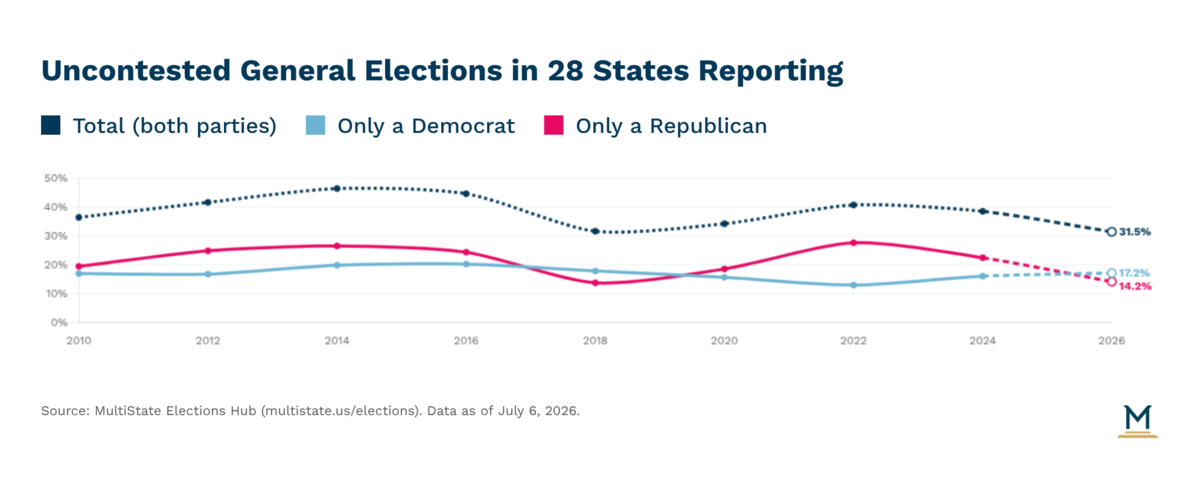
We saw a similarly strong recruiting year in 2018, when these same 28 states posted a Republican uncontested rate of 13.9% at this point, a hair below this year's 14.7%. That cycle turned out to be a great year for Democrats, who gained seven governorships and flipped six legislative chambers. Will this translate into electoral victories for the Democrats? We'll find out in November. But as Wayne Gretzky said, "You miss 100% of the shots you don't take."
Federal and state elections and redistricting can have significant policy and regulatory implications for businesses and organizations. If your organization would like to further track federal and state elections, please contact us.
What percentage of state legislative races are uncontested in 2026 compared to previous election cycles?
As of the 2026 primary cycle, 32.6% of general elections are set to go uncontested among the 28 states that have held primaries so far, compared to a historical average of 40.6% for those same states across even-numbered election cycles from 2010 to 2024. The only comparable year in that period is 2018, when the uncontested rate stood at 31.7%.
How has Democratic candidate recruitment in state legislative races changed in 2026?
Democrats have reduced the share of seats where a Republican runs unopposed from a historical average of 23.1% down to 14.7% in 2026, an 8.4 percentage point drop. By contrast, the share of seats where a Democrat is the only major-party candidate is 17.9% in 2026, essentially flat compared to the historical average of 17.5%.
Which states have Democrats fielded candidates in every state legislative district in 2026?
Democrats are contesting every single legislative district up for election in Maryland, South Carolina, and Texas. In North Carolina, Democrats fell two seats short of a full slate of candidates.
How many states have completed their 2026 primary elections so far?
As of mid-2026, 28 states have held primary elections, including South Dakota and Oklahoma, which have upcoming runoffs scheduled. These 28 states form the basis for current comparisons of candidate recruitment and uncontested race rates.
What happened in the 2018 state legislative elections when Democratic recruitment was similarly strong?
In 2018, the Republican uncontested rate in these same 28 states was 13.9%, just below 2026's 14.7%. That cycle resulted in Democrats gaining seven governorships and flipping six legislative chambers.
October 14, 2026 | Bill Kramer
September 29, 2026 | Bill Kramer
August 25, 2026 | Jose Perez