Elections & Campaigns
The Biggest Governor Turnover Since 2010
October 20, 2026 | Bill Kramer
October 20, 2026 | Mary Kate Barnauskas
Key Takeaways:
Since the Dobbs decision in 2022, voters in 16 states have decided on 18 abortion-related ballot measures. In 2022 and 2023, voters in California, Michigan, Ohio, and Vermont amended their state constitutions to protect the right to abortion, while measures to curtail it failed in Kansas, Kentucky, and Montana. In 2024, results were mixed for the first time, as protective measures passed in Arizona, Colorado, Maryland, Missouri, Montana, Nevada, and New York but failed in Florida, Nebraska, and South Dakota. Nebraska voters instead approved a competing measure banning abortion after the first trimester. In total, voters have approved 11 of the 14 measures seeking to establish or protect abortion rights and one of the four seeking to restrict abortion. This November, four additional measures are under consideration, with voters in Idaho, Nevada, Missouri, and Virginia set to consider abortion-related measures.
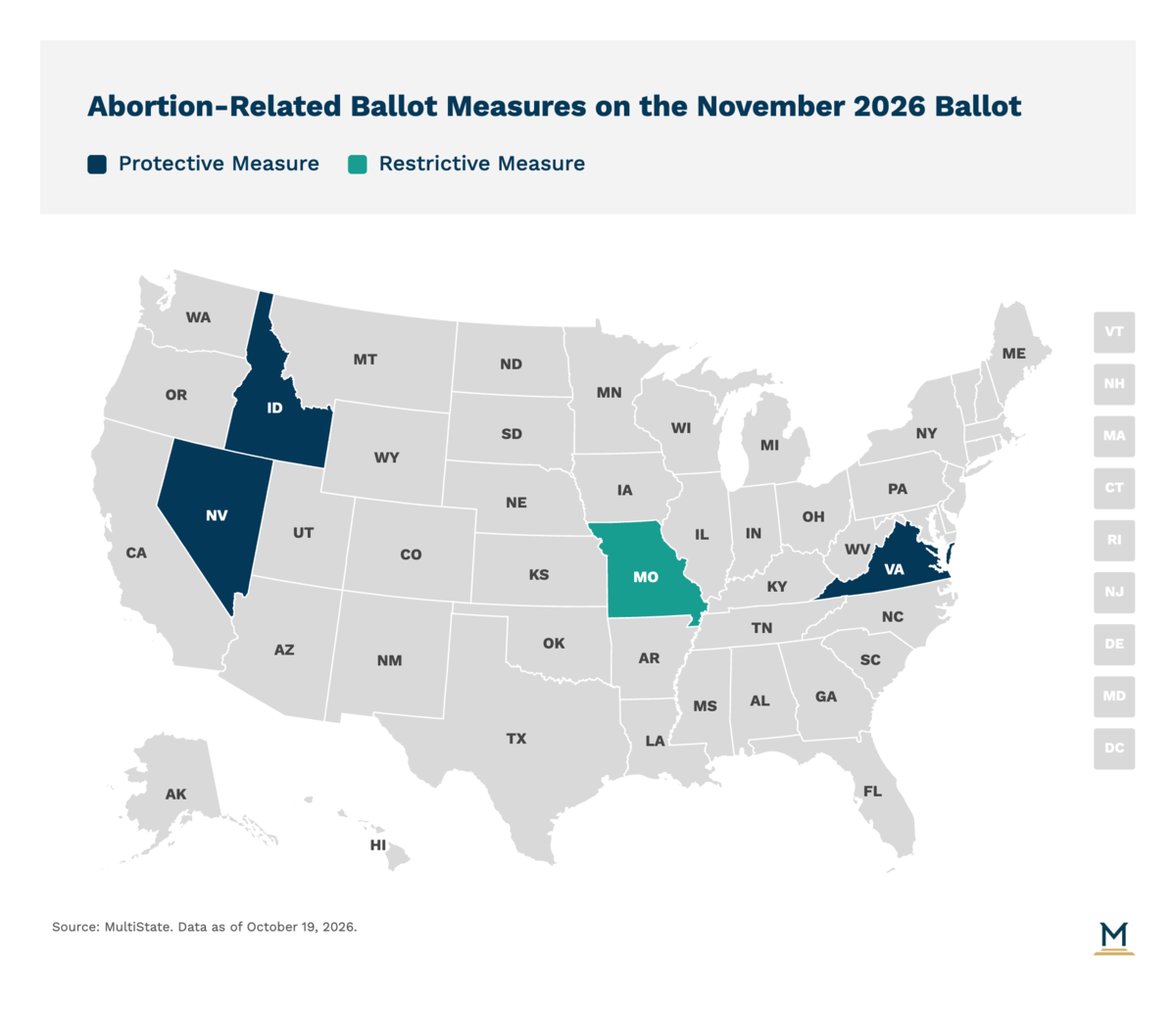
Voters in Idaho will decide on Proposition 1, a citizen-initiated measure that would create a statutory right to reproductive freedom and privacy, including decisions about the use of contraception, fertility treatments, childbirth, miscarriage care, and abortion. The measure is noteworthy, as Idaho currently enforces one of the strictest abortion laws in the country, which bans all abortions with limited exceptions to save the pregnant woman's life or in reported cases of rape or incest during the first trimester. The ban, specifically its lack of an exception for the health of the pregnant woman, has been heavily litigated. One case made it all the way to the U.S. Supreme Court in 2024 before being dismissed and returned to the lower courts. Most recently, in a separate case in August, a federal judge found the ban to be unconstitutional because it did not allow abortions to protect a pregnant woman's health or address a risk of self-harm. The litigation is ongoing, but the approval of the ballot measure could significantly affect pending legal challenges. However, because Proposition 1 is a statutory rather than a constitutional amendment, the Idaho Legislature could amend or repeal it after passage, as Idaho places no restrictions on legislative changes to citizen-initiated statutes.
Nevada voters will also see a citizen-initiated abortion measure on the ballot for the second time since 2024. Uniquely, the state constitution requires citizen-initiated constitutional amendments to pass in two consecutive general elections. In 2024, over 64 percent of voters approved the initiative, which would establish a constitutional right to abortion. Abortion is currently legal in Nevada up to 24 weeks of pregnancy.
Missouri voters will also see abortion on the ballot for the second consecutive general election, but this time through a legislatively referred measure. In 2024, voters approved a measure to establish abortion rights. The Republican-led General Assembly passed a countermeasure in 2025 that would repeal the previously passed constitutional amendment, reinstate abortion restrictions, and ban gender transition procedures for minors.
Like voters in Missouri, voters in Virginia will also decide on a legislatively referred measure, but from the other side of the issue. The measure has been in development for years since legislatively referred constitutional amendments in Virginia must pass in two successive legislative sessions to appear on the ballot. The Democratic-led General Assembly first passed the proposed amendment in 2025, and again earlier this year. The measure would establish a constitutional right to reproductive freedom, including the ability to make and carry out decisions relating to one's own prenatal care, childbirth, postpartum care, contraception, abortion care, miscarriage management, and fertility care. Currently, Virginia law does not explicitly protect or ban abortion access, making the measure notable.
Polling from Pew Research Center and KFF Health ahead of the election indicates abortion ranks lower among voters' priorities than in previous elections. Since 2022, the side favoring abortion access has typically prevailed. The results in Idaho, Missouri, Nevada, and Virginia will indicate whether that pattern holds in a cycle where other issues rank higher for voters, including in Missouri, where voters will decide for the first time whether to repeal a recently adopted constitutional amendment protecting abortion rights.
Federal and state elections and redistricting can have significant policy and regulatory implications for businesses and organizations. If your organization would like to further track federal and state elections, please contact us.
What would Idaho Proposition 1 do, and how does it interact with Idaho's current abortion ban?
Idaho Proposition 1 would create a statutory right to reproductive freedom and privacy, covering decisions about contraception, fertility treatments, childbirth, miscarriage care, and abortion. Idaho currently enforces a ban on all abortions with limited exceptions to save the pregnant woman's life or in reported cases of rape or incest during the first trimester. Because Proposition 1 is a statutory rather than a constitutional amendment, the Idaho Legislature could amend or repeal it after passage, as Idaho places no restrictions on legislative changes to citizen-initiated statutes.
Why is Nevada's abortion measure appearing on the ballot again after passing in 2024?
Nevada's state constitution requires citizen-initiated constitutional amendments to pass in two consecutive general elections before taking effect. The measure passed with over 64 percent of the vote in 2024, so it must appear on the ballot a second time for final approval. Abortion is currently legal in Nevada up to 24 weeks of pregnancy.
What does Missouri's 2026 abortion ballot measure do, and who referred it to voters?
Missouri's 2026 measure is a legislatively referred measure passed by the Republican-led General Assembly in 2025. It would repeal the constitutional amendment protecting abortion rights that voters approved in 2024, reinstate abortion restrictions, and ban gender transition procedures for minors.
What is Virginia's proposed reproductive freedom constitutional amendment, and what is the current state of abortion law in Virginia?
Virginia's measure would establish a constitutional right to reproductive freedom, including decisions relating to prenatal care, childbirth, postpartum care, contraception, abortion care, miscarriage management, and fertility care. The Democratic-led General Assembly first passed the proposed amendment in 2025 and again earlier this year; because Virginia requires legislatively referred constitutional amendments to pass in two successive legislative sessions, it now appears on the ballot. Currently, Virginia law does not explicitly protect or ban abortion access.
Across all state abortion ballot measures since the Dobbs decision, how have voters ruled on measures to protect versus restrict abortion rights?
Since the Dobbs decision in 2022, voters have approved 11 of the 14 measures seeking to establish or protect abortion rights and one of the four measures seeking to restrict abortion. Results were mixed for the first time in 2024, when protective measures passed in Arizona, Colorado, Maryland, Missouri, Montana, Nevada, and New York but failed in Florida, Nebraska, and South Dakota. Nebraska voters instead approved a competing measure banning abortion after the first trimester.. Before the FAQ section, output <div style="height: 16px;"> on the line immediately above the FAQ heading, matching the spacer used above every other H2.
October 20, 2026 | Bill Kramer

October 16, 2026 | Bill Kramer

October 14, 2026 | Bill Kramer