Key Takeaways:
- Immigration was the most discussed topic in 2026 state of the state addresses, with governors highlighting sharp partisan divides and previewing ongoing debates over enforcement and federal actions.
- The Rural Health Transformation Program, a major federal investment, was a central focus in several state of the state addresses, as governors outlined plans to strengthen rural health systems amid anticipated Medicaid funding cuts.
- AI policy and artificial intelligence appeared in nearly half of the governors’ speeches, with leaders weighing both the economic opportunities and risks of AI and signaling that state AI policy trends in 2026 will be a legislative priority.
- A growing number of governors called for restrictions on cell phones in schools, indicating that state legislation on classroom phone use is likely to advance in the coming year.
- Nuclear energy expansion and property tax relief also emerged as key priorities, reflecting governors’ focus on energy reliability and addressing rising property tax burdens.
We read and analyzed the 23 “State of the State” and inaugural addresses that governors had given at that point in the year. These speeches are an opportunity for governors to brag about past achievements but also set the stage for policy priorities in the coming year. We tallied up major policy mentions in each speech in the chart below.
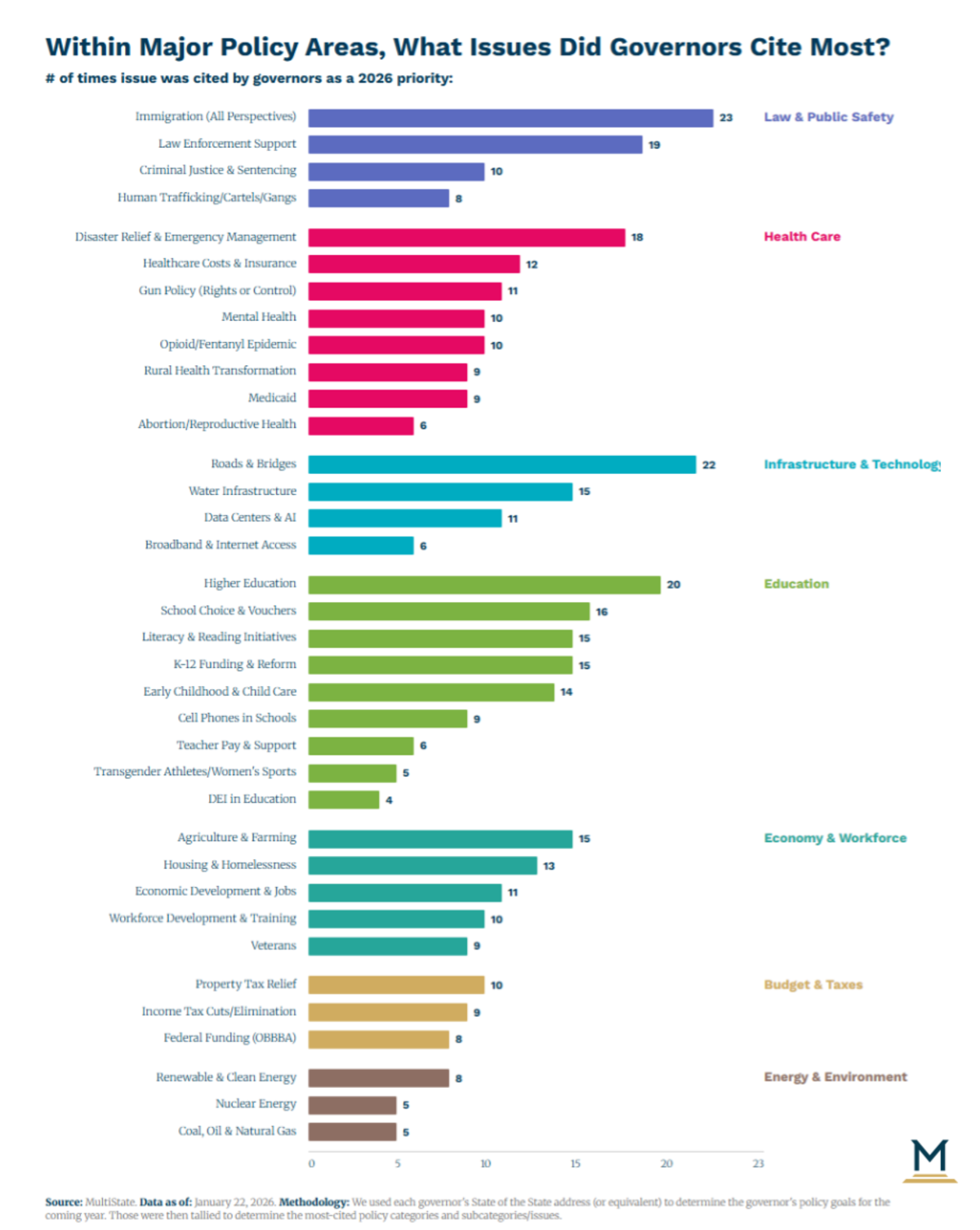
Top Policy Priorities from 2026 Governor Speeches
Below are six issue major areas from the speeches thus far.
Immigration Enforcement and Federal Actions
Every governor addressed immigration, making it the single most-discussed topic of the governors’ speeches in 2026 so far. The sharp partisan divide — with Republicans emphasizing enforcement cooperation and Democrats criticizing federal actions — previews what will be a contentious issue throughout the year.
- Gov. Larry Rhoden (R-SD): "Our saturation patrols were so successful in Sioux Falls that we took them on the road... To date, Operation: Prairie Thunder has yielded 432 individuals brought into custody, over 1,000 drug charges, nearly 250 warrants executed... 63 illegal aliens handed over to ICE custody, and 9 cartel or gang members apprehended."
- Gov. Bob Ferguson (D-WA): "We need to be direct about what is happening in our country and our state with ICE. It's horrific, it's unjust, and it needs to stop — now. As an American, I never thought I would see federal agents in masks jumping out of unmarked cars and grabbing people off our streets."
Rural Healthcare Investment and Hospital Funding
Created under the sweeping 2025 congressional reconciliation law, the Rural Health Transformation (RHT) Program marks one of the largest federal investments ever aimed at strengthening rural health systems. As created by Congress, it is a $50 billion program with $10 billion set to flow to states each year from 2026 to 2030. The program arrives at a critical moment, as states brace for significant federal Medicaid revenue cuts tied to the OBBBA and rural healthcare facilities stand to be disproportionately impacted by such cuts.
- Gov. Andy Beshear (D-KY): “And [my budget] creates a $125 million rural hospital fund. We simply cannot allow our rural hospitals to close.”
- Gov. Brad Little (R-ID): "Over the next five years, thanks to the leadership and vision of Idaho's congressional delegation and President Trump, Idaho will invest nearly one billion federal dollars to improve the accessibility and affordability of rural health care."
- Gov. Kay Ivey (R-AL): "We recently learned Alabama will receive more than $203 million dollars in first-year funding from the Rural Health Transformation Program."
Statewide Cell Phone Restrictions in Schools
What started as scattered local policies has become a statewide movement. Nine governors called for phone restrictions in 2026 speeches. Expect legislation restricting classroom phone use to advance in several states that haven’t already done so.
- Gov. Laura Kelly (D-KS): "Cell phones are making it much harder for our children to learn and for our teachers to teach. We need to step up and do something about this. This session, we must pass the bipartisan proposal to ban cell phone use during the school day."
- Gov. Kay Ivey (R-AL): "The FOCUS Act, which limits phone use during instructional time, has brought great results in only its first few months. Seems like a no-brainer, right? Even a Tuscaloosa teacher went viral for asking: Was it really that easy all along?"
Economic and Infrastructure Challenges
Property Tax Relief Strategies
Rising property values have made property tax relief politically urgent. Multiple approaches are being tested, from exemptions to assessment caps.
- Gov. Kim Reynolds (R-IA): "One issue continues to impact Iowans in every community and across every income level: property taxes. Whether you live in a small town, growing suburb, or an urban neighborhood, you've probably felt it. Property taxes are rising faster than inflation, faster than paychecks, and faster than population growth."
- Gov. Ron DeSantis (R-FL): "Florida might have the lowest taxes at the state level in the nation, but our citizens have been squeezed by escalating property tax assessments and millage increases at the local level."
Nuclear Energy Expansion Plans
Nuclear energy is experiencing a bipartisan resurgence, driven by data center energy demands and grid reliability concerns. Five governors explicitly called for nuclear expansion in their addresses.
- Gov. Kathy Hochul (D-NY): “Last summer, I took the bold step of greenlighting the first nuclear power project in a generation, a vital part of our all-of-the-above approach to energy. At the time we set a goal of building one gigawatt of nuclear power. But if there’s one thing I believe, it’s this: Go big or go home. So I’ve decided to raise the bar to five gigawatts. That’s more nuclear energy than has been built anywhere in the United States in the last 30 years!”
- Gov. Mike Kehoe (R-MO): "And that's why today, I am proud to announce that Missouri, and this administration, is all in on nuclear. We know nuclear is a safe, reliable, and clean energy source that can and will power Missouri's economic future for generations to come."
Artificial Intelligence Opportunities and Risks
Artificial intelligence appeared in nearly half of the speeches, with governors expressing both enthusiasm for economic opportunities and concern about risks:
- Gov. Ron DeSantis (R-FL): "An AI tool is only as good as the data that is inputted: garbage in, garbage out. Whoever controls the data inputs will have immense power to shape the reality for hundreds of millions, maybe billions of people."
- Gov. Gavin Newsom (D-CA): “[I]t goes without saying that no technology holds more promise and more peril, to jobs, to our economy, to our way of life than artificial intelligence. The tech genie, it’s out of the bottle. So the question is not whether change is happening; it is. The question is: What values will guide us into this new frontier?”
- Gov. Mike Braun (R-IN): "AI is going to be key to the jobs of the future, but data centers can't stick Hoosiers with the power bill. Companies that want big power in Indiana should pay their own way."
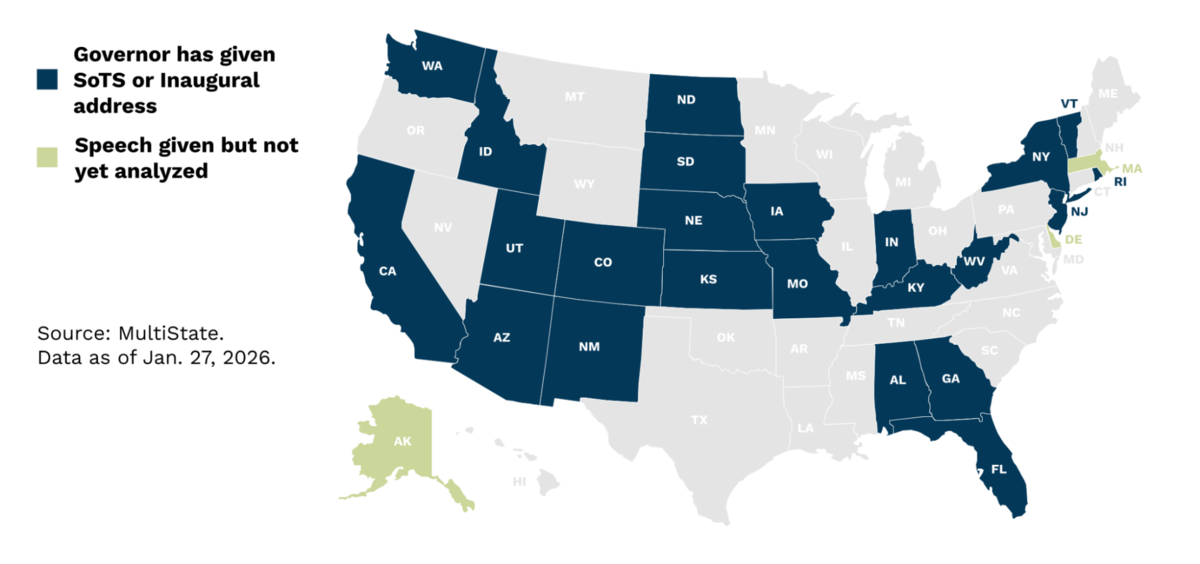
We’ll have a fuller analysis and breakdown of these State of the State addresses soon, and plan to add more speeches to the analysis as they’re delivered (e.g., governors in Alaska, Delaware, and Massachusetts delivered remark after we pulled together the initial report).
Sign Up for Morning MultiState
This article appeared in our Morning MultiState newsletter on January 27, 2026. For more timely insights like this, be sure to sign up for our Morning MultiState weekly morning tipsheet. We created Morning MultiState with state government affairs professionals in mind — sign up to receive the latest from our experts in your inbox every Tuesday morning. Click here to sign up.

-f16ae1-1200px.jpeg)