Health Care & Wellness, Financial Services & Commerce
State Food Additive Legislation Surged Across 38 States in 2025 (Plus Other Food Policy Trends We Saw Last Year)
January 14, 2026 | Katherine Tschopp
March 19, 2026 | Geoff Hawkins
Key Takeaways:
The American Gaming Association (AGA) expects regulated sports wagering operators to take in over $3 billion in wagers on this month’s NCAA basketball tournaments. But regulated sportsbooks aren't the only ones cashing in on March Madness. ESPN.com reported that Kalshi, a prediction market platform, took in nearly $1.9 billion in college basketball wagers in February alone. Last summer, we examined the conflict between regulated sports wagering companies and the emerging prediction market industry. That conflict has escalated, with state governments, prediction market operators, and federal regulators now fighting on multiple fronts.
Across all sports, the AGA estimates that states have lost out on over $600 million in tax revenue from wagers placed on unregulated prediction markets. In response, state governments have acted on two fronts: (1) legislation to either prohibit or regulate prediction markets; and (2) regulatory actions by gaming regulators and state attorneys general.
On the legislative front, lawmakers in eleven states have introduced legislation focused on prediction markets. These bills fall into several buckets, ranging from full bans on prediction markets to full market authorization.
Hawaii and Kentucky are the furthest along so far, and have taken different approaches. The Hawaii House passed a bill last week (HI HB 2198) that would expand the definition of gambling to include prediction markets and therefore make prediction markets illegal in the state. The Kentucky House passed a bill (KY HB 757) that would impose a 17.25% tax on a prediction market operator’s transaction fees. Additionally, lawmakers have amended a separate Kentucky bill (KY HB 904) to prohibit existing horse racing, sports wagering, or fantasy contest licensees from offering prediction markets. That bill is now on the House floor.
Lawmakers in New York have also proposed direct restrictions on prediction markets (NY AB 9251 / NY SB 9414), although New York's longer legislative calendar gives those bills more runway than measures in states with shorter sessions. Over the next two weeks, legislators in Tennessee and California will consider more targeted approaches.
Lawmakers in Tennessee have two bills (TN HB 2079 and TN SB 1992) scheduled for hearings this week that would criminalize conduct intended to influence the outcome of an event if the person would benefit from a contract on a prediction market for that event. Meanwhile, the California Assembly Elections Committee will hear a bill next week (CA AB 1840) that would prohibit public officials, specified government employees, and lobbyists from engaging in prediction market transactions if they possess or may foreseeably obtain material nonpublic information on the event. These bills try to address the potential “insider trading” and corruption issues that were a reason federal regulators under the Biden Administration were wary to approve prediction markets in the first place.
States are not only relying on legislation to act on prediction markets. Eleven states have issued cease and desist letters or initiated enforcement actions against prediction market operators. The states argue that prediction market operators are effectively unlicensed sports wagering operators, as the vast majority of their contracts are based upon sports events. News reports show that during the NFL season, about 90% of contracts entered into on Kalshi were sports-related.
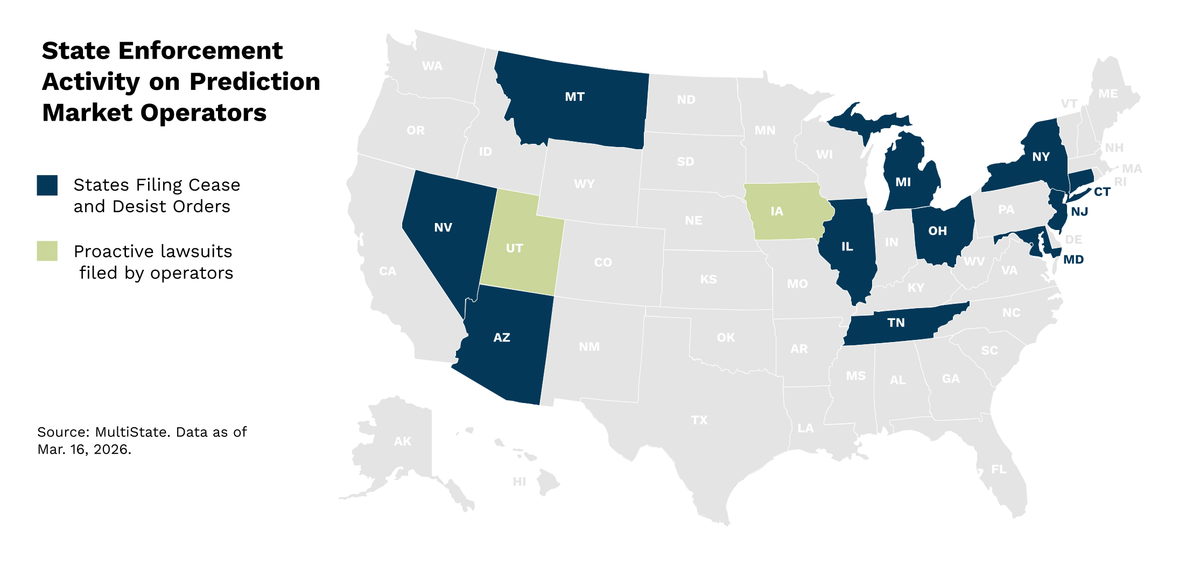
Prediction market operators have responded via litigation in several states. After the Nevada Gaming Control Board (NGCB) issued a cease and desist order last year, Kalshi sued in federal court and sought an injunction to prohibit the NGCB from enforcing its order. Last month the Ninth Circuit Court of Appeals dismissed Kalshi’s appeal of a District Court decision to not grant Kalshi’s requested injunction to stop the NGCB’s actions against the prediction market operator.
Kalshi has also filed suit in a number of other states, with mixed results so far. The prediction market operator scored temporary judicial wins in New Jersey, Connecticut, and Tennessee, while judges in Maryland and Ohio have denied Kalshi’s requests for a preliminary injunction. Most of these initial decisions are now before appeals courts.
Federal regulators, however, have shifted course. While the Biden Administration's U.S. Commodity Futures Trading Commission (CFTC) was wary of approving prediction markets — citing concerns about insider trading and market manipulation — the current CFTC under Chair Michael Selig has taken the opposite position, siding with prediction market operators over the states. As CFTC Chair, Selig has argued that Congress gave the CFTC exclusive jurisdiction over contracts based on commodities and defined commodities very broadly. He believes that prediction markets fit within the definition, and concluded by saying, “To anyone seeking to challenge the Commission’s authority over these contracts, I want to make it clear: we’ll see you in court.”
The CFTC recently issued an Advanced Notice of Proposed Rulemaking, seeking public comment on regulations that apply to prediction markets, including the types of event contracts that may be prohibited as contrary to the public interest. Comments are due by April 30.
The battle over prediction markets is accelerating on multiple fronts with no clear resolution in sight. State legislatures will continue pursuing legislative solutions, state regulators will step in to protect their existing gaming operators, and the federal government appears intent on claiming exclusive jurisdiction over prediction markets. With billions in revenue at stake for both operators and state governments, and federal courts reaching conflicting conclusions on the legality of prediction markets, this fight is likely heading toward the U.S. Supreme Court. Congress could also intervene, either to affirm or limit the CFTC's claimed authority over prediction markets. Either way, this is an area that government affairs professionals should be watching closely.
Federal and state legal activity can have significant policy and regulatory implications for businesses and organizations. If your organization would like to further track federal and state legal activity, please contact us.
January 14, 2026 | Katherine Tschopp
January 13, 2026 | Katherine Tschopp
December 9, 2025 | Katherine Tschopp