Key Takeaways:
- In 2026, 134 bills related to AI in education legislation have been introduced across 31 states, focusing on data privacy, classroom use restrictions, and curriculum integration.
- State AI education legislation is addressing student data privacy concerns through bills like California AB 1159, which prohibits using student data to train artificial intelligence models, and Idaho SB 1227, which requires data privacy protections for AI tools in schools.
- Regulations addressing AI in classrooms establish boundaries for technology use, with states like Oklahoma and Maryland requiring human oversight and banning AI from making high-stakes decisions about students.
- Several states are adding artificial intelligence curriculum requirements to graduation standards, with Georgia and Mississippi requiring computer science credits that include AI instruction starting in the late 2020s.
- States are taking a measured approach to AI in education, focusing on research, transparency, and guardrails rather than rushing to mandate widespread classroom adoption.
The artificial intelligence (AI) boom is rapidly transforming industries, boosting economic development, and shaping the future of technology. An often underdiscussed aspect of this transition is the impact on educational systems, which are now grappling with how to integrate and regulate these tools.
As AI becomes more widely used, state policymakers are moving to define clearer expectations around its implementation in schools. As of March 2026, MultiState is tracking 134 bills in 31 states this legislative session related to artificial intelligence in education. While policy approaches vary significantly by state, several clear themes are emerging across legislation.
State Legislative Priorities for AI in Education
Schools are continuing to adapt to the changes that artificial intelligence brings as a new and emerging technology. In 2025, state lawmakers focused on legislation that encouraged further research rather than jumping directly to mandating use (read more about this in our previous blog post here). Lawmakers are now beginning to dive deeper into when and how AI should be used in schools, and where limits are needed. In 2026, states have taken steps to regulate artificial intelligence in both K-12 and higher education systems.
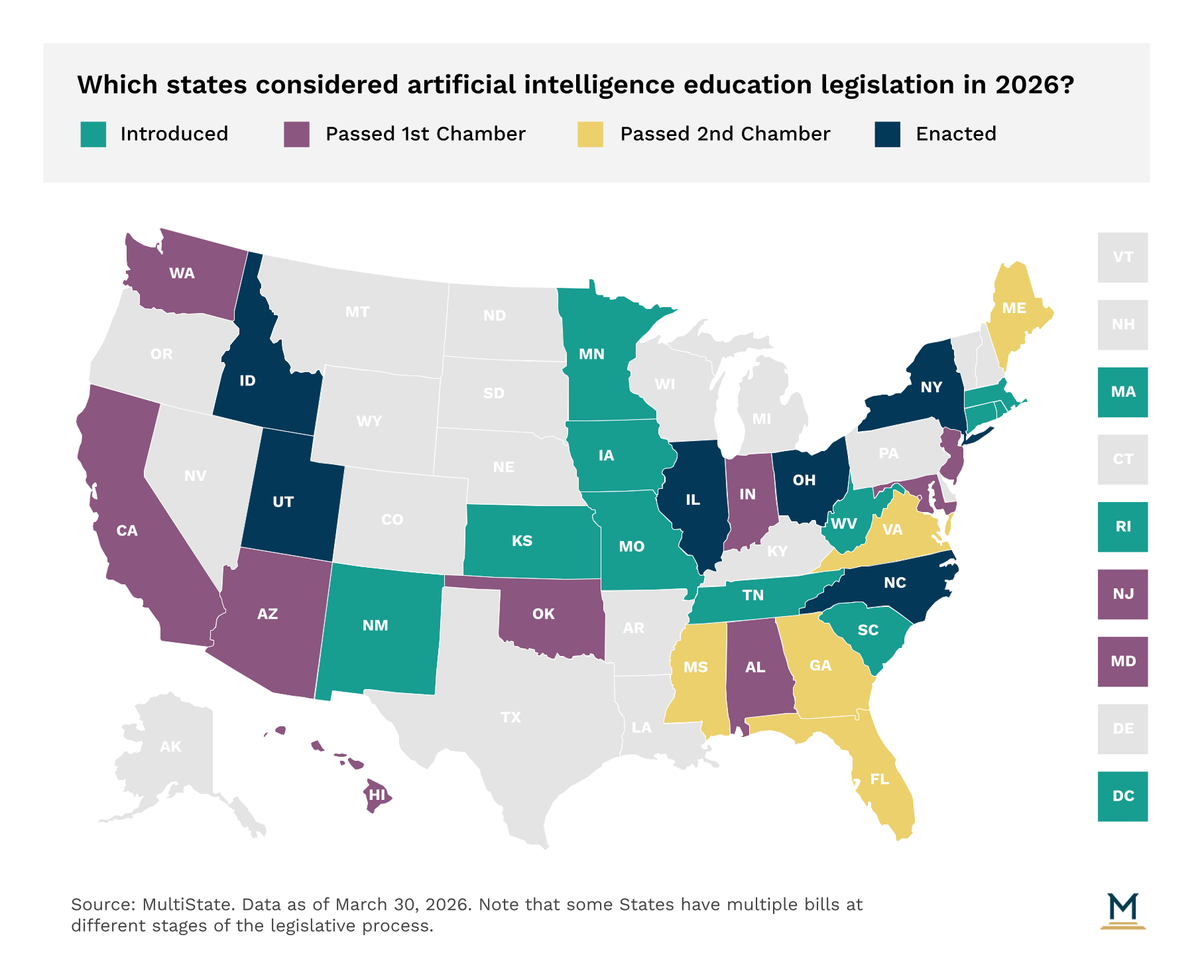
Three Key Areas of AI Education Legislation in 2026
Student Data Privacy and Protection Measures
Protecting student data has been a large concern for lawmakers, schools, and parents. In 2026, states are focusing on regulations regarding AI features and privacy in educational technology, broader human oversight of AI, and parental consent to data collection. These proposals highlight increasing awareness around privacy and how student data is collected, used, and possibly incorporated into artificial intelligence training models.
Key Bills:
-
Idaho (ID SB 1227) – Requires a statewide framework for AI in K-12 schools, mandates local policies for its use, establishes AI literacy standards and educator training, sets data privacy requirements for AI tools, and prohibits AI from replacing human teachers. Enacted
-
Vermont (VT HB 650) – Requires educational technology providers to register and certify privacy compliance annually. Directs the Agency of Education to review registrations, publish a product list, and recommend statewide certification criteria addressing features like AI, data privacy, geolocation, and targeted advertising. Passed 1st Chamber
-
California (CA AB 1159) – Expands and strengthens student data privacy protections, prohibits using student data to train AI, broadens coverage to any school-used online service, establishes new protections for college students, creates a private right of action, and extends requirements to third-party operators while removing certain exemptions. Passed 1st Chamber
-
Illinois (IL SB 3735) – Gives families the right to opt out of school tech and AI grading decisions and restricts how companies can use and retain student data for AI training without explicit consent. Introduced
AI Usage Boundaries and Oversight Requirements
Policymakers have been considering what boundaries to set for artificial intelligence in learning environments. Common legislative themes this year include limiting high-stakes AI use, increasing oversight for students, and requiring clear policies and transparency on how AI is used in classrooms. These approaches demonstrate an effort to make sure artificial intelligence is used as a support tool rather than a replacement for human decision-making in classrooms.
Key Bills:
-
Oklahoma (OK SB 1734) – Allows AI in schools only under educator supervision with human review, bans its use for high-stakes decisions, mandates state guidance and district policies, and requires annual parent disclosure. Passed 1st Chamber
-
Maryland (MD SB 720 and MD HB 1057) – Requires the State Department of Education to issue AI guidance, mandates local school systems to adopt AI policies and promote AI literacy, integrates AI into workforce standards and educator training, establishes a statewide collaborative to study AI in K-12 education, and requires designated AI coordinators and university-supported certification of compliant AI tools. Passed 1st Chamber
-
New York (NY A 9190) – Restricts AI use in classrooms to ninth grade and above (except for diagnostics or special education interventions), while allowing staff to use AI for administrative and planning tasks. Introduced
-
Arizona (AZ HB 4040) – Requires K-12 public schools and public universities to adopt policies regarding student use of artificial intelligence, including measures to detect and prevent the unauthorized use of AI in coursework, establish guidelines for authorized use, and outline consequences for violations. Introduced
AI Literacy and Graduation Requirements
Artificial intelligence literacy is a significant trend nationwide, and states are introducing legislation to prepare students for societal technological changes. Overall legislative trends include new high school and postsecondary graduation requirements and updates to STEM/technology curriculum. This legislation reflects AI literacy becoming a core workforce skill, not just a technical specialization.
Key Bills:
-
Mississippi (MS SB 2294) – Requires high school students starting with the 2029–2030 ninth-grade class to earn a computer science or CTE credit that includes instruction on emerging technologies such as AI. Passed 2nd Chamber
-
Georgia (GA SB 179) – Makes computer science, including AI, a high school graduation requirement beginning in 2031–2032 and phases in statewide access to computer science instruction. Passed 2nd Chamber
-
New Jersey (NJ A 4352 and NJ S 2862) – Requires school districts to incorporate instruction on the concepts, skills, and ethical use of AI into the K-12 curriculum, along with requiring public institutions of higher education to offer certificate and degree programs in AI. Introduced
Future Outlook for AI Education Policy
We expect to see continued legislation addressing artificial intelligence in education systems throughout the rest of 2026 and beyond. As schools gain more experience with these tools, state legislatures may revisit earlier policies and consider whether additional guardrails or standards are needed.
More broadly, education policy is emerging as a testing ground for how states approach AI regulation. For now, most states appear focused on learning, experimenting, and setting boundaries rather than rushing to widespread classroom adoption.
multistate.ai
To help you make sense of state activity on artificial intelligence and other emerging technology, we launched multistate.ai, a resource website and weekly update highlighting key developments in state AI policy and diving deep into select issue areas.