Legal, Employment & Labor
The New Economics of College Athletics (An Update on Name, Image, and Likeness Laws)
September 29, 2026 | Marvin Yates
June 10, 2026 | Sandy Dornsife
-f5e651-1200px.jpg)
Key Takeaways:
Courts do more than enforce the law; they shape it, and who sits on the bench has direct consequences for state policy. From redistricting to transgender rights to immigration, judges across the country are tasked with making determinations on some of the most controversial and consequential issues in the nation. Although neutrality and adherence to the letter of the law form the foundation on which courts operate, partisanship still plays a real role in the process. As a result, judicial selection has become the focus of serious political jockeying by players on both sides of the aisle. This year alone saw a judicial election in Wisconsin that shattered all prior campaign spending records and another in Pennsylvania that drew attention and money from across the nation.
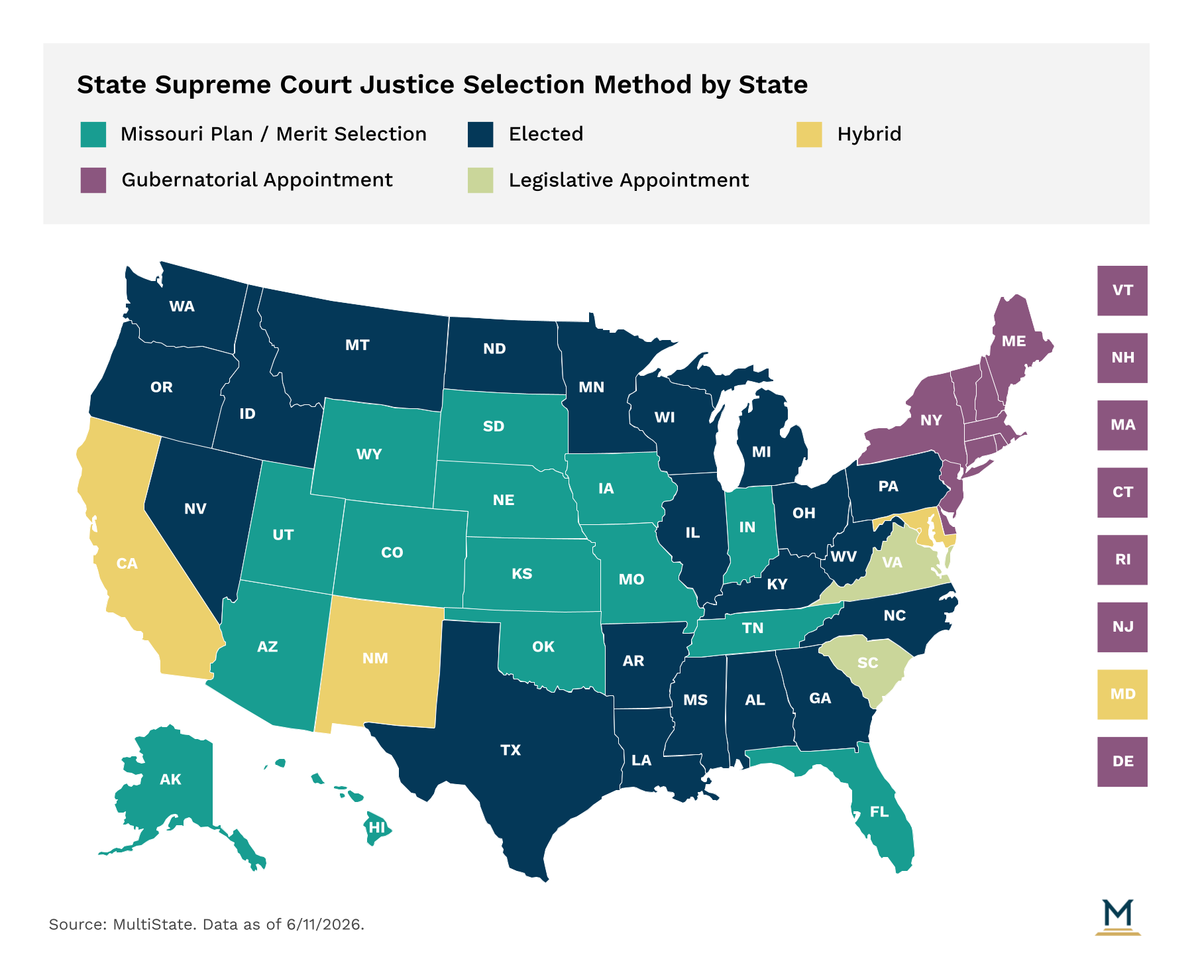
Currently, the vast majority of states use elections to select supreme court justices, with the remaining states using gubernatorial or legislative appointments or a hybrid system. Of the states that authorize the Governor to make appointments, many utilize the Missouri Plan in which an independent nominating commission presents a list of approved candidates to the Governor. Such authority allows a state’s executive branch to shape its high court. Utah is one such state, and in the coming months, its Governor faces the unprecedented opportunity to transform the state’s high court entirely.
Tensions between Utah’s Republican dominated executive and legislative branches and the judicial branch have been steadily increasing over the past five years.
In 2024, the Supreme Court voided a 2018 proposed constitutional amendment that would have expanded the legislature’s ability to amend or repeal ballot initiatives, as well as refused to override a 2018 voter-approved initiative to create an independent commission to draw fair election maps. That same year, the court also reached a highly anticipated decision on the state’s near-total abortion ban. In a 4-1 vote, the Supreme Court temporarily blocked the ban, finding that there were serious questions as to whether the law infringed upon rights to bodily integrity and to make decisions about one’s family without government interference. In reaching this holding, the court rejected the idea that a right needs to be deeply rooted in history to trigger protection so long as it “falls within the umbrella of protected rights.”
This series of decisions prompted an effort by the conservative majority government to rein in the court. The government’s push to remake the court began in 2023 through the enactment of a law that removed restrictions on gubernatorial appointments to the judicial nominating commissions. In 2025, after vetoing an initial version of the bill, Governor Cox signed compromise legislation during a special session granting the Governor authority to appoint the Chief Justice of the Supreme Court. Before this, the Chief Justice was always elected by their fellow judges on the court. Most recently, in January of this year, Utah’s Governor Spencer Cox signed UT SB 134 into law, increasing the number of judges on the State Supreme Court bench from five to seven. The bill was backed by the legislature's Republicans and passed largely along party lines. Just as the Governor was in the process of reviewing candidates to fill these new vacancies, the current Chief Justice Matthew Durrant announced his retirement and Justice Diana Hagen resigned amid a misconduct investigation into previously investigated and dismissed allegations that she had an improper relationship with an attorney who argued cases before the court. Critics argue that Justice Hagen’s resignation was driven largely by partisan objectives, as the new investigation was called for by Republican state leaders after records regarding the prior investigation were released under a public records request. Justice Hagen’s resignation also follows a recent campaign by GOP lawmakers against both her and fellow Justice Jill Pohlman in an upcoming retention election in response to their recent rulings.
On June 2, Governor Cox appointed Stephen Dent and Jay Jorgensen to the two vacancies created by the 2026 court expansion, both of whom have no prior judicial experience. Of the remaining three Supreme Court justices, two are Governor Cox’s own selections, meaning that once the remaining vacancies are filled, only one justice will not be a Cox appointee. By the end of 2026, the Supreme Court will almost entirely represent Governor Cox’s judicial vision.
Significant cases pending before the Utah court include final judgments on the state’s abortion ban, a suit by a group of young people against the Utah Department of Natural Resources regarding fossil fuel permits, and a challenge to newly enacted legislation to change the structure of the state's court to create a three-judge panel to hear all civil cases involving a state entity or official at the request of the Attorney General, Governor, or Legislature. With the new balance of power on the Court, it is not hard to imagine the impact that this will have on the current docket.
Federal and state legal activity can have significant policy and regulatory implications for businesses and organizations. If your organization would like to further track federal and state legal activity, please contact us.
September 29, 2026 | Marvin Yates
July 30, 2026 | Sandy Dornsife
May 12, 2026 | Mary Kate Barnauskas