Legal
The Supreme Court's Last Rulings of the Term, and What They Mean for States
July 30, 2026 | Sandy Dornsife
May 7, 2026 | Sandy Dornsife
Key Takeaways:
The concept of environmental, social, and governance (ESG) is a system used by individuals and corporations to take into account an entity's impact on the environment and social issues in making investment decisions. While the use of ESG is not new, the increased use of the practice over the past few years has been met with resistance in a political atmosphere where climate change and social reforms remain extremely divisive topics. To understand the current debate, it helps to look at where ESG investing came from.
As far back as the 1950s and 1960s, activists sought to use economic pressure to influence controversial issues like the Vietnam War and Civil Rights, and in 1971, two United Methodist ministers established Pax World Funds, the first publicly available mutual fund in the United States that considered ESG in making its investments. While the next four decades saw a slow and continuous interest in ESG, it was not until 2015 that the concept really started to gain significant traction when 196 parties, including 194 countries and the European Union, adopted the Paris Agreement, which entered into force the following year. The agreement, an international treaty on climate change, led to the development of Global Reporting Initiative Standards that allow businesses to uniformly report on their strides towards climate goals. The wide adoption of these standards, along with similar rating systems created by organizations such as S&P Global's SAM Corporate Sustainability Assessment and Corpwatch, has resulted in a proliferation of the ESG practice in the past five years.
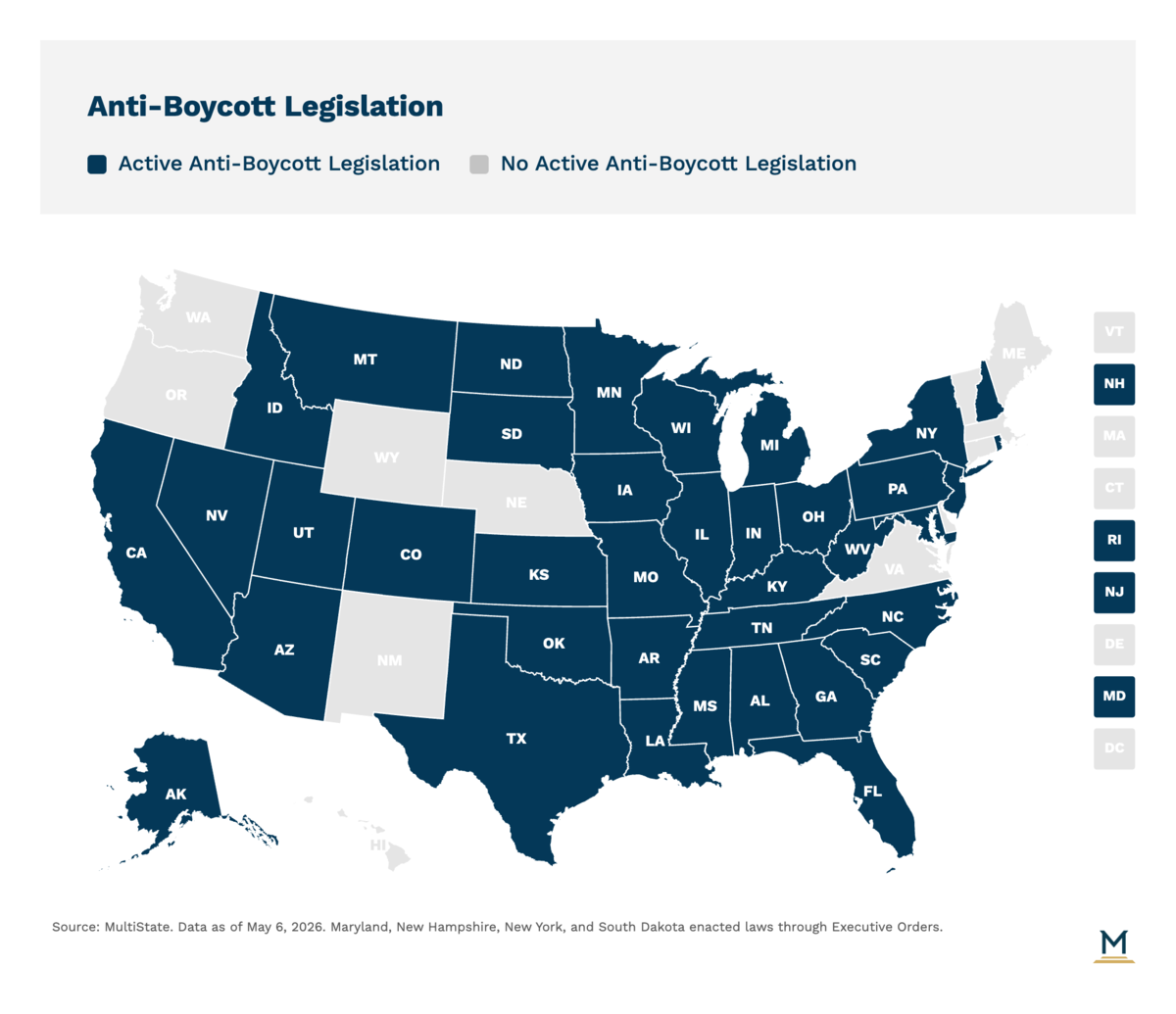
Laws attempting to restrict the use of ESG generally take one of three different forms. The first method is to prohibit the use of ESG in managing public investments. Florida and Indiana both passed such prohibitions in 2023. The second method is to restrict the private sector’s ability to use ESG in determining whether or not to provide services to a customer. Notable examples include Wyoming, which prohibits certain financial institutions from discriminating against customers based on their association with the firearms industry, and Utah, which prohibits the denial of a transaction to a consumer based on their “social credit score,” political views, or protected class. The third method, and perhaps the most popular, involves imposing restrictions on government contracting or investing with entities that “boycott” certain industries or entities. Currently, approximately two-thirds of the states limit the states’ ability to invest in or contract with entities that boycott Israel. Alabama, Arkansas, Idaho, and Utah all prohibit similar actions with regard to entities that boycott fossil fuel companies.
This month, the Oklahoma Supreme Court ruled on a case regarding the constitutionality of a common “boycott” law that could serve as a precedent for many other states.
In Keenan v. Russ, a retired public employee challenged the constitutionality of the Energy Discrimination Elimination Act’s requirement that companies that do business with the state, including the Public Employee Retirement System, certify that they do not boycott energy companies. Under the Act, the retirement system was prohibited from investing in an entity that restricted its own dealings with fossil fuel companies as a part of ESG considerations. The plaintiff argued that such a prohibition violated the state Constitution’s requirement that the retirement system operate for “the exclusive purpose of providing for benefits, refunds, investment management, and administrative expenses of the individual retirement system, and shall not be encumbered for or diverted to any other purposes.” The District Court granted summary judgment in favor of the plaintiff, and the state appealed the case to the Supreme Court.
On April 7, the Court issued its opinion, agreeing with the lower court and upholding the permanent injunction against the Energy Discrimination Elimination Act’s requirements. The Court held that restricting investment in entities that boycott certain energy companies inhibited the retirement system’s ability to make the most financially advantageous investments for its members.
The decision will certainly have implications for other states that provide similar constitutional protections for their retirement plans. However, in the meantime, opponents of such laws continue to seek out other legal avenues to challenge boycott legislation. Plaintiffs in Texas are currently in the process of challenging the state’s law restricting investment in institutions that boycott energy companies based on First and Fourteenth Amendment rights. They argue that the restriction penalizes entities for their constitutionally protected right to free speech and is unconstitutionally vague. A federal district court judge granted the plaintiff’s motion for summary judgment in February, and the government is in the process of appealing the decision. Like Oklahoma, this case is likely to end up in the Supreme Court and create repercussions across the nation. States on both sides of the political spectrum will inevitably face challenges to their ability to implement laws that penalize private entities for specific political or social positions.
Federal and state legal activity can have significant policy and regulatory implications for businesses and organizations. If your organization would like to further track federal and state legal activity, please contact us.
July 30, 2026 | Sandy Dornsife
-f5e651-400px.jpg)
June 10, 2026 | Sandy Dornsife

June 9, 2026 | Kim Miller