Legal, Energy & Environment
State Environmental, Social and Governance (ESG) Restrictions Curbed by Recent Court Action
May 7, 2026 | Sandy Dornsife
June 9, 2026 | Kim Miller
Key Takeaways:
Since 2024, 21 states have considered 34 bills addressing advanced recycling, with 14 bills in 11 states receiving consideration in 2026. This follows the enactment of advanced recycling legislation in Maine in 2024 and in California in 2025. Over the last few years, advanced recycling legislation has become somewhat more diverse. However, the trend of defining advanced recycling processes and including or excluding advanced recycling from the application of solid waste laws has continued.
Advanced recycling
An umbrella term for non-mechanical methods of recycling plastics, including chemical recycling processes. Also called chemical recycling, advanced recycling uses heat or chemical processes to break down plastic waste into raw materials rather than physically reprocessing it. The term, and the scope of what it covers, is actively contested among industry, environmental, and recycling groups.
Pyrolysis
A thermal process that breaks down plastic or other organic material at elevated temperatures in the absence or near absence of oxygen. Pyrolysis is one of the primary technologies classified as advanced recycling. How states choose to define and regulate pyrolysis — whether as recycling, solid waste processing, or something else — is a central question in advanced recycling legislation.
Additionally, some states have considered legislation that would prohibit advanced recycling facilities, but none of these bills have been enacted. States that have already enacted advanced recycling laws have also considered legislation addressing the exclusion of tire recycling facilities from advanced recycling laws, as well as siting restrictions and tax incentives.
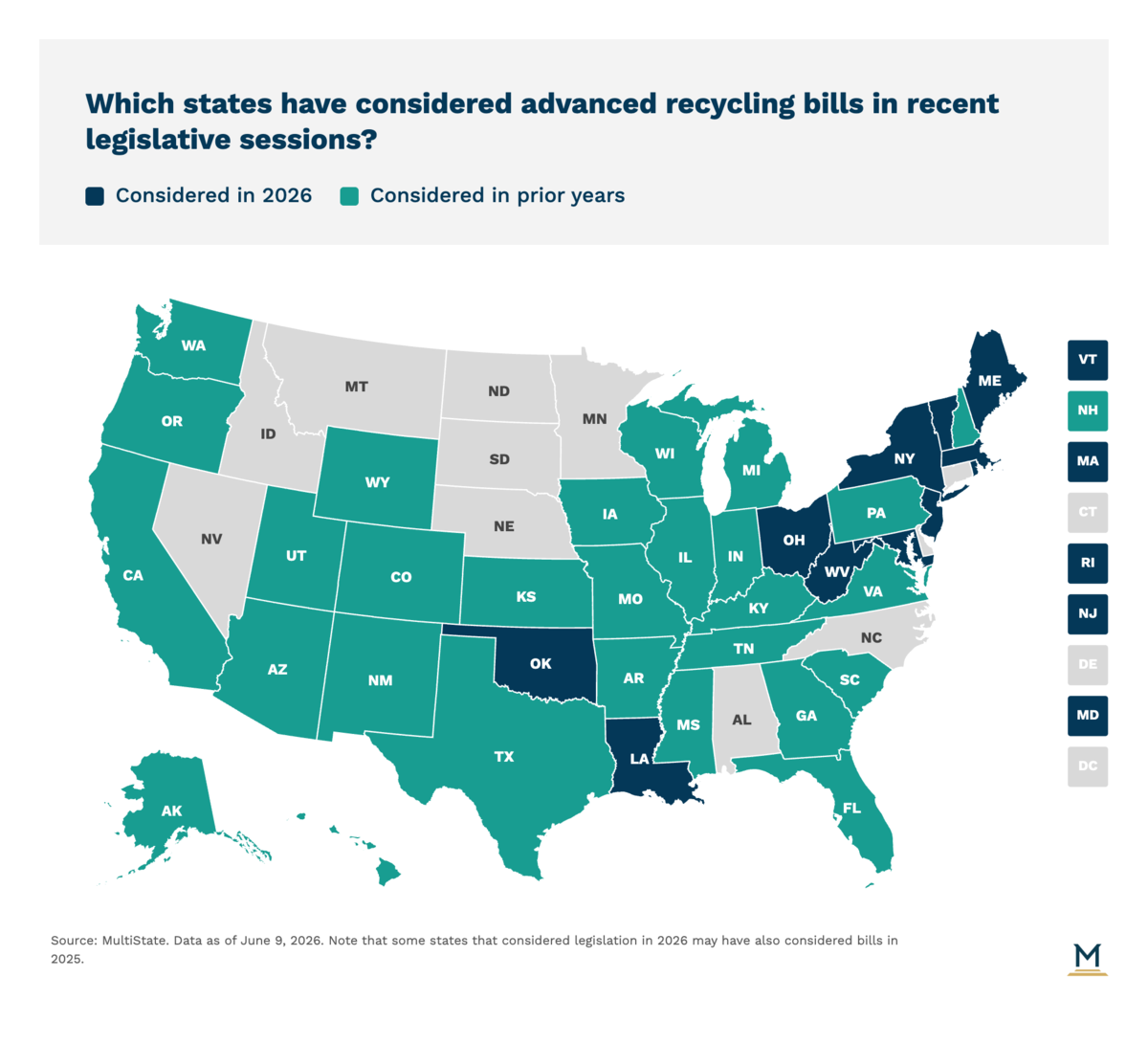
Advanced recycling legislation has generally been slow to become enacted. However, there has been some movement since February 2024 in California and Maine, which have both enacted advanced recycling legislation.
In March 2024, the Maine legislature enacted ME LD 1660, which restricts advanced recycling facilities in Maine by ensuring they are subjected to the state’s solid waste laws. The law prohibits developing any advanced recycling facility unless the developer can show the facility will recycle at least 50% of the plastic it processes and requires developers to meet certain financial assurance requirements.
Additionally, in April 2026, Maine enacted legislation (ME LD 2227) expanding the types of documents that could be provided to meet financial assurance requirements to include trust funds, insurance policies, and corporate financial tests in a manner that complies with federal regulations.
In October 2025, the California legislature enacted CA AB 70, which defines “pyrolysis” as the thermal decomposition of material at elevated temperatures in the absence or near absence of oxygen. Unlike other states that have enacted legislation defining pyrolysis and exempting the process from solid waste laws, California classified this process under existing solid waste law without classifying the process as recycling. This approach maintains a distinction between traditional recycling and advanced recycling processes while preserving stricter permitting requirements for advanced recycling facilities.
Maryland, Pennsylvania, New Jersey, and New York have all considered, but not enacted, legislation that would exempt advanced recycling facilities from certain permitting and regulatory requirements applicable to solid waste facilities since 2025.
The Maryland legislature introduced advanced recycling legislation in 2025 (MD HB 1092) and again in 2026 (MD HB 796) that would have included advanced recycling in the state’s recycling laws, which generally have less strict permitting and compliance requirements than solid waste facilities. Neither bill saw any movement and the Maryland legislature has adjourned for the year.
The Pennsylvania legislature considered similar legislation in 2025 (PA HB 1035) that would have amended the definition of advanced recycling under the state Solid Waste Management Act to include pyrolysis. This legislation has not seen any movement since it was introduced in March 2025, however, it is still eligible for consideration in 2026.
The New York legislature has also introduced legislation (NY AB 4981/SB 6371) that exempts advanced recycling facilities from permitting and regulatory requirements otherwise applicable to solid waste management facilities. This legislation was introduced in 2025 and reintroduced for consideration in January 2026, but did not have any movement in 2025 and has not seen any movement in 2026 other than its reintroduction.
In the New Jersey legislature, lawmakers introduced legislation in January 2026 (NJ AB 3553) that exempts plastic material processed through an advanced plastic processing facility from state laws regulating solid waste. This legislation has not seen any movement since it was introduced in January. However, the New Jersey legislature is in session all year and legislation introduced in 2026 will carry over into the 2027 legislative session.
Massachusetts, North Carolina, Oregon, Rhode Island, and Vermont have all considered legislation that would either prohibit advanced recycling facilities or subject advanced recycling facilities to more stringent solid waste laws.
In 2025, the legislatures in Massachusetts and North Carolina both considered legislation that would have subjected advanced recycling to solid waste laws. The North Carolina legislation (NC HB 605) passed the House in 2025, but has not had any movement in the Senate where it is still eligible for consideration in 2026. The North Carolina legislature is in session until August 31, 2026. In Massachusetts, legislation was placed on the house docket (MA HD 5595) in January 2025 that defined chemical plastic processing and excluded the process from the definition of recycling. However, this legislation saw no subsequent movement.
The Rhode Island legislature considered legislation in 2025 (RI HB 5166/SB 24) and 2026 (RI HB 7620/SB 2531) that prohibits the state from issuing permits or licenses for the construction or operation of new plastic waste conversion facilities.
This legislation would effectively prohibit advanced recycling in Rhode Island as the state does not currently have any plastic waste conversion facilities. The legislation received one hearing in the House and Senate, where the respective environmental committees recommended the bill be held for further study.
The Oregon legislature introduced legislation in 2025 (OR HB 2960) that prohibited advanced recycling facilities. This legislation received one hearing, but never passed the House and the Oregon legislature did not consider any advanced recycling legislation in 2026 and has adjourned for the year.
The Vermont legislature considered similar legislation in 2025 (VT SB 139) and 2026 (VT SB 247) that would prohibit chemical conversion technologies, effectively prohibiting advanced recycling facilities. Neither bill saw any movement following introduction and the legislature has adjourned for the year.
Since 2024, there has also been some movement in amending existing advanced recycling laws.
In April 2026, the Oklahoma legislature enacted legislation (OK HB 3472) modifying the definition of advanced recycling to include tire pyrolysis until July 1, 2031. However, the legislation clarifies that tire pyrolysis facilities will not be considered advanced recycling facilities, but will instead be considered tire recycling facilities and will be subject to all applicable laws. This includes the Oklahoma Used Tire Recycling Act, which has more strict regulatory standards than other recycling facilities, including advanced recycling facilities.
In 2025, the Florida legislature considered legislation (FL HB 1199/SB 946) that would have prohibited solid waste facilities located within two miles of the Everglades or any water storage or conveyance structure. This legislation died in committee and the Florida legislature did not consider any advanced recycling legislation in 2026.
In the 2025 Virginia budget (VA HB 1600), the state extended its tax credit for purchasing machinery and equipment used for advanced recycling and processing recyclable materials in effect through taxable years beginning before January 1, 2027. Meanwhile in Michigan, lawmakers introduced legislation in 2025 (MI SB 322) that repealed renewable portfolio standards and reestablished incentives for advanced recycling, but did not see any movement following its introduction. However, this legislation is still available for consideration in 2026 and the Michigan legislature is in session all year.
Going forward, expect states to continue to consider legislation determining how to classify advanced recycling and potentially to reexamine existing advanced recycling laws.
MultiState’s team is actively identifying and tracking Energy and Environment issues so that businesses and organizations have the information they need to navigate and effectively engage. If your organization would like to further track these or other related issues, please contact us.
Which states have enacted advanced recycling legislation since 2024?
Maine and California have enacted advanced recycling legislation since 2024. Maine enacted ME LD 1660 in March 2024, which subjects advanced recycling facilities to solid waste laws and requires them to recycle at least 50% of processed plastic, and ME LD 2227 in April 2026, which expanded financial assurance requirements. California enacted CA AB 70 in October 2025, defining pyrolysis and classifying it under existing solid waste law without designating it as recycling.
What is the difference between California's approach to pyrolysis facility regulations and other states?
California classified pyrolysis under existing solid waste law without classifying the process as recycling, maintaining stricter permitting requirements for advanced recycling facilities. This differs from other states that have enacted legislation defining pyrolysis and exempting the process from solid waste laws. California's approach preserves a distinction between traditional recycling and advanced recycling processes while maintaining more stringent regulatory oversight.
Are any states trying to ban plastic waste conversion facilities?
Rhode Island has considered legislation in both 2025 and 2026 that would prohibit the state from issuing permits or licenses for new plastic waste conversion facilities, which would effectively prohibit advanced recycling since the state currently has no such facilities. Oregon and Vermont introduced legislation in 2025 and 2026 that would prohibit advanced recycling facilities or chemical conversion technologies, but these bills did not pass. Massachusetts and North Carolina considered legislation in 2025 that would have subjected advanced recycling to solid waste laws.
How does Oklahoma HB 3472 treat tire pyrolysis facilities differently from other advanced recycling facilities?
Oklahoma HB 3472, enacted in April 2026, modified the definition of advanced recycling to include tire pyrolysis until July 1, 2031, but clarified that tire pyrolysis facilities will not be considered advanced recycling facilities. Instead, these facilities will be classified as tire recycling facilities subject to the Oklahoma Used Tire Recycling Act, which has more strict regulatory standards than those applicable to advanced recycling facilities.
Which states are considering exempting advanced recycling from solid waste laws in 2026?
Maryland, Pennsylvania, New Jersey, and New York have all considered legislation that would exempt advanced recycling facilities from certain permitting and regulatory requirements applicable to solid waste facilities. Maryland introduced HB 796 in 2026, New Jersey introduced AB 3553 in January 2026, and New York reintroduced AB 4981/SB 6371 for consideration in January 2026, though none of these bills have seen movement beyond introduction. Pennsylvania's HB 1035 from 2025 remains eligible for consideration in 2026.
May 7, 2026 | Sandy Dornsife
March 20, 2026 | Daniel Kampf
January 23, 2026 | David Shonerd