
Elections & Campaigns, Health Care & Wellness
MAHA Political Endorsements Target August Republican Primaries
August 11, 2026 | Katherine Tschopp
June 8, 2026 | Mary Kate Barnauskas
Key Takeaways:
As lawmakers tackle the affordability agenda this session, Prescription Drug Affordability Boards, or PDABs, have emerged as a key debate among several states attempting to rein in prescription drug costs. The issue was especially prominent in Virginia this year, where bipartisan legislation was vetoed by Governor Abigail Spanberger (D), who argued that similar efforts in other states have not achieved the goal of lowering prescription drug costs and have been expensive undertakings.
Prescription Drug Affordability Board (PDAB)
A state-level entity tasked with addressing prescription drug costs for the state and consumers. The most consequential PDABs have authority to conduct affordability reviews on eligible high-cost drugs and set upper payment limits on drugs they determine to be unaffordable in the state.
Upper Payment Limit (UPL)
A maximum price cap that a PDAB can set on a prescription drug after determining it to be unaffordable in the state. UPLs restrict how much state programs and certain payers can reimburse for that drug, with the goal of reducing prescription drug costs.
Affordability Review
A comprehensive evaluation conducted by a PDAB to assess whether a prescription drug's cost creates affordability challenges for the state or consumers. The review involves analyzing extensive data, requesting information from stakeholders, consulting clinical contractors, and producing detailed reports that can exceed 170 pages before determining whether to set an upper payment limit.
Nine states currently have PDABs or similar drug pricing entities, generally tasked with addressing prescription drug costs for the state and consumers. Authorities vary by state, but the most consequential PDABs are those that can conduct affordability reviews on eligible high-cost drugs and set upper payment limits (UPLs) on those they have determined to be unaffordable in the state.
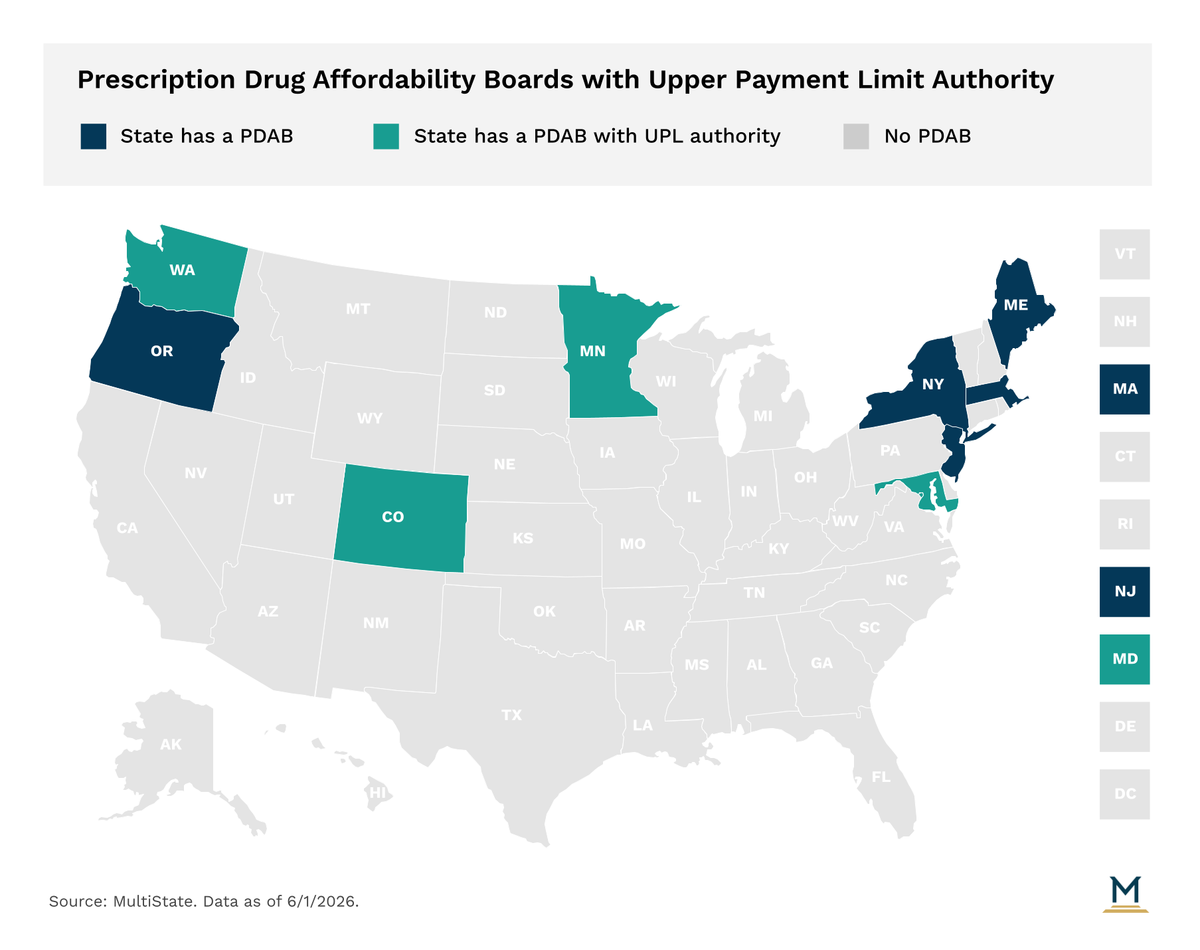
PDABs in Maryland, Colorado, Washington, and Minnesota have such authority, and their experience has emerged as a valuable consideration for states considering similar measures. MultiState closely monitors PDAB activity, and as a result, I have attended hundreds of hours of PDAB meetings, gaining insight into how these boards function operationally and the practical challenges that have shaped implementation efforts. PDABs present an interesting lesson for policymakers in that passing legislation is often just the beginning, and complex implementation procedures can play a significant role in determining the success of a measure.
Across the board, PDABs consistently require significant effort to build out their infrastructure and processes. From a board construction process, board members are often appointed by governors and legislative leadership, and appointments or vacancies can take months to process. In addition, building out administrative functions has proven to be a challenge for some states. Notably, in Minnesota, the PDAB's early work was severely hampered by a lack of an executive director. The PDAB was required to conduct the hiring process publicly, ultimately leading to a series of open meetings to approve position criteria, hiring procedures, and candidate interviews. The process took multiple months and was further extended after the first round was unsuccessful in yielding a hiring decision. Even after initial staffing is established, maintaining operational capacity has also presented an ongoing challenge for some PDABs, notably in Maryland, where the PDAB staff was not at full capacity for most of the past year, which board members frequently factored into decisionmaking, with the PDAB often prioritizing certain activities in consideration of staff capacity.
Beyond board organization, the PDAB process requires the board to develop regulatory and methodological frameworks to identify eligible drugs, select drugs for review, and conduct reviews. In several states, this process has taken up to a year as the complex methodologies often require comprehensive stakeholder input and board discussion (all of which must take place in open meetings), while regulations establishing PDAB procedures must go through the formal rulemaking process. This is evidenced by current activity in Washington and Minnesota, which have been working through this process and have yet to conduct affordability reviews on any drugs, though the PDABs were enacted in 2022 and 2023, respectively.
Once operational, the drug selection and affordability review process is complex and intensive. After the board builds out frameworks, board members must parse through hundreds of eligible drugs and corresponding data and evaluate which drugs they want to conduct affordability reviews on. Affordability reviews allow the PDABs to do an even deeper dive into the data, often requiring additional requests for information from stakeholders, consultation with clinical contractors, and data retrieval from recognized sources. In short, the PDABs are reviewing a substantial volume of complex technical data and information in the review process. Of note, Maryland selected six drugs for review in May 2024 and has completed three cost review studies to date, with additional reviews still pending. The final reports for the completed studies average over 170 pages, with multiple attachments containing additional data.
Even after affordability reviews are completed, UPL implementation has also proven to be a lengthy process. In Colorado, rulemaking for its first UPL was scheduled to start in January 2025, but faced several delays. Of note, staff identified a data categorization issue that required the PDAB to review validated data and reaffirm prior affordability determinations before proceeding with rulemaking. Furthermore, the rulemaking process occurred over four separate, hours-long rulemaking hearings to evaluate data and receive stakeholder testimony. Colorado eventually finalized its first UPL in October 2025. However, the UPL is not scheduled to take effect until January 2027, in order to provide time to implement contracting and reimbursement changes. Colorado has also faced litigation challenging its authority and process, further adding time and complexity to implementation.
Collectively, the experience of existing PDABs demonstrates the complexity of their implementation, shifting the debate around PDABs beyond policy and into questions of operational feasibility. This dynamic has increasingly influenced legislative outcomes. Notably, debates on PDAB effectiveness and budgetary concerns ultimately led to the repeal of New Hampshire’s PDAB last year, which was tasked with determining spending targets for specific drugs for public payers.
This session, Louisiana’s legislature passed a more limited approach than the traditional PDAB model by focusing on transparency and reporting functions, while an effort in Illinois failed to pass before the end of regular session. At the same time, it is important to note that no UPL has yet taken effect, and the broader debate could ultimately shift depending on the outcome of UPLs and whether PDABs deliver on their promise of generating savings. As existing PDABs move closer to implementation, lawmakers in other states will be watching closely to assess whether the potential savings generated by PDABs justify the significant effort required to implement them.
The ever-evolving state health policy landscape will continue to influence how health care organizations make business decisions. MultiState’s team pulls from decades of expertise to help you effectively navigate and engage. MultiState’s team understands the issues, knows the key players and organizations, and we harness that expertise to help our clients effectively navigate and engage on their policy priorities. We offer customized strategic solutions to help you develop and execute a proactive multistate agenda focused on your company’s goals. Learn more about our Health Care Policy Practice.
What states currently have Prescription Drug Affordability Boards with authority to set upper payment limits?
Maryland, Colorado, Washington, and Minnesota have PDABs with authority to conduct affordability reviews and set upper payment limits (UPLs) on drugs determined to be unaffordable. These represent the most consequential PDABs among the nine states that currently have PDABs or similar drug pricing entities. Other states have PDABs with more limited authorities focused on transparency and reporting functions.
How long does it typically take for a PDAB to become operational after legislation passes?
PDABs typically require up to a year or more to become operational after legislation passes, as they must develop regulatory frameworks, complete board appointments, hire staff, and establish methodologies for drug selection and review. Washington and Minnesota, which had PDABs pass in 2022 and 2023 respectively, have yet to conduct affordability reviews on any drugs as they continue working through this process. The complexity of building infrastructure, conducting stakeholder input through open meetings, and completing formal rulemaking procedures significantly extends the timeline.
What are the main implementation challenges facing state Prescription Drug Affordability Boards?
PDABs face significant challenges including lengthy board appointment processes, difficulty hiring and maintaining adequate staff, and complex regulatory development that requires extensive stakeholder input through public meetings. Minnesota's PDAB was severely hampered by a months-long public hiring process for an executive director, while Maryland's PDAB operated below full staff capacity for most of the past year, affecting its ability to complete work. The drug selection and affordability review process itself is intensive, requiring boards to analyze hundreds of eligible drugs and substantial volumes of complex technical data.
How long does it take from completing a drug affordability review to implementing an upper payment limit?
The timeline from completing an affordability review to implementing a UPL can extend several years due to rulemaking processes, data validation, stakeholder hearings, and implementation planning. Colorado completed its first affordability review but did not finalize its first UPL until October 2025, and that UPL is not scheduled to take effect until January 2027 to allow time for contracting and reimbursement changes. The process has also been complicated by litigation challenging PDAB authority and procedural requirements.
Did Louisiana establish a traditional PDAB with upper payment limit authority in 2025?
No, Louisiana's legislature passed a more limited approach in 2025 focused on transparency and reporting functions, rather than the traditional PDAB model with upper payment limit authority. This differs from the Maryland, Colorado, Washington, and Minnesota model that includes authority to set UPLs on drugs deemed unaffordable. An effort in Illinois failed to pass before the end of regular session.
Why haven't any PDAB upper payment limits taken effect yet?
No PDAB upper payment limit has taken effect yet because the implementation process has proven far more complex and time-consuming than anticipated. States have spent years building out staff, developing regulatory frameworks, conducting affordability reviews, and navigating rulemaking processes. Colorado finalized its first UPL in October 2025, but it won't take effect until January 2027. The process has also been slowed by litigation, data validation issues, and the need to allow time for contracting and reimbursement system changes.
What happened to New Hampshire's Prescription Drug Affordability Board?
New Hampshire's PDAB was repealed last year following debates on PDAB effectiveness and budgetary concerns. The board had been tasked with determining spending targets for specific drugs for public payers. The repeal reflects growing questions about operational feasibility and whether the significant effort required to implement PDABs justifies the potential savings, particularly given that no state has yet demonstrated actual cost reductions through an implemented upper payment limit.
August 11, 2026 | Katherine Tschopp
May 12, 2026 | Mary Kate Barnauskas

April 1, 2026 | Mary Kate Barnauskas